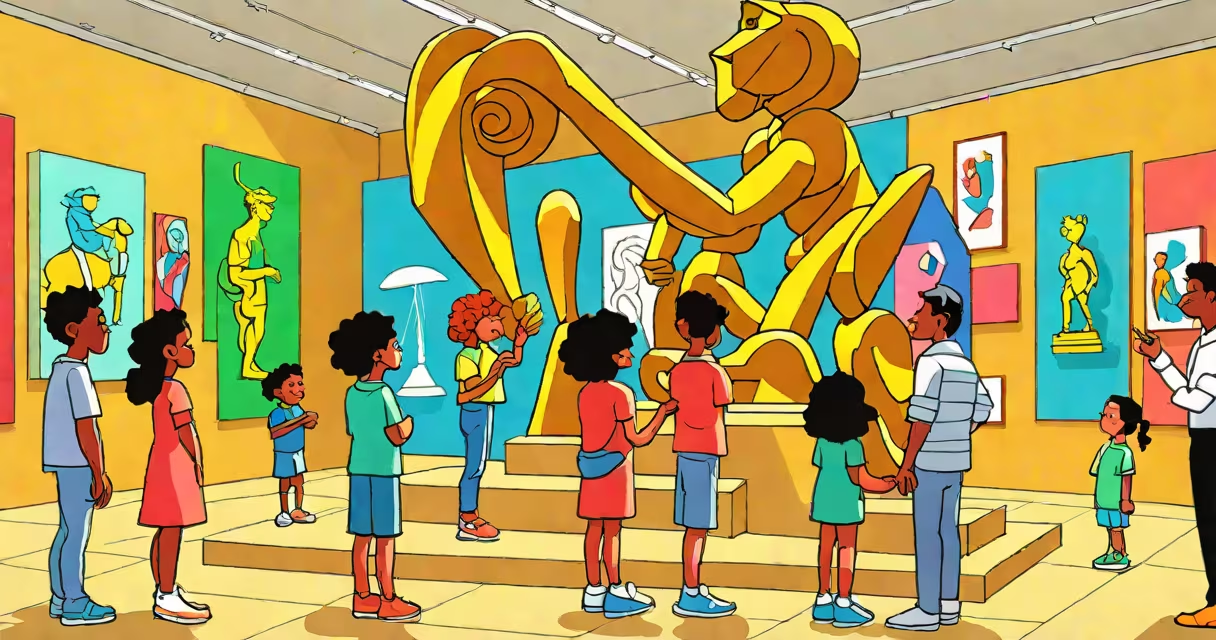
Youth engagement in museums involves how children and teens interact with exhibits, collections, and programs designed to educate and inspire. This changing reflects differences in attention span, prior knowledge, and learning styles between young visitors and traditional museum environments.
Museums were historically built for adult scholars and collectors. Their quiet halls, labeled artifacts, and chronological layouts often fail to capture the attention of younger audiences. A 2021 study by the American Alliance of Museums found that only 38% of children aged 6-12 reported feeling "engaged" during a typical museum visit, compared to 74% of adults.
When young people enter a museum, their expectations differ sharply from those of older visitors. They seek interaction, movement, storytelling, and sensory stimulation. A static display of a 19th-century textile may not register unless paired with a hands-on activity or a narrative about a child who wore it. Museums that recognize this gap redesign spaces and programs to meet younger minds where they are.
The concept of "young v a museum" describes the mismatch between how institutions present content and how younger audiences process it. Children learn through play, touch, and emotional connection. Museums traditionally emphasize observation, interpretation, and silence-values rooted in academic tradition rather than developmental science.
Research from the National Science Foundation shows that children retain 70% more information when learning is multisensory. Yet most museum exhibits rely on visual cues and written text. A child reading a plaque about ancient Egyptian burial practices may not grasp the significance unless shown a model tomb they can crawl into or hear a recording of a priest's chant.
Some institutions now embed play-based learning into core experiences. The Children's Museum of Indianapolis uses role-play stations where kids act as archaeologists, using brushes and tools to uncover replicas of artifacts. This shifts the focus from passive viewing to active participation-aligning with how young brains encode memory.
Young v A Museum isn't a single model. It varies by age group, institution type, and exhibit design. The following table outlines common approaches and their effectiveness:
| Type | Design Feature | Target Age | Effectiveness (Based on 2022 Study) |
|---|---|---|---|
| Interactive Stations | Touchscreens, puzzles, physical models | 4-10 years | 83% reported enjoyment; 61% retained facts |
| Immersive Environments | Themed rooms, projections, soundscapes | 6-14 years | 79% stayed engaged past 30 minutes |
| Story-Based Exhibits | Characters, timelines, narrative arcs | 5-12 years | 76% recalled story details after 1 week |
| Guided Family Tours | Facilitated walks with prompts and games | 3-14 years | 91% said they learned something new |
These formats reflect a shift from "museum as archive" to "museum as experience." The most effective designs don't just accommodate youth-they center them.
Young v A Museum principles are applied in science centers, art museums, historical sites, and children's museums. The approach is especially critical in urban areas with high youth populations and limited access to informal education.
This model demonstrates that when young people contribute to content creation, they're not just visitors-they become stakeholders. The museum becomes a site of co-creation, not just consumption.
Many assume that young audiences only respond to flashy or digital elements. But research from the University of Washington's Center for Childhood Development shows that tactile, low-tech activities-like drawing from life or building models from clay-generate deeper cognitive engagement than screens alone.
Another myth is that children lack interest in complex topics. A 2023 pilot at the Smithsonian's National Museum of Natural History tested a "Dinosaur Detective" program for ages 7-9. Kids solved clues using fossil records, weather patterns, and migration maps. Post-visit assessments showed 89% could explain how scientists date fossils-a concept previously thought too advanced for this age.
These findings correct the assumption that complexity must be simplified for youth. Instead, clarity and relevance matter more than age-appropriate dumbing down.
In 2022, the Cleveland Museum of Art launched a monthly evening event for teens aged 13-18. The program features live music, artist talks, and rotating pop-up installations. Admission is free, and participants receive a digital badge for completing sessions.
One installation, "Echoes of the Past," invited teens to record spoken-word pieces about family history. These were played back in a mirrored room filled with projected images of old photographs. The experience blended personal memory with collective history.
After six months, 72% of attendees reported visiting the museum more than once. One participant wrote: "I didn't think art was for me until I saw my grandma's voice in a gallery." That moment captures the heart of young v a museum-not just engagement, but transformation.
I've seen this effect firsthand while volunteering at a local art center. A 9-year-old boy initially stood frozen in front of a large abstract painting. He said, "It doesn't look like anything." After being invited to describe what he *felt*-not what he saw-he pointed to swirling red shapes and said, "This feels like anger." The staff then connected his reaction to the artist's biography. The boy stayed for 45 minutes, asking questions. That shift-from confusion to connection-is the goal of young v a museum.
Understanding young v a museum reveals that museums aren't failing young people-they're simply operating under outdated assumptions. When institutions listen, adapt, and include youth in design, they stop being places of distance and become spaces of belonging.