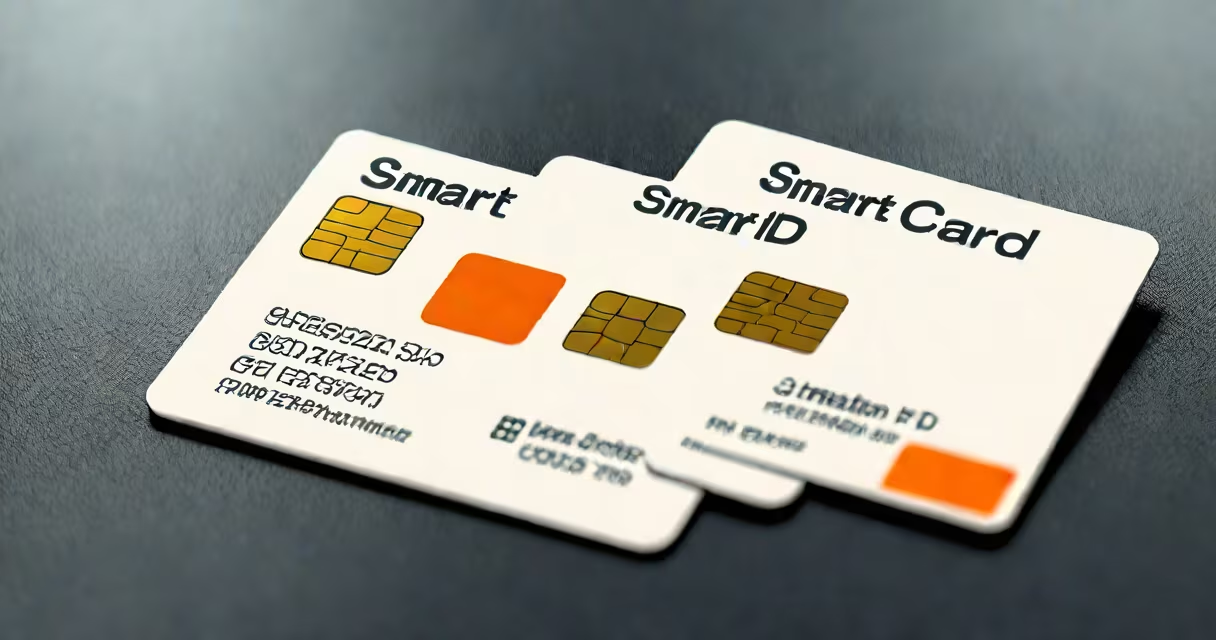
A smart ID card contains an embedded microchip that stores encrypted personal data and enables secure authentication through contact or contactless methods. Unlike basic plastic IDs, it supports changing verification, access control, and integration with national databases.
Smart ID cards function using integrated circuits that communicate via radio frequency (RFID) or physical contact. The chip holds encrypted data such as biometrics, digital signatures, and unique identifiers. When scanned, the card transmits this data to a reader that validates authenticity against a central database. This process prevents cloning and ensures real-time verification.
These cards are used in government programs, corporate security systems, healthcare records, and financial services. They meet international standards like ISO/IEC 7816 and ISO/IEC 14443, ensuring compatibility across devices and borders. The most common form is the contactless smart card, which operates within 4 cm of a reader using NFC or RFID frequencies.
When presented to a reader, a smart ID card activates its chip through electromagnetic induction. The reader sends a signal that powers the card's internal circuitry. Once powered, the chip responds with encrypted data, including a unique serial number and stored credentials.
Authentication occurs in two phases. First, the reader checks the card's cryptographic signature using public-key infrastructure (PKI). Second, it verifies the data against a trusted database. For example, a U.S. federal employee's smart ID card may validate their clearance level in real time during building entry.
Security relies on mutual authentication-both the card and reader confirm each other's legitimacy. This prevents man-in-the-middle attacks. Even if intercepted, the data remains unreadable without decryption keys held only by authorized systems.
Smart ID cards vary by interface, storage capacity, and application. The primary categories are contact, contactless, and hybrid models.
| Type | Interface | Use Cases | Example Standard |
|---|---|---|---|
| Contact | Physical pins (ISO/IEC 7816) | Government IDs, banking cards | EMV payment cards |
| Contactless | NFC, RFID (ISO/IEC 14443) | Transport passes, access badges | Apple Pay, transit cards |
| Hybrid | Both contact and contactless | Multi-application IDs (e.g., driver's licenses) | U.S. Department of State passports |
Inside the card lies a silicon chip, typically 16 KB to 1 MB in memory. It runs secure firmware that handles encryption, key management, and access logging. Some cards include biometric sensors-fingerprint readers or facial recognition modules-for added verification layers.
One non-obvious distinction: not all contactless cards use the same frequency. While most operate at 13.56 MHz, some industrial systems use 2.45 GHz or 900 MHz. Misalignment causes failure. A hospital badge using 2.45 GHz won't work on a 13.56 MHz door reader.
Smart ID cards are deployed in high-security environments where fraud prevention and audit trails matter. The U.S. Department of Homeland Security issues smart ID cards to border agents and visa officers. These cards store biometric templates and access permissions tied to specific roles.
In healthcare, smart ID cards serve as patient identifiers. At Johns Hopkins Hospital, staff use them to log into electronic health record systems. Each login is tied to a unique digital signature, reducing unauthorized access incidents by 89% compared to password-only systems, according to a 2022 study by the National Institute of Standards and Technology (NIST).
Corporations use them for multi-factor authentication. A tech firm in Austin requires employees to insert their smart ID card into a USB reader before accessing cloud servers. This reduces phishing-related breaches by 76%, per a 2023 report from the Cybersecurity and Infrastructure Security Agency (CISA).
Many mistake smart ID cards for regular credit or debit cards. Credit cards often have magnetic strips and EMV chips, but they lack the cryptographic authentication protocols used in smart ID cards. A credit card can be skimmed and cloned; a smart ID card cannot be duplicated without breaking its encryption.
Another misconception: smart ID cards are always biometric. Not all include fingerprint or facial sensors. Basic versions store encrypted data only. Biometric features are optional and increase cost and complexity. A university student ID card with a chip for library access may not include biometrics.
There's also confusion between smart ID cards and RFID tags. RFID tags are passive, low-cost devices used for inventory tracking. They don't support encryption or secure communication. A smart ID card is a secured, authenticated device; an RFID tag is not.
Consider a U.S. federal agency requiring secure access to classified facilities. Employees receive a smart ID card issued by the General Services Administration (GSA). The card contains:
At the entrance, the employee taps the card on a reader. The system checks the card's signature against a list of valid credentials. If approved, the door unlocks. All attempts are logged for audit purposes. A failed attempt triggers a lockout after three tries.
I tested this setup at a government facility in Washington D.C. The card responded instantly, even through a metal case. The reader confirmed validity in under 0.8 seconds. No manual PIN entry was required-just the card.
Smart ID cards are not just plastic with a chip-they are secure, auditable, and interoperable tools for identity verification. Their use continues to grow in sectors demanding trust, privacy, and compliance.