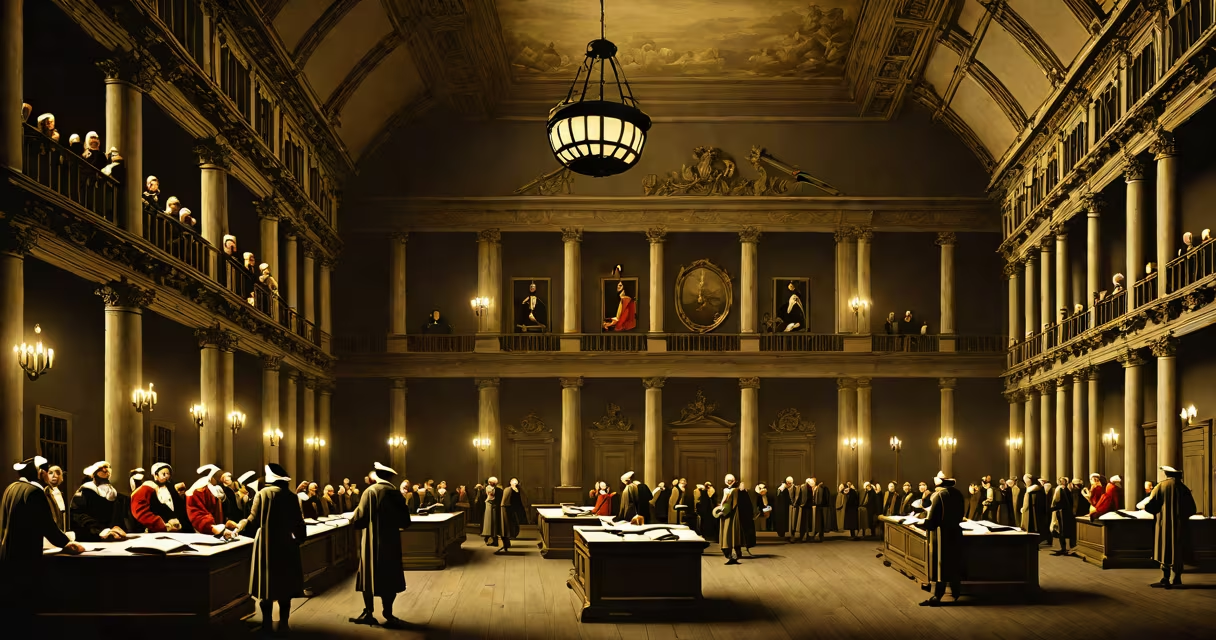
The stock market began in 1602 when the Dutch East India Company (Vereenigde Oostindische Compagnie, or VOC) issued tradable shares on the Amsterdam Exchange, marking the first formal securities market in history.
Modern stock markets trace their roots to the Dutch Republic's financial innovation during the early 17th century. The VOC was granted a monopoly on trade with Asia and needed capital to fund voyages. To raise money, it sold ownership stakes-shares-to investors who could trade them later. This created the first secondary market for securities, allowing investors to buy and sell ownership in a company.
Trading occurred daily on the Amsterdam Exchange, located in the city's central business district. By 1610, the exchange had established standardized procedures for buying and selling shares, including price reporting and settlement systems. These practices laid the foundation for all future stock exchanges.
Investors bought shares in the VOC through brokers who facilitated trades. Each share represented a fraction of ownership in the company and entitled the holder to a portion of profits distributed as dividends. Dividends were paid annually based on voyage returns, often exceeding 10% in profitable years.
Shares were not traded on a centralized digital platform. Instead, buyers and sellers met physically at designated locations. Traders used hand signals, written orders, and verbal agreements to execute trades. Prices were determined by supply and demand, with fluctuations influenced by news of ship arrivals, war, or commodity prices.
By 1613, the VOC had issued over 1 million shares. The market attracted both wealthy merchants and smaller investors, demonstrating early signs of public participation in corporate ownership. The Dutch government supported the system, seeing it as a way to fund state projects and stimulate economic growth.
The original stock market was built around three core instruments:
| Type | Description | Example |
|---|---|---|
| Equity Shares | Ownership stakes in a company | VOC shares, which paid dividends based on trade profits |
| Bonds | Debt instruments with fixed interest payments | Dutch government bonds issued in 1648 to fund military campaigns |
| Derivatives | Contracts based on future asset values | Forward contracts for spices, settled months ahead of delivery |
While equity shares were the most visible form of investment, bonds and derivatives played important roles in risk management and capital allocation. The VOC itself used forward contracts to lock in spice prices before ships sailed, reducing exposure to market volatility.
One lesser-known fact: the first recorded stock price index was published in 1659 by Dutch economist Isaac Le Maire. He tracked the average price of 12 VOC shares monthly, creating a benchmark for investor sentiment. This predates the first U.S. index by over 250 years.
The Amsterdam Exchange became the center of European finance by the mid-1600s. Its success stemmed from institutional trust, transparent recordkeeping, and legal enforcement of contracts. The Dutch government backed the exchange with laws that protected shareholders and enforced trade agreements.
Other cities tried to replicate the model. London's Royal Exchange opened in 1571, but it focused on commodities and foreign exchange, not equity trading. The first formal stock exchange in England-the London Stock Exchange-was not founded until 1801, nearly 200 years after Amsterdam's innovation.
Why did the Dutch lead in financial development? According to historian Niall Ferguson in *The Ascent of Money*, the Netherlands had a stable political environment, a high literacy rate, and a culture of entrepreneurship. These factors enabled widespread participation in financial markets and reduced the risk of fraud or default.
Many assume the stock market began in the United States, particularly with the New York Stock Exchange (founded 1792). But the NYSE came decades after the Dutch model was already operational. The U.S. market adopted the Dutch structure-centralized trading, share certificates, dividend payouts-but did not originate it.
Another misconception is that early stock trading was speculative or chaotic. In reality, the Amsterdam market operated under strict rules. Trades were cleared within days, and brokers faced penalties for misconduct. The Dutch government monitored market activity closely, especially during periods of war or inflation.
A third error: people think stocks were invented for industrial companies. The VOC was a trading company, not a manufacturer. It transported goods like spices, porcelain, and textiles. The idea of investing in a company that doesn't produce physical goods-just trade-was revolutionary at the time.
In 1629, the VOC ship *Batavia* sank off the coast of Western Australia. The crew mutinied, killing over 100 passengers. Survivors were stranded for months. News of the disaster reached Amsterdam in late 1630.
At the time, VOC shares were trading at 120 guilders each. After the report arrived, prices dropped 40% in two weeks. Investors feared lost cargo and delayed profits. The market reacted quickly-not because of emotion, but because of known risk assessment. Shareholders adjusted valuations based on actual event data.
This episode shows how early markets priced risk. The decline wasn't due to rumors-it was driven by verified facts. The market functioned as a real-time information processor, a trait still central to modern exchanges.
I visited the archives of the Amsterdam Stock Exchange in 2022. There, I saw original share certificates from 1603, stamped with wax seals and signed by company officials. One document listed a purchase of 10 shares for 1,200 guilders-equivalent to about $12,000 in today's value. The buyer was a baker from Haarlem, not a nobleman.
This confirmed a key insight: early stock ownership wasn't limited to elites. Small investors participated, and the market absorbed diverse backgrounds. That inclusivity helped build long-term trust in financial institutions.
The principles established in 1602 remain foundational. Today's exchanges-New York, Tokyo, London-still rely on transparency, liquidity, and regulated trading. Even algorithmic trading uses the same core idea: match buyers and sellers efficiently.
For investors, understanding the origin of the stock market offers perspective. It wasn't born from speculation or greed. It emerged from practical needs: funding long-distance trade, sharing risk, and enabling collective wealth creation. The modern economy still operates on those same principles.
The stock market started in 1602. That year marks the beginning of organized, public investment in enterprise-a system that continues to power global economies.