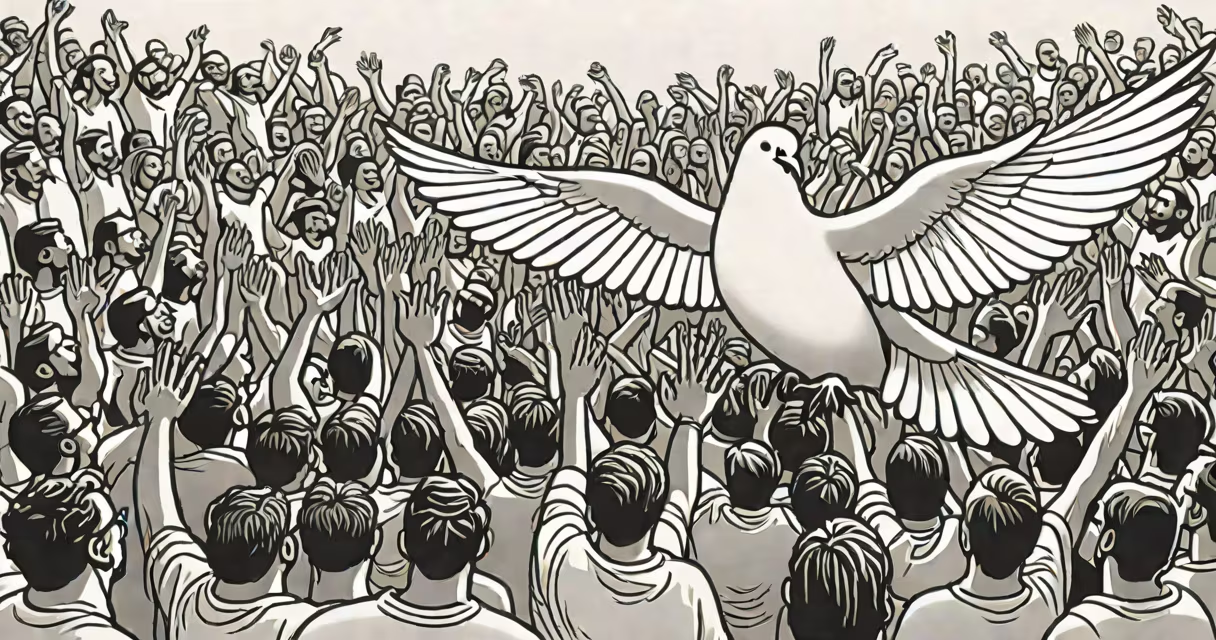
Pentecost is a Christian festival celebrating the descent of the Holy Spirit upon the apostles and other followers of Jesus Christ, occurring 50 days after Easter. It marks the beginning of the Christian Church's public mission and is rooted in Jewish tradition as Shavuot, a harvest festival commemorating the giving of the Torah at Mount Sinai.
The event is described in Acts 2:1-4, where a sound like a rushing wind filled the room, tongues of fire appeared above each person, and they began speaking in languages they had not learned. This moment fulfilled Jesus' promise in John 14:26 that the Father would send the Helper-the Holy Spirit-to guide and help his disciples.
For Christians, Pentecost is not just a historical memory but a living reality. It signifies the moment when the divine presence moved from the Temple in Jerusalem to the hearts of believers worldwide. The Holy Spirit became the inner guide, teacher, and source of spiritual power for the Church.
On the day of Pentecost, the apostles were gathered in Jerusalem. A loud noise filled the house, and flames appeared above their heads. They were filled with the Holy Spirit and began speaking in foreign languages, which amazed the crowd because Jews from many nations were present. People heard their message in their native tongues, leading to 3,000 conversions in a single day (Acts 2:41).
This event was not a private vision-it was communal, audible, visible, and major. The Holy Spirit did not come to individual comfort alone but to equip the Church for mission. The ability to speak in tongues was not an end in itself but a sign of God's power breaking through cultural and linguistic barriers.
Modern churches observe Pentecost with liturgical colors such as red, symbolizing fire and blood. Many hold services with music, prayers for spiritual gifts, and sermons focused on the Holy Spirit's role in daily life. Some denominations, like Pentecostals, emphasize ongoing experiences of speaking in tongues and healing as evidence of the Spirit's presence.
Pentecost is composed of three core elements: historical roots, theological significance, and liturgical practice. Its foundation lies in the Jewish Feast of Weeks (Shavuot), celebrated 50 days after Passover. The Hebrew Bible describes Shavuot as a time of offering firstfruits and remembering the giving of the Law at Sinai (Exodus 23:16).
Early Christians reinterpreted Shavuot as the fulfillment of Old Proof prophecy. Joel 2:28-32 foretold that God would pour out His Spirit on all people, and Peter quoted this passage during his sermon on Pentecost (Acts 2:17-21). This linkage shows that Pentecost is both a continuation and a transformation of Jewish faith.
| Aspect | Jewish Shavuot | Christian Pentecost |
|---|---|---|
| Timing | 50 days after Passover | 50 days after Easter |
| Original Meaning | Harvest festival; giving of the Torah | Descent of the Holy Spirit; birth of the Church |
| Key Symbol | Firstfruits, wheat, Ten Commandments | Fire, wind, tongues, conversion |
While both festivals occur 50 days after a major spring celebration, their meanings diverge. Shavuot honored the written law; Pentecost honors the living Spirit who interprets and fulfills it.
Pentecost is observed annually by most Christian denominations, including Roman Catholic, Eastern Orthodox, Lutheran, Anglican, and Methodist churches. The date varies each year because it depends on Easter Sunday, which follows the lunar calendar. In 2024, Pentecost fell on May 19.
Churches use this day to reflect on spiritual renewal, evangelism, and the unity of the Church. The liturgy often includes readings from Acts 2, Romans 8:14-17, and John 14-16. Many congregations hold baptisms or confirmations on Pentecost, symbolizing the new life received through the Spirit.
A lesser-known fact: the term "Pentecost" comes from the Greek word *pentekoste*, meaning "fiftieth." It was used in the Septuagint (Greek translation of the Hebrew Bible) to describe the Feast of Weeks. Early Christians adopted the term to mark the fiftieth day after Christ's resurrection, linking the resurrection to the outpouring of the Spirit.
Many assume Pentecost is primarily about speaking in tongues. While glossolalia occurred on the day of Pentecost, it was not the central purpose. The goal was mission-proclamation of the gospel to all nations. The miracle of language enabled the message to reach diverse groups, not to create private devotional practices.
Another misunderstanding is that Pentecost is a standalone event. In reality, it completes the Easter season. Easter celebrates Christ's victory over death; Pentecost celebrates the Church's empowerment to live out that victory. Without Pentecost, Easter would lack mission and expansion.
I once attended a Pentecost service in a small rural church in Tennessee. The congregation sang in harmony, then broke into spontaneous prayer. A woman spoke in a language I didn't recognize, and someone translated: "The Lord is near." The atmosphere wasn't theatrical-it felt like presence. That moment clarified something I'd read: the Holy Spirit doesn't perform for us. He draws us into relationship.
Pentecost means the arrival of God's empowering presence in human history. It is not a mystical event confined to ancient times but a living reality for believers today. The same Spirit who descended on the apostles continues to guide, convict, and unite the Church.
Understanding what Pentecost means helps explain why Christians gather, pray, and serve. It is the reason the Church exists-not as an institution, but as a community animated by divine breath. For those seeking deeper connection, more on spiritual beings and divine messengers offers context on how God communicates beyond words.