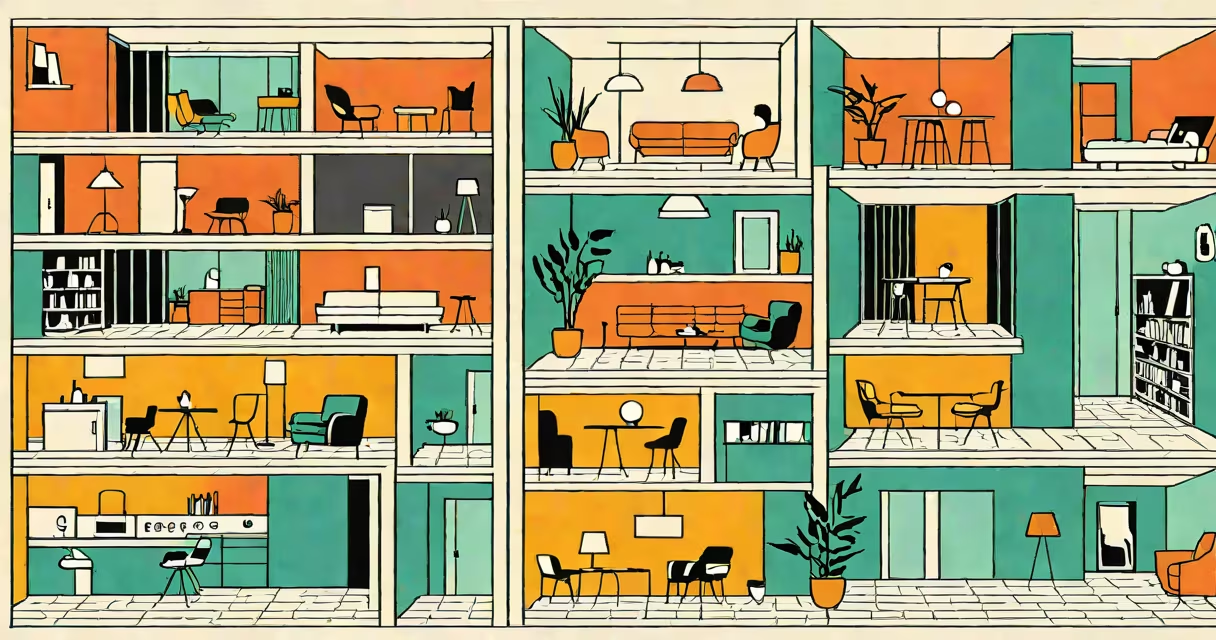
"What is this design called" refers to the process of identifying a specific visual style, aesthetic, or design movement based on its formal characteristics-such as color palette, typography, material use, and spatial composition. Accurate naming enables clear communication among designers, clients, and researchers.
Designs are grouped into recognizable families based on historical context, cultural origin, and formal traits. For example, a chair with tapered legs, walnut finish, and organic curves likely belongs to the mid-century modern movement. A building with exposed concrete, asymmetrical forms, and raw textures fits the brutalist category. These names aren't arbitrary-they reflect shared principles and documented usage in architectural and graphic design literature.
Identifying a design's name requires analyzing its core features. The term "design" here includes architecture, product design, web interfaces, and branding. Misnaming leads to confusion in research, client briefs, and design history. For instance, calling a 1960s Danish lounge chair "modernist" lacks precision-it's specifically mid-century modern, a subset of modernism with distinct regional and temporal markers.
Design names emerge from consistent visual patterns observed across multiple works within a time period or geographic region. Historians and curators compile these patterns into categories. The Oxford Dictionary of Architecture defines mid-century modern as "a style of architecture and interior design popular between 1945 and 1975, characterized by simplicity, functionality, and integration with nature." This definition anchors the term in both form and timeframe.
Names often derive from geography or movement. "Scandinavian design" refers to Nordic countries' emphasis on minimalism, light woods, and function. "Art Deco" originates from the 1925 Exposition Internationale des Arts Décoratifs et Industriels Modernes in Paris. The name itself became a label for geometric motifs, bold colors, and streamlined shapes used in everything from skyscrapers to cocktail shakers.
Some names arise from critical theory. "Brutalism" comes from the French *béton brut* ("raw concrete"), coined by Le Corbusier to describe his use of unadorned concrete in buildings like the Unité d'Habitation. Critics later adopted the term to describe the movement's stark, imposing aesthetic. The name stuck because it captured both material and emotional impact.
The table below outlines five major design styles, their origins, and key identifiers. These are not interchangeable-each reflects a different philosophy and set of constraints.
| Style | Origin Period | Key Features | Example |
|---|---|---|---|
| Mid-Century Modern | 1945-1975 | Organic shapes, teak wood, tapered legs, integrated lighting | Charles Eames Lounge Chair (1956) |
| Brutalist | 1950s-1970s | Exposed concrete, geometric massing, lack of ornamentation | Barbican Centre, London (1982) |
| Scandinavian Minimalism | 1950s-present | Neutral palettes, functional furniture, natural materials | Artek's Paimio Chair (1932) |
| Art Deco | 1920s-1940s | Geometric symmetry, chrome accents, stepped forms | Chrysler Building, New York (1930) |
| Neon Retro | 1980s-2000s | High saturation colors, pixel art, synthwave aesthetics | Netflix's "Stranger Things" title sequence (2016) |
Each style is tied to a specific era and intent. Brutalism emerged from post-war reconstruction needs and a belief in honesty through material expression. Scandinavian design grew from northern Europe's climate and resource limitations, favoring durability and warmth. Recognizing these roots prevents misapplication-using brutalist forms in a children's playground would clash with intended emotional tone.
"Modern" is not synonymous with "mid-century modern." Modernism was a broad 20th-century movement emphasizing function over decoration. Mid-century modern is a subset focused on domestic interiors and postwar optimism. Confusing the two leads to incorrect attribution-calling a 1920s Bauhaus desk "mid-century modern" misplaces it by decades.
Another frequent error is assuming "minimalism" means "simple." Minimalism in design is a deliberate reduction to essential elements, often involving negative space, monochrome palettes, and precise proportions. The Apple iPhone's early interface design exemplifies this-not because it's clutter-free, but because every element serves a purpose and no surplus exists.
A lesser-known but important distinction: "industrial design" refers to the creation of manufactured objects, while "industrial style" describes interiors with exposed ductwork, metal beams, and factory finishes. The former is a profession; the latter is a decor trend. Mixing them causes misunderstandings in project briefs and sourcing.
Suppose you see a living room with a low-profile sofa, a round glass coffee table, and floor-to-ceiling windows facing a garden. The walls are white, the rug is wool, and the lighting is recessed. You ask, "What is this design called?"
Step 1: Identify dominant features-low silhouette, large windows, natural materials, neutral tones. Step 2: Cross-reference with known styles. The combination points to Scandinavian minimalism. Step 3: Confirm via authoritative sources. The Victoria and Albert Museum's online collection notes that Scandinavian design emphasizes "light, space, and simplicity," aligning with the described space.
I once encountered a client who insisted their office renovation was "modern." Upon review, the space had dark wood paneling, ornate moldings, and gilded mirrors. It wasn't modern-it was neo-classical revival. Correcting the name prevented costly redesigns and ensured accurate vendor selection.
When you're uncertain, consult databases like the Design Museum's online archive or the Library of Congress's subject headings. These systems use standardized terms verified by curators and scholars. Using them ensures consistency across projects and publications.