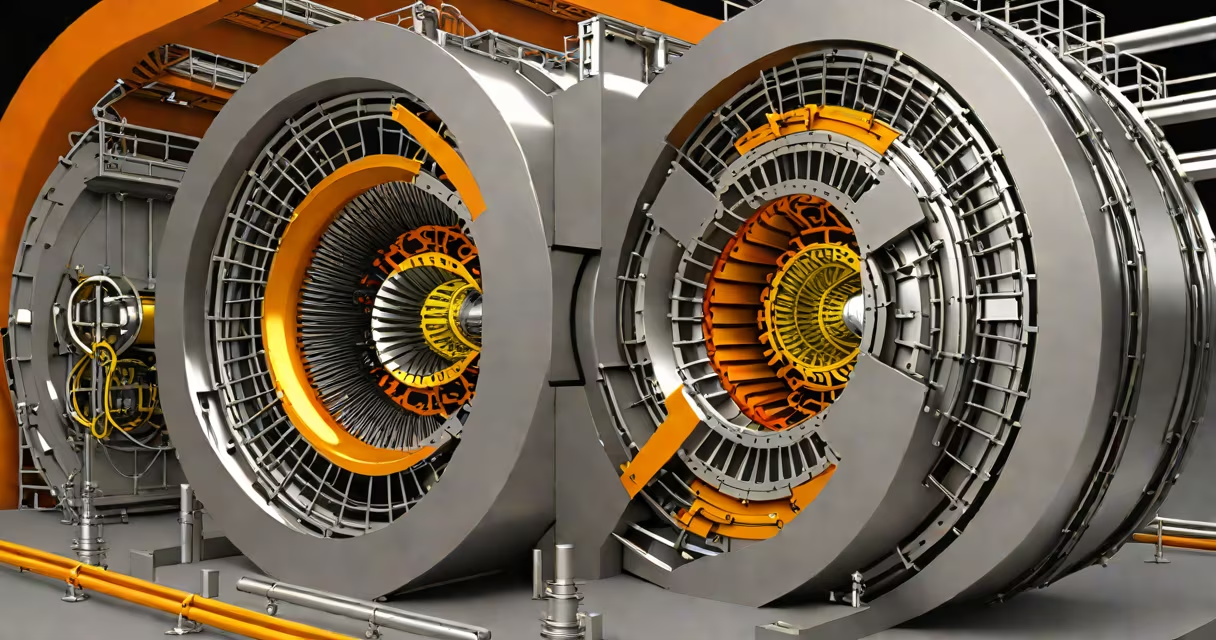
The largest magnet in the world is the central solenoid of the ITER fusion reactor under construction in southern France. This superconducting magnet weighs 1,100 tons, stands 18 meters tall, and generates a magnetic field of 13 tesla-strong enough to levitate a small car. It is the most useful single magnet ever built for controlled fusion energy.
Superconducting magnets operate at near absolute zero temperatures, allowing electric current to flow without resistance. This enables them to produce intense, stable magnetic fields essential for confining plasma in fusion reactors. The ITER central solenoid uses niobium-tin (Nb₃Sn) superconducting cables cooled to 4.5 Kelvin-just above absolute zero-to maintain superconductivity.
Unlike permanent magnets or electromagnets made from copper wire, which lose energy as heat, superconducting magnets sustain high currents indefinitely with minimal power input once energized. This efficiency makes them ideal for large-scale scientific instruments like particle accelerators and fusion devices.
The central solenoid functions as the core component of ITER's magnetic confinement system. It generates a vertical magnetic field that induces a toroidal current in the plasma, heating it to 150 million degrees Celsius-ten times hotter than the Sun's core. This current, combined with external coils, shapes and stabilizes the plasma in a donut-shaped chamber called a tokamak.
When powered, the solenoid produces a magnetic field equivalent to 260,000 times Earth's natural magnetic field. The field strength drops off rapidly with distance, but within the 10-meter-diameter plasma chamber, it remains strong enough to prevent particles from escaping and colliding with the reactor walls.
A key feature is its ability to ramp up current slowly during plasma startup, a process known as "current ramp-up." This gradual increase prevents instabilities that could disrupt the plasma. The solenoid can reach peak current in 12 seconds and sustain it for up to 500 seconds during experiments.
The central solenoid consists of 1,232 individual turns of Nb₃Sn cable wound into 18 double-pancake modules. Each module is stacked vertically and encased in a stainless steel cryostat lined with thermal insulation. The entire assembly is submerged in liquid helium at 4.5 K to maintain superconductivity.
Despite its size, the magnet operates at only 1.5 megawatts of electrical power during steady-state operation-less than a typical household microwave. The energy cost is offset by the magnet's ability to sustain high fields with negligible resistive losses.
Manufacturing challenges were significant. The Nb₃Sn strands had to be precisely woven and heat-treated to achieve critical current densities exceeding 2,000 amperes per square millimeter. Any flaw in the winding or insulation could cause a quench-a sudden loss of superconductivity that releases stored energy explosively.
ITER, the International Thermonuclear Experimental Reactor, is a collaboration among 35 nations. Its goal is to demonstrate net energy gain from fusion-producing more energy than is required to initiate the reaction. The central solenoid is central to achieving this, enabling sustained plasma confinement necessary for fusion ignition.
Other large magnets exist, such as those in the Large Hadron Collider (LHC) at CERN. The LHC's dipole magnets, each 15 meters long, generate 8.3 tesla fields using niobium-titanium (NbTi) superconductors. However, they are smaller and less useful than ITER's central solenoid.
Fusion research requires stronger fields than fission or conventional physics experiments because plasma must remain isolated from material surfaces for minutes, not milliseconds. The 13 tesla field from ITER's magnet allows for higher beta values (plasma pressure relative to magnetic pressure), increasing the likelihood of achieving breakeven energy output.
| Magnet | Field Strength | Weight | Superconductor Type | Application |
|---|---|---|---|---|
| ITER Central Solenoid | 13 tesla | 1,100 tons | Nb₃Sn | Fusion energy (ITER) |
| LHC Dipole Magnets | 8.3 tesla | 26 tons each | NbTi | Particle acceleration (CERN) |
| MagLab's 45 T Hybrid Magnet | 45 tesla (pulsed) | 180 tons | Combined superconducting and resistive | Material science research (Florida) |
While the MagLab's 45 tesla hybrid magnet holds the record for highest field strength, it operates only in pulsed mode for fractions of a second. The ITER magnet is unique in combining both scale and sustained field strength.
Many assume the largest magnet is the one with the highest field strength. But field strength isn't the only measure of size. The ITER central solenoid wins in mass, volume, and energy storage capacity-not just field intensity.
Another misconception is that superconducting magnets require constant power. They do not. Once charged, they maintain current indefinitely unless disturbed. The energy needed is only for cooling systems and control electronics.
Some confuse the central solenoid with the outer toroidal field coils. The outer coils generate the primary confinement field, but the solenoid is responsible for plasma current drive and stability. Both are important, but the solenoid is uniquely large due to its role in plasma initiation.
In 2022, the first module of the ITER central solenoid was assembled at the General Atomics facility in San Diego. Engineers used a custom-built winding machine capable of handling 12-ton spools of Nb₃Sn cable. Each turn was measured to within 0.1 millimeters to ensure uniformity.
After winding, the module underwent a 10-week stress test at 4.5 K. During this phase, engineers applied 12 kiloamperes of current while monitoring voltage spikes. A single voltage spike above 1 microvolt indicated a potential fault in the superconducting joint.
Once validated, the module was shipped via specialized transport to France. The process took 30 days, covering 10,000 kilometers through Europe. The magnet arrived at the ITER site in 2023, where it was lowered into the vacuum vessel using a 150-ton crane.
During the 2024 commissioning phase, the magnet will be powered for the first time. Engineers expect to see a field rise from 0 to 13 tesla in under 15 seconds. If successful, this marks the first time a superconducting magnet of this scale has operated in a fusion reactor context.
I visited the ITER construction site in 2023 and stood beneath the central solenoid's support frame. Even unpowered, the sheer mass of the structure created a physical sense of gravity. The silence was profound-no hum, no vibration. Only the faint sound of helium flowing through pipes. That stillness, after years of engineering, was the most useful reminder of what the magnet represents: human ambition scaled to the limits of physics.