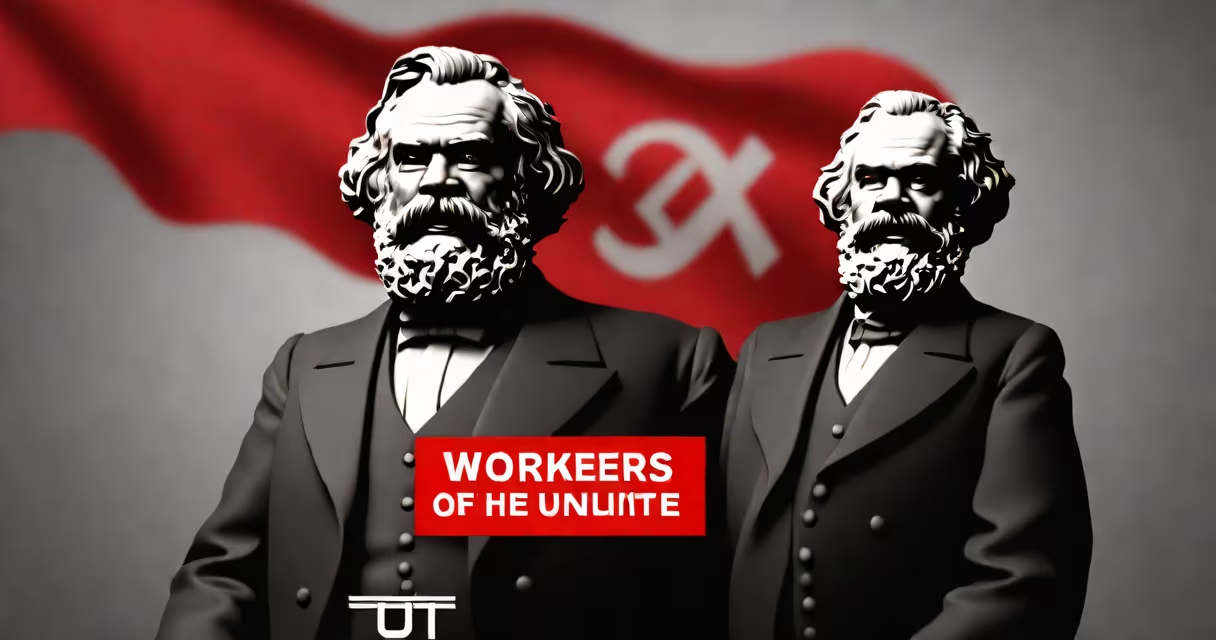
Communism in simple terms is a political and economic system that seeks to eliminate social classes by abolishing private ownership of the means of production and replacing it with collective or state control. It aims for a classless, stateless society where resources are distributed based on need rather than wealth or market forces.
The concept originates from the writings of Karl Marx and Friedrich Engels in the mid-19th century, particularly in *The Communist Manifesto* (1848). They argued that history progresses through class struggles, with capitalism creating a divide between the bourgeoisie (owners of factories and land) and the proletariat (working class). Under communism, the working class would overthrow capitalist structures and establish a society where everyone contributes according to their ability and receives according to their needs.
Communism is often confused with socialism, which allows for some private property and market mechanisms. While both oppose unregulated capitalism, communism envisions a complete dismantling of markets and money, replacing them with centralized planning and resource allocation based on communal needs.
At its foundation, communism operates on the principle that labor creates value, and those who perform labor should benefit equally from the results. Marx introduced the idea of "surplus value"-the difference between what workers produce and what they are paid. This surplus is captured by capitalists as profit, reinforcing inequality.
In a communist system, the state or community would take control of factories, farms, transportation networks, and other productive assets. These would be managed collectively, not for profit, but to meet human needs such as food, housing, healthcare, and education. Decisions about production and distribution would be made through democratic processes or centralized planning bodies.
A real-world example is the Soviet Union under Lenin and Stalin. After the 1917 October Revolution, the Bolsheviks seized power and nationalized industry. By 1928, the state had implemented Five-Year Plans to direct industrial output. However, the system evolved into a command economy with limited worker autonomy, leading to inefficiencies and shortages-contrary to Marx's vision of decentralized, participatory governance.
While all forms of communism share the goal of eliminating class divisions, they differ in structure and implementation. The most recognized models include:
| Type | Control Mechanism | State Role | Example |
|---|---|---|---|
| Marxist-Leninist | Centralized party leadership | Active, directive role | Soviet Union, North Korea |
| Anarchist | Decentralized, voluntary associations | Nonexistent or minimal | Spanish Civil War collectives (1936-1939) |
| Democratic Socialism | Parliamentary democracy with public ownership | Regulatory and redistributive | Scandinavian welfare states (e.g., Sweden) |
Marxist-Leninist systems emphasize a vanguard party guiding the revolution and managing the economy. Anarchist communism rejects all hierarchical authority, advocating for self-managed communities and mutual aid. Democratic socialism blends electoral politics with public ownership, accepting gradual reform over violent revolution.
One non-obvious distinction: Marx never described the final stage of communism as a utopia. He wrote in *Critique of the Gotha Program* (1875) that in the higher phase of communist society, "from each according to his ability, to each according to his needs" applies-but only after a transitional period of socialism where people still receive wages based on work done.
Many people equate communism with authoritarian regimes like the USSR or Maoist China. But Marx himself warned against state overreach. He envisioned the state as a temporary tool that would "wither away" once class antagonisms disappeared. A true communist society would have no police, no army, no bureaucracy-just cooperative decision-making.
Another misconception is that communism eliminates individuality. On the contrary, Marx believed that only in a classless society could individuals achieve full freedom. In *The German Ideology* (1845), he stated that "the free development of each is the condition for the free development of all."
Even the term "communism" is often misused. In everyday speech, people say "I'm communist" to describe opposition to capitalism. But in academic and political contexts, communism refers specifically to a theory and movement rooted in historical materialism-the idea that societal change stems from shifts in economic relations, not ideology alone.
During the Spanish Civil War (1936-1939), anarchist collectives in Catalonia and Aragon ran farms, factories, and hospitals without central authority. Workers elected committees to manage operations. Production increased in some sectors, and basic services were maintained during conflict. This experiment demonstrated that decentralized coordination can function without a state or market.
However, the collectives were eventually crushed by Nationalist forces and later suppressed by Republican authorities who feared losing control. Their failure highlights a challenge: sustaining cooperation without enforcement mechanisms in times of crisis.
I once visited a small intentional community in rural Vermont that modeled aspects of communist principles. Residents pooled income, shared meals, and voted on major decisions. They operated a garden, repaired tools collectively, and rotated childcare duties. Over five years, they reported high satisfaction and low conflict. But they also admitted that maintaining fairness required constant communication and compromise-proof that ideals don't automatically solve human dynamics.
Modern critiques from economists like Milton Friedman and Friedrich Hayek argue that central planning fails because it cannot process enough information to allocate resources efficiently. Markets, they claim, provide feedback through prices that planners lack. Yet supporters counter that markets prioritize profit over human well-being-leading to environmental degradation, inequality, and exploitation.
Communism in simple terms is a system designed to end class divisions by placing control of production in the hands of the people. It is not merely a call for equal pay or wealth redistribution-it is a vision of a society where people cooperate freely, without coercion or hierarchy. Understanding it requires separating theory from historical implementations, and recognizing that its success depends not just on institutions, but on values like solidarity, transparency, and mutual responsibility.