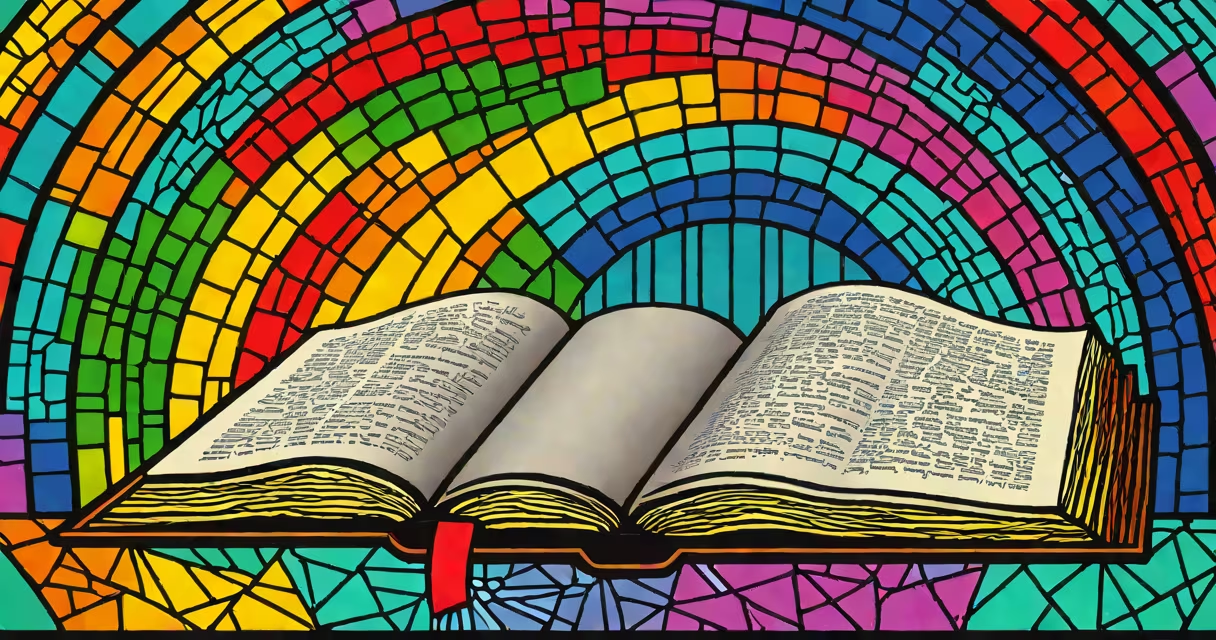
The rainbow bible is a symbolic structure that assigns specific biblical meanings to colors, interpreting Scripture through a chromatic lens. It draws from Old and New Proof references to color, especially the rainbow covenant in Genesis 9:13-17, and applies those associations to theological themes like redemption, judgment, and divine presence.
Unlike a physical book with colored pages, the rainbow bible is a hermeneutical method-a way of reading scripture through the lens of color symbolism. It's not a single published text but a conceptual model used in sermons, devotional materials, and Christian education to deepen understanding of spiritual concepts.
For example, red often symbolizes sacrifice (as in the blood of Christ), blue represents heaven and divine revelation, green stands for life and renewal, and white signifies purity and holiness. These associations are rooted in biblical passages such as Exodus 24:10, where God's throne is described as "like sapphire," and Revelation 6:13, where stars fall like figs from a tree.
Color symbolism in the rainbow bible is derived from scriptural references, liturgical traditions, and early Christian writings. The foundational idea comes from Genesis 9:13-17, where God sets the rainbow in the sky as a sign of His covenant with Noah after the flood. This passage establishes the rainbow as a divine promise, marking the beginning of color-based spiritual interpretation.
Early Church Fathers like Origen and Augustine wrote extensively about color in sacred texts. Origen, in his *Commentary on the Song of Songs*, linked the color white to resurrection and eternal life. Later, medieval theologians expanded these ideas into liturgical color schemes still used today-purple for penitence, green for ordinary time, red for martyrdom, and white for celebration.
A modern example: in a sermon series titled "Colors of the Kingdom," a pastor assigned each week a color theme. Week one was red-focused on Jesus' crucifixion and the sacrificial love of God. The congregation studied John 1:29 ("Behold, the Lamb of God") and Romans 5:8 ("God demonstrates His love for us in that while we were still sinners, Christ died for us"). The color red became a visual anchor for the message.
Each color in the rainbow bible system corresponds to a theological concept. The table below outlines the most common associations based on Scripture and tradition.
| Color | Biblical Reference | Symbolic Meaning |
|---|---|---|
| Red | Revelation 1:13-14 (Jesus' eyes like flame) | Sacrifice, blood of Christ, divine judgment |
| Blue | Exodus 24:10 (God's throne like sapphire) | Heaven, divine revelation, truth |
| Green | Psalm 23:2 ("He makes me lie down in green pastures") | Life, restoration, growth |
| White | Revelation 7:14 (clothed in white robes) | Purity, victory, resurrection |
| Gold | Exodus 25:10-11 (ark of the covenant overlaid with gold) | Divine glory, kingship, eternity |
These associations are not arbitrary. For instance, the use of gold in the tabernacle construction (Exodus 25:10-11) reflects God's enduring presence. The ark was covered in pure gold, symbolizing both divine holiness and the promise of God's dwelling among His people.
One non-obvious point: the rainbow itself is not inherently red, orange, yellow, etc., in Scripture. The colors appear in nature due to refraction, but the biblical rainbow is described as a single, unified sign. The modern association of the rainbow with multiple hues stems from later scientific understanding, not ancient Hebrew thought. The original covenant was not about color diversity but about divine faithfulness.
Many assume the rainbow bible is a literal book with colored pages or a modern invention. It is neither. It is a interpretive tool, not a physical artifact. Some confuse it with the "Rainbow Bible" sold online as a novelty gift-those are simply Bibles with printed color overlays, not theological systems.
Another confusion: equating the rainbow bible with New Age spirituality. While both use color symbolism, the rainbow bible is grounded in biblical texts and historical Christian theology. New Age practices often draw from Eastern mysticism or astrology, which have no basis in Scripture. The rainbow bible uses color only as a secondary interpretive layer, not as a primary source of doctrine.
I once led a small group study using the rainbow bible method during Lent. We focused on purple (penitence and preparation) and white (resurrection). On Easter Sunday, we read Revelation 7:14 together: "These are the ones who come out of the great tribulation. They have washed their robes and made them white in the blood of the Lamb." The group connected the white robes to the resurrection, and the color symbolism deepened their emotional and spiritual engagement with the text.
Artaban, a figure from the apocryphal tale of the Magi, is sometimes linked to the rainbow bible concept through symbolic interpretation. Though he is not mentioned in the canonical Gospels, the story of Artaban-the Magus who lost his gifts while helping others-has been interpreted as representing spiritual perseverance and divine timing.
In some devotional materials, Artaban is associated with the color gold, symbolizing the value of sacrifice and faithful service. His process mirrors the path of discipleship: delayed fulfillment, persistent hope, and ultimate reward. The idea that he carried three gifts-one for the infant Jesus, one for the poor, and one for himself-has been analyzed through the lens of color theology, with each gift representing a different hue and purpose.
While Artaban appears only in non-canonical narratives, his story is frequently referenced in sermons and retreats that use the rainbow bible structure. For example, a sermon preached at Grace Fellowship Church in 2022 used Artaban's process to illustrate the color gold as "divine investment"-not in wealth, but in purposeful giving.
The rainbow bible is not a substitute for careful exegesis. It is a supplementary tool that enhances understanding when used alongside textual analysis, historical context, and doctrinal clarity. Its strength lies in making abstract truths tangible through sensory imagery.
The rainbow bible is a way of seeing Scripture through a lens of beauty and meaning. It reminds readers that God's word is not only true-it is also radiant.