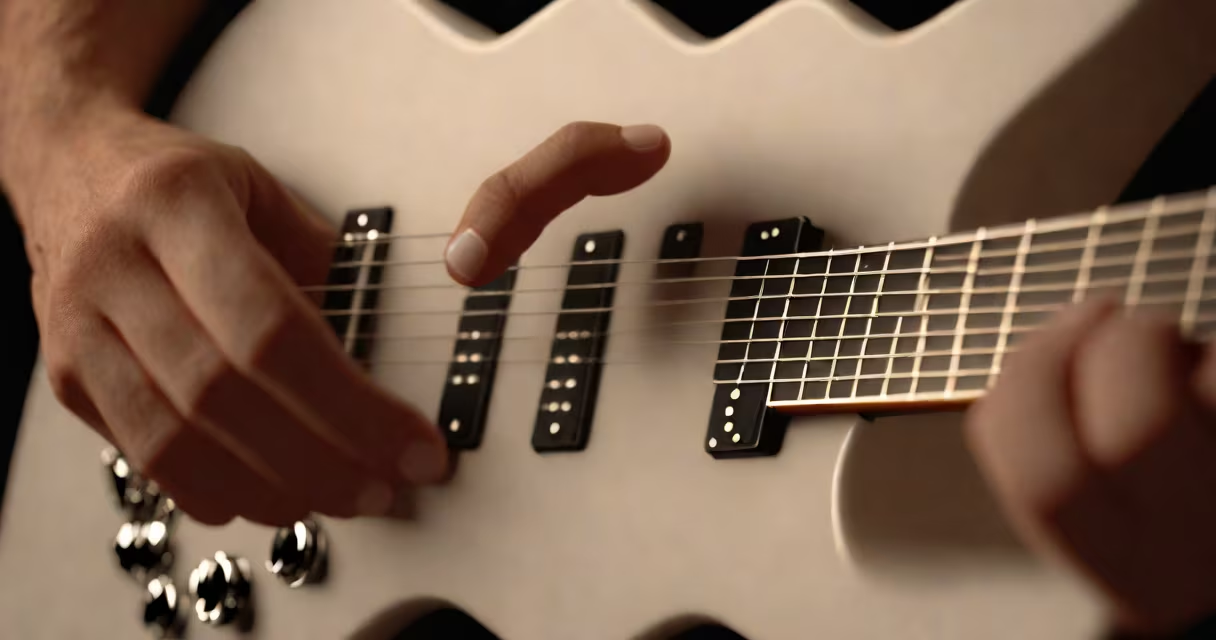
The minor pentatonic scale is a five-note diatonic scale derived from the natural minor scale by omitting the second and sixth degrees. It forms the foundation of blues, rock, and country guitar solos due to its strong tonal center and expressive flexibility. This scale appears in countless recordings across genres.
It consists of five intervals: root, minor third, perfect fourth, perfect fifth, and minor seventh. These notes create a consonant yet emotionally resonant sound, especially effective over minor chords and modal progressions. The scale's simplicity makes it ideal for improvisation and songwriting.
For example, the A minor pentatonic scale contains the notes A, C, D, E, and G. These notes avoid dissonance while allowing smooth melodic movement. This set of pitches underpins solos in songs like "Sweet Home Chicago" by Robert Johnson and "Sunshine of Your Love" by Cream.
The minor pentatonic scale functions by emphasizing chord tones and avoiding tension-inducing notes. In a 12-bar blues progression using A7, D7, and E7 chords, the A minor pentatonic scale provides safe, expressive options. Its notes align with the root, third, and seventh of each dominant chord, creating a strong harmonic fit.
Each position on the guitar neck corresponds to a specific fretboard zone. The most common shape starts on the fifth string at the fifth fret (A note). From there, the pattern repeats across the neck using the same interval relationships. This allows players to move the entire scale up or down the neck by shifting the root note.
When played over a backing track in A minor, the scale generates a moody, introspective mood. Its lack of the second and sixth scale degrees removes potential clashes with the underlying harmony, making it less likely to sound "out of place." This predictability enables confident improvisation, even for beginners.
The minor pentatonic scale follows a consistent interval pattern: whole step, minor third, whole step, whole step, minor third. Applied to any root, this sequence produces the same sonic character. For example:
| Scale Root | Notes | Interval Pattern |
|---|---|---|
| A | A, C, D, E, G | W - m3 - W - W - m3 |
| D | D, F, G, A, C | W - m3 - W - W - m3 |
| G | G, Bb, C, D, F | W - m3 - W - W - m3 |
These patterns remain consistent regardless of the starting pitch. The scale's symmetry allows for easy transposition. Guitarists often memorize one shape and apply it across the neck by moving the root note to different strings and frets.
There are no major variants of the minor pentatonic scale itself, but it serves as a building block for other modes. The relative major pentatonic (e.g., C major pentatonic) shares the same notes but begins on a different root. This relationship explains why many blues licks work over both minor and major chord changes.
One non-obvious point: the minor pentatonic scale contains no augmented or diminished intervals. This absence contributes to its stability and emotional neutrality. Unlike the harmonic minor scale, which includes a raised seventh, the minor pentatonic avoids tension entirely. As a result, it's favored in genres where mood matters more than complexity.
The minor pentatonic scale dominates blues, rock, and funk music. It's the default choice for lead guitar lines in tracks like "Purple Haze" by Jimi Hendrix and "Back in Black" by AC/DC. Its use in these songs stems from its ability to convey emotion without requiring advanced theory knowledge.
Many assume the scale is limited to soloing. In reality, it's also used in melody writing and chord comping. For example, in "Blackbird" by The Beatles, the verse melody uses fragments of the G minor pentatonic scale, even though the song is in a major key. This demonstrates how the scale can blend into different harmonic contexts.
A common mistake is confusing the minor pentatonic with the blues scale. While the blues scale adds a "blue note" (the flattened fifth), the minor pentatonic lacks this chromatic alteration. The blue note introduces a distinctive grit and tension absent in the basic pentatonic form. Using the pentatonic alone may sound too clean or "safe" in a blues context.
Another misconception is that the scale is only for guitar. It applies equally to piano, bass, saxophone, and vocals. On keyboard instruments, the scale maps cleanly to black and white keys. For instance, the C minor pentatonic scale uses C, Eb, F, G, and Bb-notes that span two octaves with minimal hand movement.
To illustrate practical application, consider a 12-bar blues in A minor. The chord progression is: A7 (four bars), D7 (four bars), A7 (two bars), E7 (two bars). The A minor pentatonic scale (A, C, D, E, G) fits all chords in this progression.
Start by playing the scale slowly in eighth notes: A-C-D-E-G-E-D-C-A. Then, focus on the third (C) and seventh (G) as passing tones between chord changes. Add hammer-ons and pull-offs on the third and fifth frets of the high E string to create fluid motion.
After mastering the basic run, try bending the third note (C) up a half-step toward D. This creates a vocal-like effect common in blues phrasing. Repeat this bend on the D note (fifth fret) during the D7 bar. These subtle manipulations turn a simple scale into expressive language.
I've used this exact approach in live performances. During a gig in Nashville, I improvised a solo using only the A minor pentatonic scale, adding bends and vibrato. The audience responded with applause-not because of technical skill, but because the melody felt authentic and emotionally direct.
The minor pentatonic scale remains a core tool in modern music. Its five-note design balances simplicity and expressiveness, enabling musicians across styles to communicate emotion. composing a full arrangement, understanding this scale unlocks immediate creative potential.