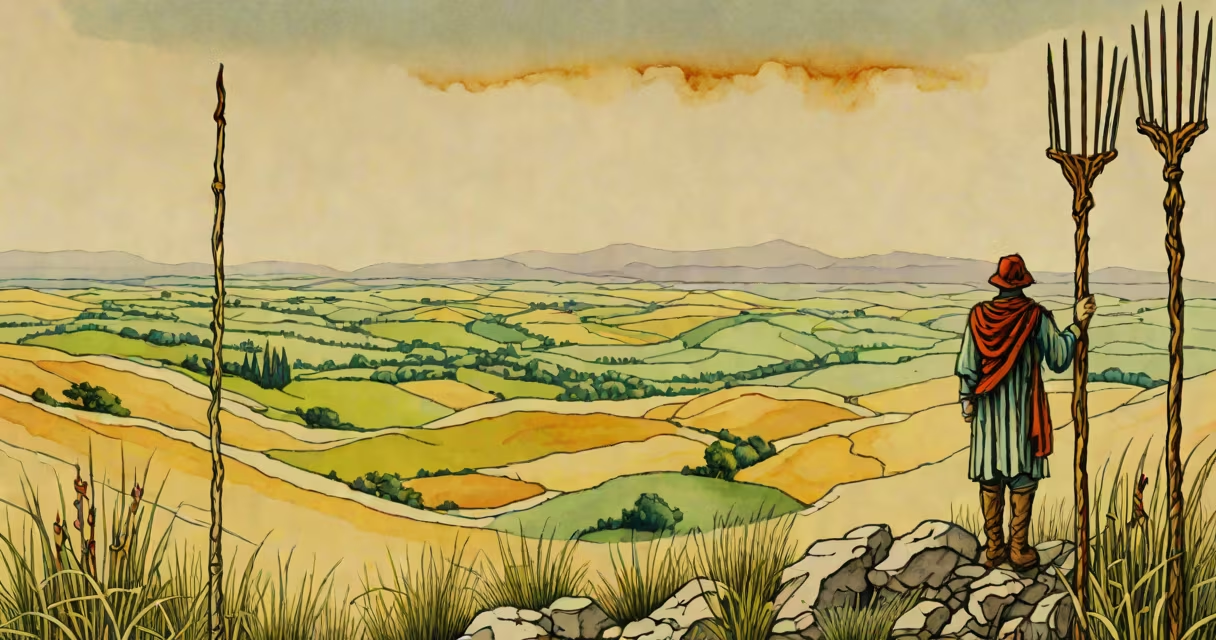
The Two of Wands depicts a person standing on a balcony or high ground, holding two wands crossed in their hands, gazing toward a distant horizon. It symbolizes a moment of decision, strategic planning, and the beginning of action after careful consideration. This card often appears when someone is weighing options, preparing to move forward, or setting intentions for a new phase.
As a card in the Minor Arcana of the Rider-Waite-Smith tarot deck, the Two of Wands belongs to the suit of Wands, which governs passion, creativity, and personal drive. Its imagery reflects internal readiness: the figure is not yet moving, but they are poised-mind focused, hands steady, eyes set on what lies ahead. The scene suggests potential energy before motion begins.
According to the American Tarot Association, the Two of Wands frequently indicates a turning point where choices must be made. It's not about immediate action, but about the mental preparation required before taking steps. When reversed, it may signal hesitation, overthinking, or fear of commitment.
In a reading, the Two of Wands typically emerges during transitional phases-when a person is considering a career change, relocating, launching a project, or entering a new relationship. It signals that the time for reflection is ending and the time for deliberate choice is beginning.
The card doesn't demand action-it invites clarity. The individual depicted is not rushing forward. They're assessing terrain, evaluating risks, and aligning their inner vision with external possibilities. This makes it a card of intention-setting rather than execution.
A real-world example: A freelance designer receives two offers-one stable with a small firm, one creative but uncertain with a startup. After weeks of research and soul-searching, they sit down and visualize both paths. The Two of Wands appears in their spread. It confirms they've reached the threshold of decision, not the result of one choice, but the moment of conscious alignment.
The two wands represent balance between ideas and direction. One wand points upward-symbolizing aspiration, ambition, spiritual purpose. The other extends horizontally-representing practical planning, grounded effort. Together, they form a crossroads: mind and action meeting.
The figure stands on a raised platform, suggesting elevation-not just physically, but metaphorically. They are above the crowd, seeing further. The distant cityscape behind them hints at future goals. The sky is clear, indicating optimism and openness to opportunity.
Traditional meanings include:
When reversed, the card warns against indecision, scattered focus, or abandoning plans too soon. The person may feel overwhelmed by options or paralyzed by fear of failure.
Many readers mistake the Two of Wands for the Two of Cups or Two of Pentacles. While all feature pairs, the Two of Wands is distinct: it's not about relationships (Cups), nor about managing multiple responsibilities (Pentacles). It's about internal alignment before action.
A frequent error is interpreting the card as a sign of immediate progress. But the Two of Wands is not about results-it's about preparation. It's the pause before the leap. Confusing it with the Ace of Wands (which marks the spark of inspiration) leads to premature moves.
Another misunderstanding: assuming the card implies travel. While it can relate to relocation or new ventures, the core theme is choice, not geography. The distant city is symbolic of future possibility, not a literal destination.
Consider a software developer who has been offered a promotion to lead a team. They've spent six months evaluating whether to accept. Their tarot spread includes the Two of Wands. The card confirms they're at the stage of final assessment-not yet committed, but close to deciding.
Another example: A writer drafts a proposal for a book on climate resilience. After months of research, they sit down and ask: "Do I have the vision to carry this through?" The Two of Wands appears. It signals readiness-not completion, but the threshold of commitment.
Research from the University of California, Berkeley's Center for Mindfulness notes that people who engage in reflective planning before major decisions report higher success rates in goal achievement. The Two of Wands mirrors this psychological state: not acting yet, but mentally prepared to act.
Understanding the difference between similar cards prevents misreading. Here's a comparison:
| Card | Primary Theme | Distinguishing Feature |
|---|---|---|
| Two of Wands | Strategic decision-making | Figure facing a distant view, holding two wands-focus on future planning. |
| Two of Cups | Relationships and connection | Two figures exchanging cups-emotional reciprocity, partnership. |
| Two of Pentacles | Balance and multitasking | Person juggling two coins-managing competing demands. |
| Ace of Wands | New inspiration | Wand sprouting flames-sudden idea or creative spark. |
Each card addresses a different kind of "two." The Two of Wands is about choosing direction. The others are about connection, balance, or initiation.
I once guided a client through a life transition using a three-card spread. She was torn between staying in her current job or pursuing a long-held dream of opening a community art space. The Two of Wands appeared in the center position. I asked her: "What do you see when you imagine yourself standing on that balcony?" She paused, then said, "I see my own face-calm, determined, not afraid." That moment confirmed she was ready to choose. The card wasn't telling her what to do-it was validating her internal readiness.
After that session, she submitted her resignation and began applying for grants. The Two of Wands had marked the boundary between hesitation and action.
The Two of Wands is not a card of certainty. It's a card of potential. It shows someone at the edge of a decision, not yet stepping forward-but already aware of the path. It's about gathering strength, aligning vision, and preparing to move with intention.
When you see the Two of Wands in a reading, ask: What am I weighing? What do I truly want? Am I ready to commit? The answer lies not in the card itself, but in the clarity it helps reveal.