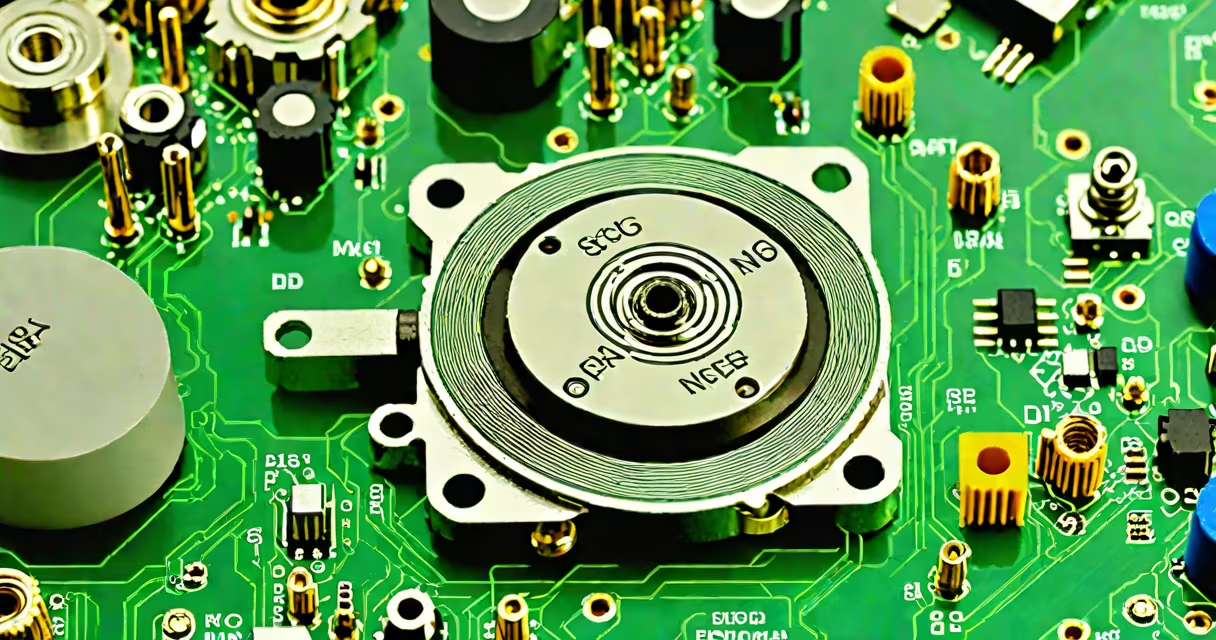
An encoder translates mechanical motion or analog signals into digital data that machines and computers can interpret. It acts as a translator between physical movement and electronic instructions.
Encoders are essential in systems requiring precise position, speed, or direction tracking. They convert rotation, linear movement, or analog voltage into pulses or codes sent to controllers. This enables accurate feedback in automation, robotics, and motion control.
For example, a stepper motor in a 3D printer uses an encoder to confirm each step was completed. Without it, the print head could drift, causing layer misalignment. Encoders ensure precision by sending real-time position updates.
Most encoders use optical, magnetic, or mechanical sensors to detect changes in position. Optical encoders shine a light through a rotating disk with slits. As the disk turns, light passes through and is detected by photodiodes. Each pulse corresponds to a known angular increment.
Magnetic encoders use a magnetized wheel and Hall effect sensors. As the wheel spins, the changing magnetic field generates electrical signals. These signals are processed into digital counts representing rotation.
Linear encoders measure distance along a track using a scale and readhead. The readhead detects patterns etched onto the scale-typically grating lines-and outputs a series of pulses proportional to displacement.
Encoders fall into two main categories: incremental and absolute.
| Type | Signal Output | Use Case | Pros & Cons |
|---|---|---|---|
| Incremental | Pulses (A/B phase quadrature) | Speed monitoring, motor control | Simple, low cost. Requires homing to find reference point. |
| Absolute | Unique digital code per position | Robot arm positioning, CNC machines | Knows exact location at power-up. More expensive. |
Incremental encoders output a stream of pulses. Two channels (A and B) are offset by 90 degrees. A controller counts pulses and compares phase shifts to determine direction. For example, 1000 pulses per revolution means each pulse equals 0.36° of rotation.
Absolute encoders assign a unique binary code to every position. Single-turn models use a single code wheel with 12-bit resolution (4096 positions per turn). Multi-turn versions track rotations beyond one full cycle using gears and secondary wheels.
Industrial robots often use absolute encoders because they don't need a homing routine after startup. A robotic arm can resume work immediately upon power-on, knowing its exact joint angles.
Encoders appear in devices requiring positional accuracy. In factory automation, servo motors use encoders to maintain precise speed and position during assembly tasks. A conveyor belt driven by a motor with an encoder stops exactly at a sensor point every time.
In consumer electronics, digital cameras use encoders in autofocus mechanisms. The lens moves based on feedback from an encoder measuring focus ring rotation. This ensures sharp images without manual adjustment.
Automotive applications include steering angle sensors and transmission speed monitors. Modern vehicles use encoders to track wheel rotation for anti-lock braking systems (ABS). A failure in the encoder can trigger a warning light and degrade safety performance.
One non-obvious fact: many encoders operate at high sampling rates. A typical industrial encoder may update every 10 microseconds-20,000 times per second. This allows real-time control in high-speed machinery.
Encoders are not the same as sensors. While both detect physical conditions, sensors output raw data (e.g., temperature, pressure). Encoders specifically convert motion into digital signals.
Some assume encoders only measure rotation. But linear encoders track straight-line movement. They're used in semiconductor manufacturing equipment to move wafers with nanometer precision.
Another error: thinking all encoders require external power. Passive encoders exist-like certain rotary switches-but most modern encoders need power to drive internal circuits and signal conditioning.
I once tested a faulty encoder on a CNC lathe. The machine repeatedly missed cuts by 0.1 mm. Replacing the encoder resolved the issue. The original unit had worn contacts, causing intermittent signal loss. This showed how small failures in encoding can cause major errors in production.
Understanding what an encoder does clarifies how digital systems interact with the physical world. Whether in a factory robot or a smartphone camera, encoders provide the feedback needed for accurate control. Their role in converting motion into usable data makes them fundamental to modern automation.