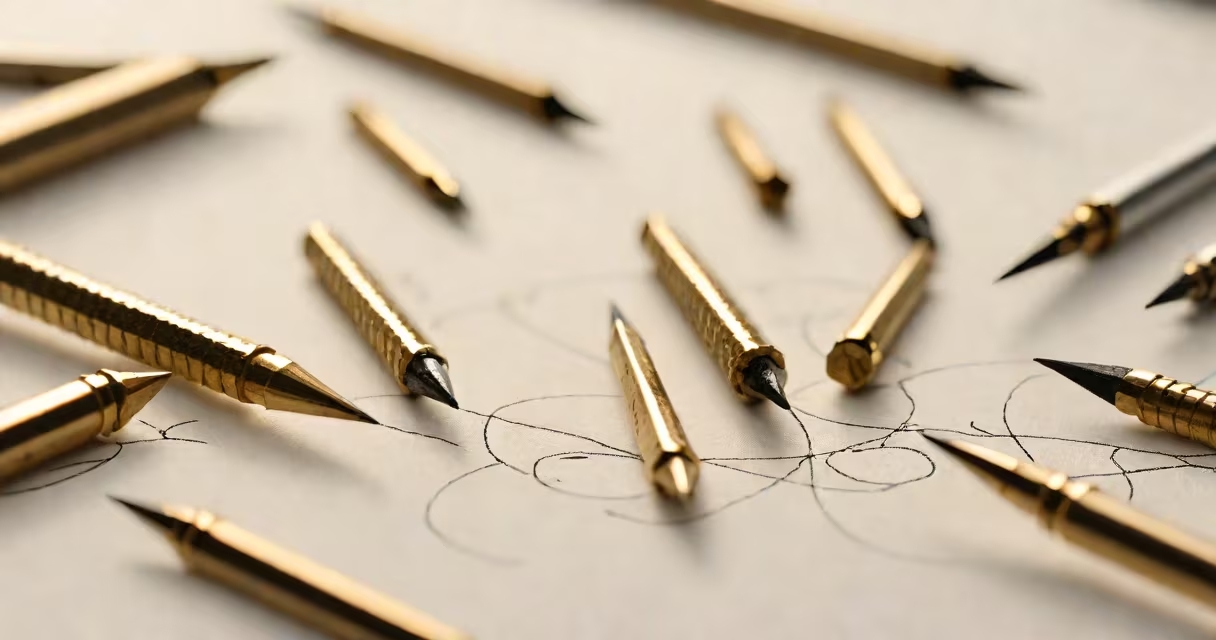
Trammel points are a pair of adjustable metal or brass components connected by a rigid bar, used to draw precise ellipses and arcs of variable radius. They function as a mechanical extension of a compass, allowing artists and drafters to create non-circular curves without relying on templates.
These tools consist of two sliding pins-one fixed and one movable-attached to a central rod. By adjusting the distance between the pins, users control the major and minor axes of an ellipse. The fixed pin acts as the center point, while the moving pin traces the curve. This mechanism enables consistent, repeatable shapes essential in architectural plans, engineering schematics, and artistic perspective work.
Trammel points are especially useful when standard compasses cannot produce elliptical forms. Unlike a compass, which draws circles using a single radius, trammel points allow independent adjustment of horizontal and vertical dimensions. This makes them indispensable in fields requiring accurate representation of circular objects in oblique views-such as wheels in side profile or curved architectural elements.
The mechanism relies on a fixed pivot point and a sliding guide. One pin remains stationary at the desired center of the ellipse. The second pin, attached to a sliding sleeve along the connecting rod, moves freely around the center. As the user rotates the assembly, the second pin traces a path defined by the ratio of the distances between the two pins and the center.
For example, setting the fixed pin at the origin and placing the movable pin 60 mm from it creates a semi-major axis of 60 mm. Adjusting the second pin to 40 mm from the center along the perpendicular axis produces a semi-minor axis of 40 mm. Rotating the tool around the fixed pin generates an ellipse with those exact dimensions.
This principle mirrors the mathematical definition of an ellipse: the set of all points where the sum of distances to two foci is constant. The trammel's dual-pin system approximates this geometric property through physical constraint, eliminating the need for complex calculations during manual drafting.
Trammel points come in several configurations based on material, adjustability, and intended use. Common types include:
| Type | Material | Adjustment Method | Use Case |
|---|---|---|---|
| Standard Brass | Brass with steel tips | Sliding sleeve with locking screw | Architectural and engineering drawings |
| Adjustable Steel | Stainless steel | Threaded barrel with micrometer scale | High-precision technical work |
| Wooden with Metal Tips | Hardwood with brass fittings | Fixed-length rods with interchangeable pins | Artistic sketching and historical reproduction |
Brass models offer durability and resistance to corrosion, making them ideal for long-term use in drafting studios. Steel versions often feature calibrated scales for measuring increments down to 0.1 mm, critical in manufacturing blueprints. Wooden variants are lighter and less likely to damage delicate paper surfaces, preferred by illustrators working on fine art projects.
A lesser-known fact: many vintage trammel points from the early 20th century were manufactured with interchangeable pin lengths. This allowed users to switch between different ellipse ratios without recalibrating the entire tool-a design feature absent in most modern versions.
Trammel points are frequently mistaken for compasses or dividers. While all three are hand-held drafting instruments, they serve distinct purposes. Compasses draw circles with a fixed radius. Dividers measure distances between points. Trammel points draw ellipses by varying the radius in two directions.
Another confusion arises from the term "trammel." In nautical contexts, a trammel refers to a rope or chain used to secure a ship's anchor. This unrelated usage causes occasional mix-ups in historical texts. However, in technical drawing, "trammel" specifically denotes the adjustable drafting device.
Some users assume trammel points require advanced math to operate. In reality, they function purely mechanically. A drafter only needs to set the correct spacing between pins and rotate the tool steadily. The resulting shape adheres to geometric principles automatically, regardless of the user's mathematical skill level.
To illustrate how trammel points are applied, consider designing a window with an elliptical arch in a residential floor plan. The client specifies a width of 1.2 meters and a height of 0.8 meters.
This process ensures symmetry and precision. Using a template would introduce scaling errors. A compass fails because the shape is not circular. Only trammel points provide both accuracy and flexibility.
I once used a 1940s brass trammel set to restore a vintage engineering drawing of a steam engine's piston chamber. The original had a distorted ellipse due to hand-drawing error. Reconstructing it with the trammel restored the correct proportions. The tool's weight and balance made it easier to maintain steady pressure than modern plastic versions.
While digital tools like CAD software now handle ellipse creation automatically, trammel points remain relevant in hands-on workflows. They are preferred when:
For digital workflows, software such as AutoCAD or SketchUp offers ellipse commands with parameter input. But these lack the directness of manual drafting. Trammel points preserve the connection between hand and form-an advantage in education and training.
When choosing between tools, consider the context. For rapid prototyping, digital methods win. For teaching geometry or demonstrating spatial reasoning, trammel points offer immediate, tangible results. Their physical nature reinforces concepts like focal distance and eccentricity in ways that screen-based simulations often fail to match.
Understanding trammel points enhances appreciation for analog tools in a digital age. They are not obsolete-they are specialized. Their role persists in disciplines demanding precision, consistency, and physical engagement with the drawing process.