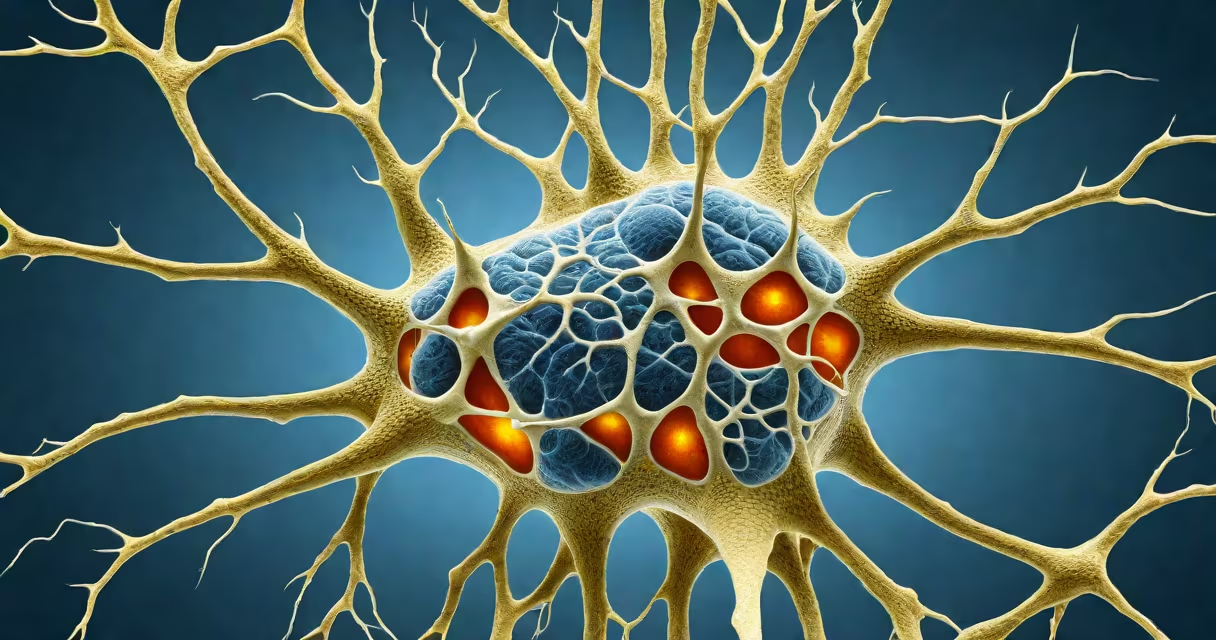
Neurons are specialized cells in the nervous system that process and transmit information via electrical and chemical signals. They form the core units of brain function, enabling everything from voluntary movement to memory formation.
Each neuron consists of a cell body (soma), dendrites that receive incoming signals, and an axon that sends outputs to other neurons or muscles. Signals travel along the axon as electrical impulses called action potentials, which trigger neurotransmitter release at junctions called synapses.
Neurons communicate using both electrical and chemical mechanisms. An action potential travels down the axon and causes voltage-gated calcium channels to open at the synaptic terminal. Calcium influx triggers vesicles filled with neurotransmitters-like dopamine, serotonin, or glutamate-to fuse with the membrane and release their contents into the synaptic cleft. These chemicals bind to receptors on the receiving neuron's dendrites, initiating a new signal.
When a neuron receives sufficient input from multiple dendrites, the summed electrical charge reaches a threshold. This triggers an action potential-a brief reversal of the cell's internal voltage-from approximately −70 mV to +30 mV. The impulse propagates down the axon at speeds ranging from 1 meter per second in unmyelinated fibers to over 100 meters per second in myelinated ones.
The myelin sheath, produced by oligodendrocytes in the central nervous system and Schwann cells in the peripheral system, insulates the axon and allows saltatory conduction-where the signal jumps between nodes of Ranvier. This dramatically increases transmission speed and energy efficiency.
A single neuron can connect to thousands of others. In the human cerebral cortex, each neuron averages around 7,000 synaptic connections. This dense network enables complex processing, such as recognizing faces or solving math problems, by distributing tasks across vast arrays of interconnected cells.
Neurons are categorized by structure and function. Sensory neurons carry signals from sensory organs to the spinal cord and brain. Motor neurons send commands from the central nervous system to muscles and glands. Interneurons, the most numerous type, process information within the brain and spinal cord.
| Type | Structure | Function | Example Location |
|---|---|---|---|
| Sensory | Unipolar or pseudounipolar | Transmits external stimuli (touch, pain, temperature) | Dorsal root ganglia |
| Motor | Bipolar or multipolar | Controls muscle contraction and gland secretion | Ventral horn of spinal cord |
| Interneuron | Multipolar | Processes information internally; involved in learning and reflexes | Cerebral cortex, hippocampus |
Some neurons, like those in the retina or inner ear, have unique shapes adapted to their roles. Retinal ganglion cells, for example, have radial dendritic trees optimized for detecting light patterns across the visual field.
Neurons do not fire in a binary "on/off" manner. Instead, they operate through graded potentials and frequency coding. A neuron fires more frequently in response to stronger stimuli-not by changing the size of its action potential, which remains consistent.
Another misconception is that we only use 10% of our brains. Brain imaging studies using fMRI show activity across nearly all regions during routine tasks. Even during sleep, widespread neural activity persists. The idea originated from misinterpretations of early neuroscience research and has no basis in modern science.
Neurons are not replaced frequently. Most neurons formed during fetal development remain throughout life. While neurogenesis-the creation of new neurons-occurs in specific areas like the hippocampus, it's limited and does not involve large-scale replacement of existing circuits.
Consider the knee-jerk reflex. A tap on the patellar tendon stretches the quadriceps muscle. Stretch receptors in the muscle send signals via sensory neurons to the spinal cord. There, interneurons relay the signal directly to motor neurons, which cause the quadriceps to contract-kicking the leg forward.
This entire sequence takes less than 50 milliseconds. The signal bypasses the brain entirely, allowing rapid protection against injury. Without this direct neural circuit, reaction time would be too slow for survival in dangerous environments.
Neurons also underlie higher functions. In a study published in *Nature Neuroscience*, researchers tracked neural activity in monkeys performing decision-making tasks. They found that prefrontal cortex neurons encoded choices before the animal moved, demonstrating how specific neuron populations represent intentions and goals.
Disruptions in neuronal signaling lead to neurological disorders. In Parkinson's disease, dopaminergic neurons in the substantia nigra degenerate, impairing motor control. Alzheimer's involves the accumulation of amyloid-beta plaques and tau tangles, which disrupt synaptic communication and eventually kill neurons.
Research shows that maintaining healthy neuron function reduces cognitive decline. A 2023 longitudinal study from the National Institute on Aging found that individuals with higher levels of physical activity had slower rates of gray matter loss in the hippocampus-critical for memory-over a 10-year period.
Understanding neurons also informs treatments. Deep brain stimulation (DBS) uses implanted electrodes to modulate abnormal neural activity in conditions like essential tremor and obsessive-compulsive disorder. By targeting specific brain circuits, DBS restores balance to faulty signaling pathways.
I once observed a patient with epilepsy undergoing video EEG monitoring. During a seizure, electrode recordings showed synchronized bursts of activity across hundreds of neurons in the temporal lobe. After medication adjustment, the abnormal firing patterns ceased. That moment confirmed how fragile yet precise neural networks must be to maintain normal function.
Neurons are not just biological components-they are the physical substrate of consciousness, emotion, and identity. Their ability to adapt through synaptic plasticity forms the basis of learning and memory. Every thought, memory, and decision arises from coordinated activity among billions of these specialized cells.
Neurons enable perception, behavior, and cognition. Their function extends beyond isolated signaling to include changing network interactions shaped by genetics, environment, and experience. Understanding them is essential to advancing medicine, neuroscience, and artificial intelligence.