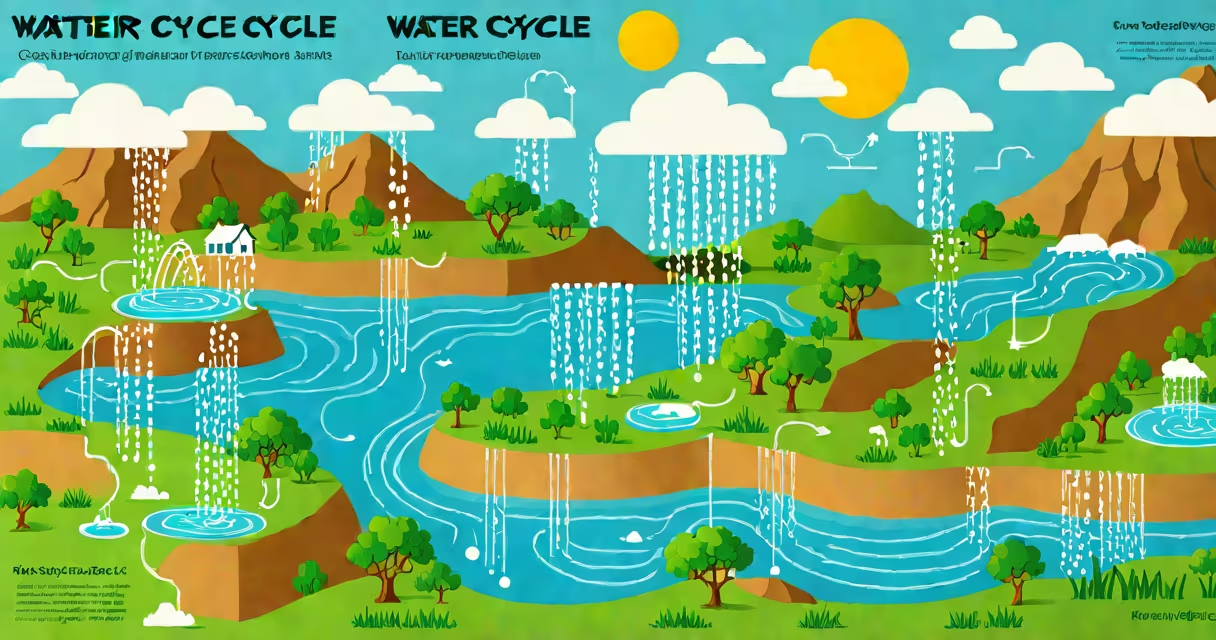
The water cycle, also known as the hydrological cycle, is the continuous movement of water on, above, and below Earth's surface through evaporation, condensation, precipitation, and collection. This process recycles water across ecosystems and drives weather patterns globally.
Water evaporates from oceans, lakes, rivers, and soil when heated by sunlight. As temperature rises, molecules gain energy and escape into the atmosphere as water vapor. Over 86% of global evaporation originates from oceans, according to the U.S. Geological Survey. This vapor rises and cools, forming clouds through condensation.
When water droplets in clouds grow large enough, they fall as precipitation-rain, snow, sleet, or hail-depending on air temperature. Precipitation replenishes freshwater sources and triggers runoff, infiltration, and groundwater recharge. The entire cycle takes between days and years, depending on location and climate.
Each stage plays a distinct role in sustaining life and regulating climate. The sequence begins with evaporation and ends with collection, though the cycle is continuous.
| Stage | Description | Timeframe | Example |
|---|---|---|---|
| Evaporation | Water turns from liquid to vapor due to solar heat. | Minutes to hours | A puddle vanishes after a sunny afternoon. |
| Condensation | Vapor cools and forms liquid droplets in clouds. | Hours to days | Fog forms over a lake at dawn. |
| Precipitation | Droplets fall as rain, snow, or ice. | Minutes to hours | Thunderstorm delivers 2 inches of rain in 30 minutes. |
| Collection | Water gathers in oceans, lakes, glaciers, or underground aquifers. | Days to centuries | Rainwater flows into a river system over several hours. |
Evaporation occurs fastest in tropical regions. In the Amazon Basin, average daily evaporation rates reach 6 mm per day during the wet season. Condensation happens when air cools to its dew point-the temperature at which vapor becomes liquid. This cooling often occurs as air rises over mountains or during nighttime.
Not all precipitation reaches the ground. Some evaporates mid-air-a process called virga-common in arid zones like the Mojave Desert. In one recorded event, 1.2 inches of rain fell over Phoenix, Arizona, but only 0.3 inches reached the surface due to evaporation in dry air.
The water cycle maintains freshwater availability, supports agriculture, and regulates Earth's temperature. Without it, ecosystems would collapse. For example, the Nile River's annual flooding-driven by Ethiopian highland rains-fertilized farmland for millennia. Ancient Egyptians relied on this predictable cycle for crop success.
Urban areas face challenges when the cycle is disrupted. Impervious surfaces like asphalt prevent infiltration, increasing flood risk. After Hurricane Harvey in 2017, Houston experienced 50 inches of rainfall in four days. Runoff overwhelmed drainage systems, leading to widespread flooding. The city's infrastructure was not designed for such extreme events, highlighting how human development alters natural flow paths.
Climate change intensifies the cycle. Warmer air holds more moisture-about 7% more per 1°C rise in temperature, per the Intergovernmental Panel on Climate Change (IPCC). This increases both drought frequency and heavy precipitation events. In 2021, Germany saw record rainfall linked to warmer Atlantic air masses, causing deadly floods.
Many assume evaporation only happens from open water. In reality, plants release water vapor through transpiration-a process that accounts for 10% of global atmospheric moisture. A single mature oak tree can transpire up to 40 gallons of water per day.
Another error is equating precipitation with rain. Snowfall in mountainous regions contributes to seasonal water supply. In California, snowpack in the Sierra Nevada stores over 30% of the state's annual water supply. When snow melts slowly in spring, it feeds rivers and reservoirs. Droughts worsen when winter snowpack drops below 60% of average, as seen in 2015.
Some believe the water cycle is linear. It is not. Water moves in loops-some cycles take decades, others months. A drop of water entering a glacier in Greenland may take 10,000 years to return to the ocean via melting and runoff.
Consider a raindrop falling in the Appalachian Mountains near the source of the Ohio River. It begins its process as precipitation. The drop joins a stream flowing downhill, gaining speed and volume. By the time it reaches the Mississippi River near Memphis, Tennessee, it has merged with thousands of other drops.
From there, it travels 2,300 miles south to the Gulf of Mexico. Along the way, it passes through multiple states, supporting agriculture, industry, and wildlife. About 20% of U.S. agricultural production depends on water from this basin. Once it enters the Gulf, the drop evaporates under intense sun, rising again into the atmosphere.
This drop completes a full cycle in approximately 12 days-evaporation, cloud formation, precipitation, and collection. The rate varies based on local conditions. In drier climates, the cycle may take weeks longer.