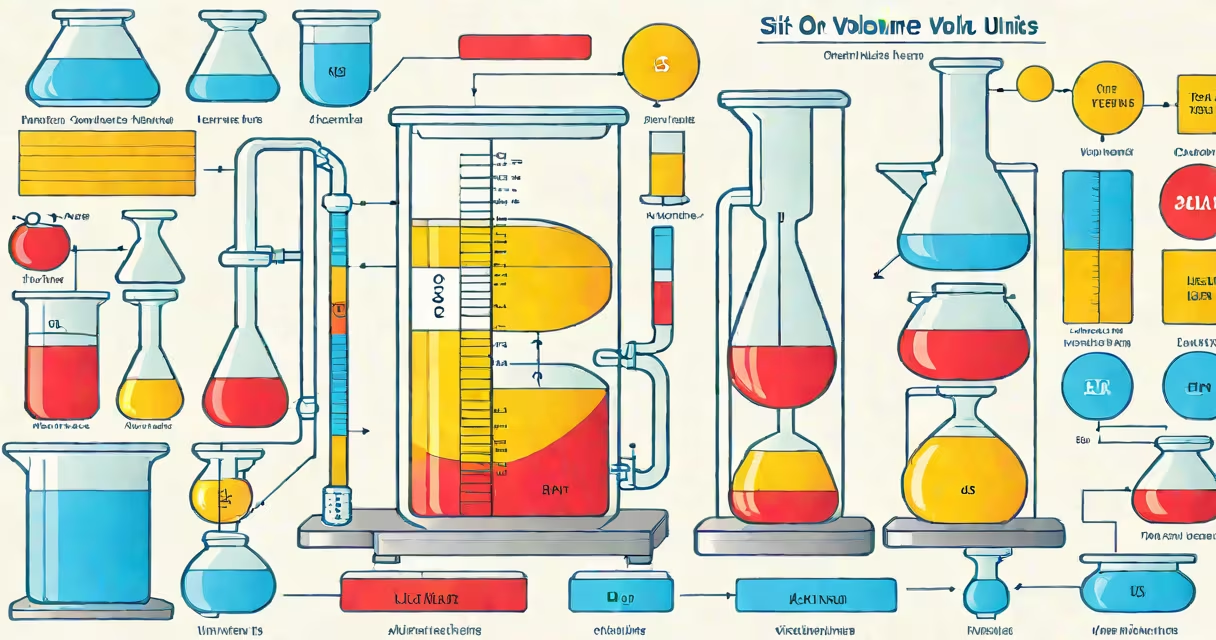
The SI system defines volume using the cubic meter (m³) as the base unit, with the liter (L) as a commonly used derived unit accepted for use alongside SI. Volume measures three-dimensional space occupied by a substance, and SI ensures consistent global measurement across science, engineering, and commerce.
Volume in the International System of Units (SI) is derived from the meter, the base unit of length. A cubic meter (m³) equals the volume of a cube measuring one meter on each side. This unit forms the foundation for all other volume measurements in the system. The liter, though not an official SI unit, is accepted for use with SI and is defined as exactly 0.001 m³-equivalent to 1,000 cubic centimeters (cm³).
For everyday use, especially in cooking, medicine, and consumer products, the liter and its submultiples-milliliters (mL), centiliters (cL)-are widely adopted. One milliliter equals 1 cm³, making conversions between metric volume and mass straightforward for water: 1 mL of pure water at 4°C weighs exactly 1 gram.
SI volume is calculated geometrically for regular shapes. For example, a rectangular prism with dimensions 2 m × 3 m × 4 m has a volume of 24 m³. This method applies universally across scientific fields, including fluid dynamics, thermodynamics, and material science.
In chemistry, volume is critical for preparing solutions. A 1 M (molar) solution of sodium chloride requires dissolving 58.44 grams of salt in enough water to make exactly 1 liter of solution. This precision relies on standardized SI units to ensure reproducibility across labs worldwide.
Industrial processes depend on accurate volume measurements. In oil refining, throughput is measured in cubic meters per hour. A refinery processing 15,000 m³/h of crude oil uses SI units to track efficiency, safety, and environmental impact.
The following table outlines the primary SI volume units and their relationships:
| Unit | Symbols | Value in Cubic Meters | Common Use |
|---|---|---|---|
| Cubic meter | m³ | 1 | Scientific research, large-scale engineering |
| Liter | L or l | 0.001 | Everyday containers, food labeling, medicine |
| Milliliter | mL | 1 × 10⁻⁶ | Medication dosing, lab experiments |
| Cubic centimeter | cm³ | 1 × 10⁻⁶ | Medical syringes, small component volumes |
One non-obvious fact: the liter was originally defined based on the kilogram and the cubic decimeter. In 1964, the General Conference on Weights and Measures formally redefined the liter as exactly 1 dm³ (0.1 m³), aligning it precisely with the metric system's decimal structure.
SI for volume is mandatory in international trade, scientific publications, and regulatory compliance. The U.S. National Institute of Standards and Technology (NIST) requires SI units in federal standards, including those governing pharmaceuticals and fuel quality.
Global organizations like the World Health Organization (WHO) use SI volume units in health guidelines. For example, WHO recommends oral rehydration solution doses in milliliters per kilogram of body weight, ensuring consistency across countries with different local measurement systems.
When converting between systems, confusion arises. The U.S. customary gallon (≈3.785 L) differs from the imperial gallon (≈4.546 L). Using SI avoids errors in cross-border logistics. A shipment of 10,000 L of liquid detergent shipped internationally must be measured in SI units to meet customs and safety regulations.
Many assume the liter is an SI base unit. It is not. The SI base unit for volume is the cubic meter. The liter is a non-SI unit accepted for use with SI, as confirmed by the BIPM (International Bureau of Weights and Measures).
Another misconception: "cc" (cubic centimeter) is interchangeable with "mL." While numerically equivalent, "cc" is discouraged in formal contexts due to potential misreading. A doctor's prescription written as "5 cc" could be misread as "50 cc" if handwriting is unclear. The correct notation is "5 mL."
I once observed a lab technician accidentally use "cc" in a report submitted to a regulatory agency. The document was rejected for non-compliance with ISO 80000-7, which mandates use of SI-compliant terminology. Correcting the error delayed the approval process by two weeks.
Consider a recipe requiring 2 cups of milk. To convert this to SI units:
This conversion ensures accuracy when scaling recipes for industrial production. A bakery producing 1,000 loaves of bread needs precise volume inputs. Using 0.473 L per batch avoids waste and maintains product consistency.
For smaller quantities, such as adding 1/4 teaspoon of vanilla extract, the SI system allows direct conversion: 1 tsp ≈ 4.929 mL, so 1/4 tsp ≈ 1.232 mL. This level of precision supports both culinary science and nutritional analysis.
Understanding si for volume enables accurate communication across disciplines. Whether measuring blood volume in a clinical trial or calculating fuel capacity for a spacecraft, SI units eliminate ambiguity. The system's consistency prevents costly errors in manufacturing, healthcare, and environmental monitoring.