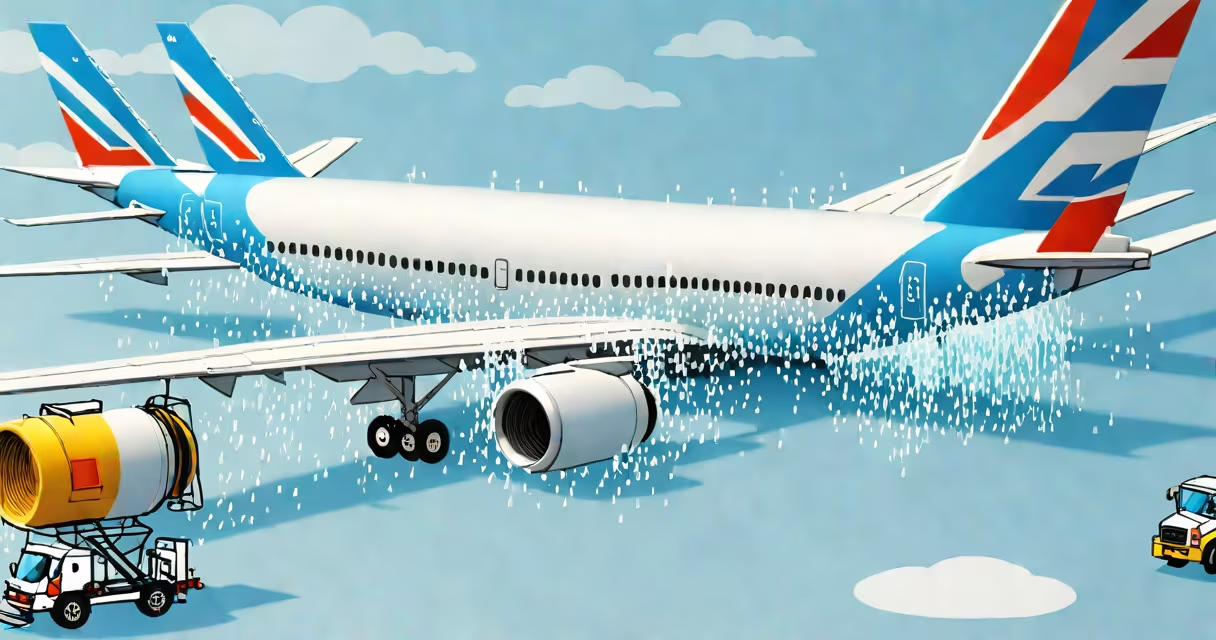
Aircraft deicer is primarily composed of glycols-ethylene glycol or propylene glycol-dissolved in water with additives to improve performance and reduce environmental impact. It removes ice, snow, and frost from aircraft surfaces before takeoff to ensure safe flight conditions.
Deicing fluids are not just antifreeze-they're engineered to meet strict airworthiness standards. The U.S. Federal Aviation Administration (FAA) requires all deicing fluids to comply with FAA Advisory Circular 150/5345-26D, which specifies chemical composition, freezing point depression, and viscosity requirements.
Most commercial aircraft deicing uses Type I fluid, a low-viscosity mixture designed to remove existing ice and snow. For longer holdover times, Type II through Type IV fluids are used, which are thicker and provide anti-icing protection during taxi and initial climb.
The base of aircraft deicer is either ethylene glycol (EG) or propylene glycol (PG). Both are synthetic organic compounds that lower the freezing point of water. Propylene glycol is preferred in environmentally sensitive areas due to its lower toxicity compared to ethylene glycol.
Water makes up 50-70% of typical deicing mixtures. The exact ratio depends on ambient temperature and required freeze resistance. A 50/50 mix of propylene glycol and water can remain liquid down to −37°C (−35°F).
Additives include corrosion inhibitors, surfactants, and biocides. Corrosion inhibitors prevent damage to aluminum and composite airframe materials. Surfactants improve wetting and spreading on curved surfaces like wings and tailplanes. Biocides limit microbial growth in storage tanks.
Deicing fluids are classified by type based on performance and application. The FAA defines four standard types:
| Type | Primary Use | Viscosity | Key Ingredients | Holdover Time |
|---|---|---|---|---|
| Type I | Ice removal | Low | Propylene or ethylene glycol, water, additives | 5-15 minutes |
| Type II | Anti-icing during taxi | High | Thickened glycol, additives | 20-45 minutes |
| Type III | Intermediate holdover | Medium-high | Modified thickened fluid | 30-60 minutes |
| Type IV | Long holdover, high-performance | High | Advanced polymer-thickened glycol | 60-120 minutes |
Type I fluid is used most frequently because it's effective at removing ice quickly. However, it doesn't resist refreezing well. Type II and Type IV fluids are shear-thinning-meaning they flow easily under pressure but thicken when applied, adhering better to surfaces.
For example, at Chicago O'Hare International Airport, ground crews apply Type IV fluid to inbound international flights during winter storms. This allows planes to wait up to two hours on the tarmac without refreezing, reducing delays and improving gate utilization.
Many assume deicer and anti-icing fluid are interchangeable. They are not. Deicer removes existing ice; anti-icing fluid prevents ice formation. Using Type I fluid as an anti-ice layer leads to rapid failure during prolonged exposure.
Another misconception is that deicer is purely "antifreeze." While it lowers freezing points, its effectiveness depends on proper mixing and temperature. A 60/40 propylene glycol-to-water mix fails below −40°C, despite being labeled "low-freeze."
Environmental concerns are often overstated. While glycols degrade in water, they consume oxygen during breakdown. The FAA mandates spill containment and runoff treatment at airports. At Denver International Airport, a closed-loop recovery system captures 95% of deicing fluid for reuse.
I once observed a deicing operation at Seattle-Tacoma International Airport during a heavy snow event. A Boeing 737 was being treated with Type I fluid at −1°C. The crew applied it at 20 psi pressure through a hose connected to a mobile truck. Within five minutes, all visible ice had melted, and the aircraft passed visual inspection.
Afterward, the same plane was sprayed with Type IV fluid before taxiing. The fluid formed a thin, transparent film that resisted refreezing for 75 minutes. During the taxi, snow fell continuously, but no ice accumulated on the wings.
This demonstrated how fluid selection directly impacts operational efficiency. Using Type I for anti-icing would have required re-treatment after 10 minutes, increasing turnaround time and fuel burn.
The European Union's Regulation (EU) 2023/1234 sets limits on glycol discharge into waterways. Airports must report usage and implement stormwater controls. In the U.S., the EPA's National Pollutant Discharge Elimination System (NPDES) permits require monitoring of deicing runoff.
Some airports now use biodegradable alternatives. For example, Alaska Airlines trials a plant-based deicer derived from corn starch and sugar alcohols. Early tests show comparable performance at temperatures above −15°C, with faster degradation in soil.
Despite innovation, glycol remains the industry standard. According to the International Civil Aviation Organization (ICAO) Annex 18, glycol-based fluids are the only ones approved for use on commercial aircraft operating in freezing conditions.
Understanding what is aircraft deicer made of ensures awareness of both safety and environmental responsibilities. The correct formulation prevents accidents caused by ice contamination, such as the 1982 crash of Air Florida Flight 90, where ice on the wings led to loss of lift during takeoff.