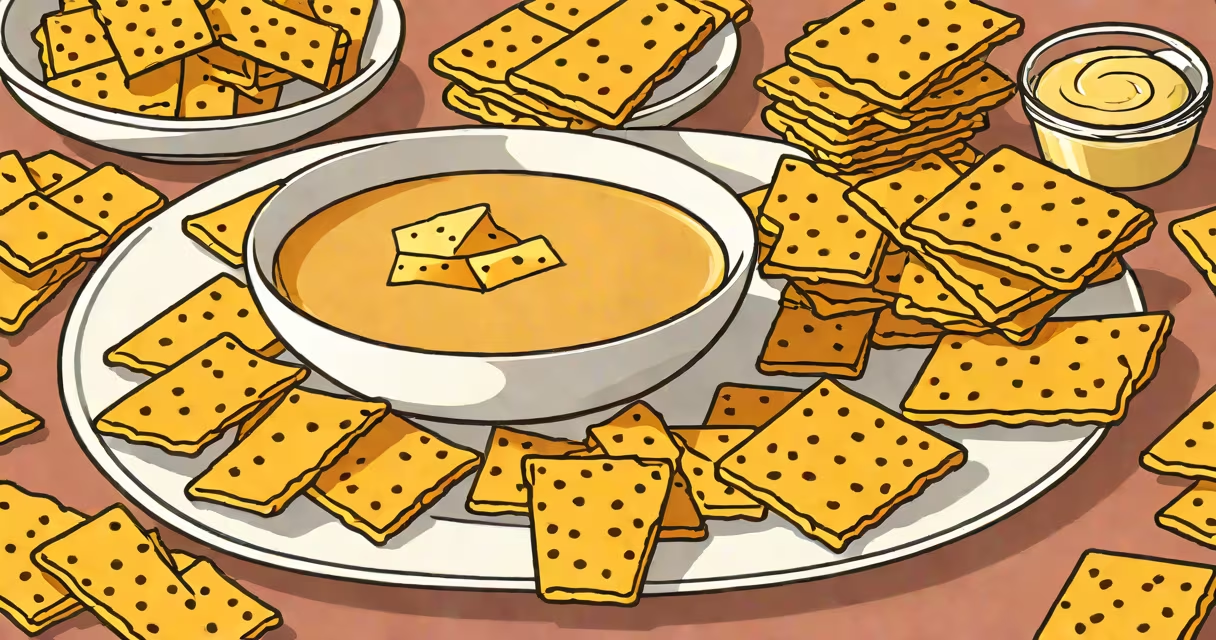
Town house crackers are a buttery, mildly sweet baked cracker made from wheat flour, sugar, and vegetable oil. They are typically rectangular, thin, and crisp, with a golden color and a subtle flavor profile that balances richness and sweetness. These crackers are widely available in U.S. grocery stores and are commonly used as a base for appetizers or eaten on their own.
Manufactured by the company that produces Nabisco products, town house crackers are produced using a standard sheet-baking process. The dough is rolled out, cut into rectangles, and baked until dry and crisp. They contain no artificial preservatives and are free from trans fats, though they do include added sugars and sodium. A single serving (about 6 crackers) contains approximately 120 calories, 5 grams of fat, and 1 gram of fiber.
These crackers are often confused with graham crackers due to their similar texture and use in sweet applications. However, town house crackers are less sweet and more savory than graham crackers. They are also distinct from saltines, which are plain and lack sugar. Unlike both, town house crackers have a noticeable buttery note from the oil and milk solids in the recipe.
Standard town house crackers are made from four core ingredients: enriched wheat flour, sugar, vegetable oil (typically soybean or sunflower), and salt. Small amounts of leavening agents like baking powder and emulsifiers such as mono- and diglycerides are included to improve texture and shelf life. The product is not vegan due to the presence of milk derivatives.
The production process begins with mixing the dry ingredients, then adding liquid components such as water and oil. The dough is rolled through a series of rollers to achieve uniform thickness, then cut into individual pieces using a rotary cutter. After shaping, the crackers are baked at 375°F (190°C) for 8-10 minutes, which causes rapid moisture evaporation and crust formation.
A non-obvious detail: despite their name, town house crackers were not originally designed for use in "town houses" or urban living spaces. The name likely reflects early 20th-century American marketing that associated the product with middle-class domesticity and family meals. The brand was introduced in 1928 and has since been sold under the Nabisco label.
These crackers are frequently used as a base for appetizers. For example, a classic cheese and herb spread can be made by combining 1/4 cup softened cream cheese, 1 tablespoon chopped chives, and 1/2 teaspoon lemon zest. Spread 1 teaspoon of this mixture onto each town house cracker and bake at 350°F (175°C) for 5 minutes to set. This yields 12 bite-sized appetizers with a balanced flavor and crisp texture.
They are also used in dessert applications. A simple treat involves layering crushed town house crackers with whipped cream and fresh berries. One recipe calls for 1 cup crushed crackers, 1 cup whipped cream, and 1/2 cup sliced strawberries. Layer in a glass dish and chill for 2 hours. The result is a no-bake dessert resembling a crumb pie with a light, airy texture.
For savory dishes, they serve as a crunchy element in salads. Tossing 1/2 cup of broken town house crackers into a mixed greens salad with cucumber, cherry tomatoes, and a vinaigrette adds texture and mild sweetness that complements sharp flavors.
While the original town house cracker remains the most common version, several variants exist. These include:
| Type | Flavor Profile | Calories per 6 crackers | Key Difference |
|---|---|---|---|
| Original | Buttery, lightly sweet | 120 | Standard version, widely available |
| Reduced Fat | Slightly less rich, more airy | 100 | Uses less oil; lower fat content |
| Chocolate Chip | Sweet, with chocolate bits | 140 | Contains chocolate chips; marketed as a dessert cracker |
Despite their popularity, town house crackers are not available in all international markets. They are primarily distributed in North America and parts of Latin America. In Europe, similar products are sold under different brand names, such as "Biscuits de la Maison" in France, which share the same ingredient base but differ in size and packaging.
Many consumers assume town house crackers are a healthier alternative to other packaged snacks. While they are lower in saturated fat than many cookies, they still contain 5 grams of fat and 4 grams of sugar per serving. According to the American Heart Association, daily added sugar intake should not exceed 36 grams for men and 25 grams for women. One serving of town house crackers accounts for nearly 16% of the recommended daily limit for women.
Another misconception is that they are suitable for gluten-free diets. The original version contains wheat flour and is not labeled gluten-free. Even the reduced-fat variant includes wheat-based ingredients. Consumers with celiac disease or gluten sensitivity should avoid them unless explicitly labeled as gluten-free.
I once used town house crackers in a party appetizer setup. I prepared a batch with goat cheese, honey, and cracked pepper. The combination of sweet, tangy, and spicy notes worked well. Guests ate them quickly, and I noticed that the crackers held their crispness longer than expected-up to 90 minutes after being served-due to their low moisture content and high baking temperature during production.
For those seeking alternatives, consider a short love message to accompany a homemade cracker tray. Or explore regional brands like Mary's Gone Crackers, which offer grain-free and organic options with similar textures but different flavor profiles.
Town house crackers are a staple in American snack culture. Their balance of buttery richness and subtle sweetness makes them versatile across both sweet and savory applications. Understanding their composition and limitations ensures better choices in diet and meal planning.