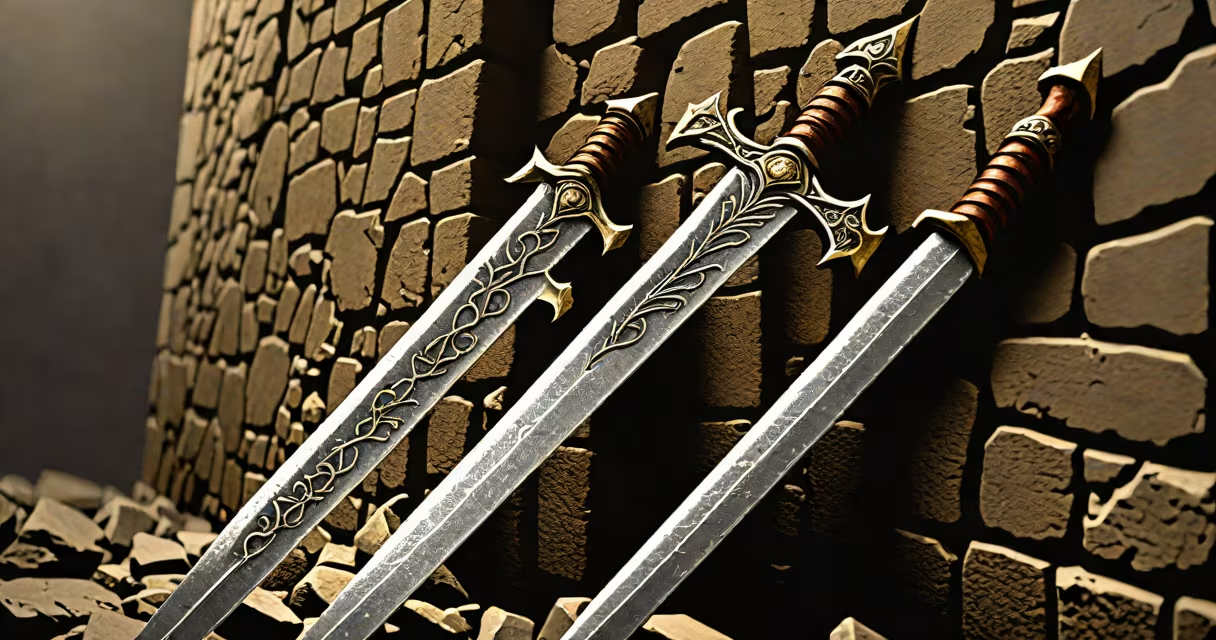
"The Blade Itself" by Joe Abercrombie is the debut novel in the "First Law" trilogy, a grimdark fantasy series that redefines the genre through morally ambiguous characters, relentless pacing, and unflinching depictions of violence and political intrigue.
The story centers on Logen Ninefingers, a brutal warrior with a shattered past, and his reluctant alliance with Jezal dan Luthar, a vain nobleman whose life unravels after a failed duel. Their paths converge under the shadow of a war-torn continent where power is seized through bloodshed, betrayal, and cold calculation. The narrative unfolds across shifting perspectives, each character driven by personal failure, ambition, or survival instinct.
Abercrombie's prose strips away fantasy tropes like chosen ones and heroic destinies. Instead, he presents a world where victory is fleeting, loyalty is transactional, and heroes are often the most dangerous people in the room. The novel's title references both literal weapons and the idea that power resides not in ideals, but in the act of wielding force-whether with a blade or a lie.
"The Blade Itself" uses a rotating third-person perspective across six central characters, each narrating chapters in alternating sequences. This structure avoids a single protagonist, forcing readers to engage with multiple flawed viewpoints. No character is consistently heroic; their actions stem from trauma, fear, or desire for control.
Logen Ninefingers, a Northman warrior with a reputation for savagery, fights not for honor but to survive. His internal monologue reveals a man haunted by past atrocities, yet capable of sudden compassion. He is not a hero-his strength lies in endurance, not righteousness. His arc begins with a desperate attempt to escape his past, only to be drawn deeper into the conflict.
Jezal dan Luthar, meanwhile, represents the collapse of aristocratic privilege. A skilled swordsman in theory, he fails in combat due to ego and poor training. His process is one of humiliation and forced growth. After being defeated in a public duel, he is stripped of status and thrust into a world where skill matters more than lineage. His transformation is slow, painful, and deeply human.
The novel subverts classic fantasy elements. There is no prophecy. No ancient magic. No grand quest to save the world. Instead, the central conflict revolves around regional warlords vying for dominance in a fractured land. The "war" is less about ideology than survival-food, territory, and control over trade routes.
Violence is presented as routine, not glamorous. Characters die suddenly, often off-screen. The aftermath is shown in quiet moments: a hand still clutching a broken dagger, a child's empty bowl left beside a dead mother. Abercrombie avoids glorifying combat. When Logen kills, it's not triumphant-it's mechanical, necessary, and emotionally draining.
One non-obvious fact: the title "The Blade Itself" is not a metaphor for justice or destiny. It refers to a specific weapon-the blade of a legendary warrior, lost and later recovered. But even that artifact doesn't change outcomes. Its wielder dies within days. Power lies not in objects, but in who holds them.
Published in 2006, "The Blade Itself" gained immediate attention for its sharp dialogue, bleak tone, and refusal to follow fantasy conventions. It won the David Gemmell Legend Award in 2007 and was shortlisted for the British Fantasy Society's Best Novel award.
According to the Guardian, Abercrombie "reinvents fantasy as a genre of moral ambiguity," replacing the traditional hero's process with a narrative of consequence and regret. The New York Times Book Review noted that the novel "feels like a war diary written by someone who survived the worst parts."
Readers use the book as a benchmark for grimdark storytelling. It's frequently recommended for those tired of idealized fantasy worlds. Its influence appears in later works like Brandon Sanderson's "Mistborn" series and George R.R. Martin's "A Song of Ice and Fire," though Abercrombie's tone remains sharper, more cynical.
| Element | Description | Why It Matters |
|---|---|---|
| Protagonists | Logen Ninefingers, Jezal dan Luthar, Glokta | No clear hero. All are damaged, selfish, or compromised. |
| Setting | North, Union, and the Broken Province | Political factions based on geography and resource control, not good vs evil. |
| Themes | Power, betrayal, survival, identity | Characters define themselves through action, not belief. |
Many readers assume "The Blade Itself" is a standalone novel. It is not. It launches the "First Law" trilogy, followed by "Before They Are Hanged" and "Last Argument of Kings." Skipping the sequels undermines the full arc of characters like Glokta, whose fate hinges on decisions made in the first book.
Another misconception: that the story is purely violent. While combat scenes are frequent and graphic, they serve structural and thematic purposes. Violence is not spectacle-it's a tool for revealing character. When Logen kills, we see not triumph, but exhaustion. When Jezal is beaten, we feel his shame, not his glory.
One correction: the term "grimdark" is often misapplied. According to the British Fantasy Society, grimdark describes stories where hope is rare, endings are unresolved, and morality is fluid. "The Blade Itself" fits this definition precisely. It does not offer redemption, only consequences.
Consider the duel between Jezal and Sult. Jezal enters the ring confident, trained in the formal fencing of the Union. Sult, a street fighter from the slums, moves with unpredictable speed. The fight lasts 47 seconds. Jezal lands two clean strikes, but Sult dodges the third and counters with a blow to the jaw.
After the fall, Jezal lies stunned. Sult stands over him, breath ragged. He says nothing. Then he kicks Jezal's sword out of reach. The crowd roars-not in approval, but in recognition of the outcome: the privileged fail when faced with raw capability.
This scene illustrates the novel's core principle: skill and preparation are not enough. Survival depends on adaptability, instinct, and the willingness to act without hesitation. Jezal's training is useless against someone who fights without rules.
I read this passage during a late-night session in a dimly lit apartment in Portland. The rain tapped against the window. When I reached the line "He wasn't thinking-he was just moving," I paused. That moment captured the entire philosophy of the book: action precedes thought, and thought too often arrives too late.
"The Blade Itself" by Joe Abercrombie is not a story about saving the world. It's about surviving it. The novel's enduring appeal lies in its refusal to offer easy answers. Characters make bad choices, suffer, and sometimes grow-but rarely become better people. The blade itself is not a symbol of justice. It is a mirror.