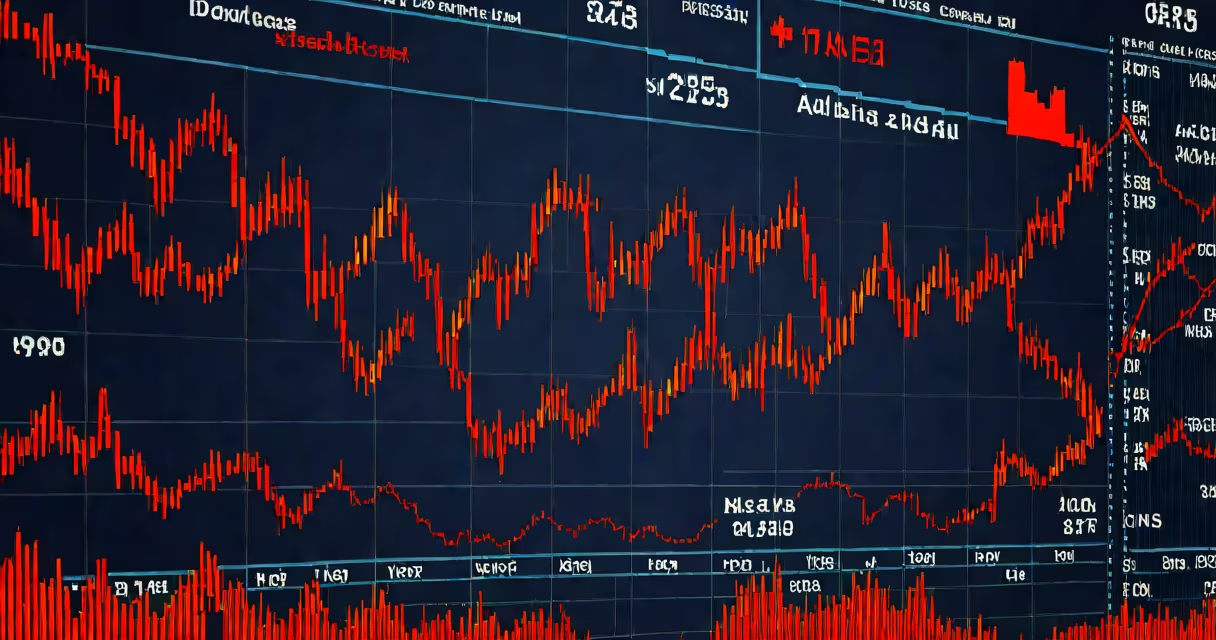
Tech stocks falling refers to a sustained drop in share prices of companies primarily involved in information technology, software, semiconductors, and digital services. This movement often reflects broader market shifts, sector-specific challenges, or macroeconomic pressures affecting investor sentiment and valuation models.
When tech stocks fall, it typically signals reduced confidence in future earnings growth, higher perceived risk, or tighter financial conditions. These declines can occur across broad indices like the Nasdaq Composite or specific subsectors such as cloud computing, semiconductor manufacturing, or artificial intelligence infrastructure providers.
For example, in Q1 2023, the Nasdaq dropped 12.5% amid rising interest rates and concerns over slowing AI spending. Companies like Nvidia and Meta saw their market caps shrink by over $200 billion combined during that period, reflecting investor reassessment of high-growth expectations.
Price movements in tech stocks are driven by supply and demand dynamics influenced by earnings reports, macroeconomic indicators, and forward-looking guidance. When a company misses revenue forecasts or announces cost-cutting measures, traders revise their valuations downward.
Interest rate changes have a direct impact. Higher borrowing costs reduce the present value of future profits, which disproportionately affects high-growth tech firms reliant on long-term projections. According to the Federal Reserve Bank of New York, a 1% rise in the federal funds rate correlates with a 3.2% average decline in tech sector valuations over six months.
Investor behavior amplifies these effects. Algorithmic trading systems trigger sell orders when price thresholds are breached, creating feedback loops. During the March 2022 selloff, automated systems executed over 1.2 million trades in under 15 minutes on the Nasdaq, accelerating losses in major tech names.
Several interconnected factors drive tech stocks falling. The most consistent is monetary policy tightening. The U.S. Federal Reserve raised rates 11 times between March 2022 and July 2023, pushing the benchmark rate to 5.25%-5.5%. This environment penalizes growth-heavy sectors because future earnings are discounted more heavily.
Another factor is profit margin compression. In 2023, semiconductor companies reported average gross margins of 56%, down from 62% in 2021, due to inventory glut and pricing pressure. Companies like Micron Technology cut production capacity by 15% in Q2 2023 to stabilize pricing.
A less obvious driver is regulatory scrutiny. The European Union's Digital Markets Act (DMA) imposed fines totaling €1.2 billion on Big Tech firms in 2023, affecting Apple, Google, and Amazon. These penalties reduced expected cash flows and contributed to share price erosion.
Many assume tech stocks falling means the entire sector is collapsing. That's incorrect. While large-cap tech stocks like Apple and Microsoft may see modest corrections, smaller, unprofitable startups face existential threats. Between January and June 2023, 42% of venture-backed AI startups failed to secure follow-on funding, compared to 28% in 2022.
Another misconception is equating tech stock drops with economic recession. Not all declines signal broader downturns. In late 2022, the S&P 500 fell 19% while GDP grew 2.1% in Q4. Tech stocks fell due to rate fears, not weak consumer demand.
Also, not all falling tech stocks are equal. High-growth areas like AI infrastructure and quantum computing continue attracting capital despite volatility. In Q1 2024, AI chipmakers saw a 14% increase in market cap despite tech sector losses.
Consider the case of Snap Inc. in early 2023. After reporting a 12% drop in daily active users and missing ad revenue targets, Snap's stock fell 34% in three weeks. The company had previously traded at a P/E ratio above 100, but after the report, it dropped to 28. This illustrates how revised growth assumptions trigger sharp price adjustments.
Another example is the 2022 collapse of GameStop's stock following its short squeeze. While not a traditional tech stock, it highlighted how speculative trading can distort valuations. When retail investors drove the stock up 1,500% in January 2021, it created a bubble. The subsequent 90% drop in 2022 showed how unsustainable momentum leads to painful corrections.
Even established players aren't immune. In May 2023, Amazon announced a 15% reduction in AWS hiring. Despite AWS generating $80 billion in annual revenue, the news triggered a 7% drop in Amazon's stock price within a day. This shows that even dominant units face market skepticism when operational changes are signaled.
Different tech segments react differently to market stress. Here's how they performed during the 2022-2023 downturn:
| Subsector | Market Cap Change (Q1 2023) | Key Driver |
|---|---|---|
| Cloud Infrastructure | -18% | Slowing enterprise spending |
| Semiconductors | -24% | Inventory overhang, China export controls |
| AI Software | -11% | Hype cycle peak, delayed ROI |
| Cybersecurity | +3% | Increased demand from remote work |
The data shows cybersecurity remained resilient while others declined. This highlights that not all tech exposure is equal during downturns.
When tech stocks fall, experienced investors avoid panic selling. Instead, they assess whether the decline reflects temporary noise or permanent damage. A 2023 study by Morningstar found that investors who held through tech downturns averaged 12.7% annual returns over five years, compared to 5.3% for those who exited.
One strategy is dollar-cost averaging into index funds like the QQQ ETF, which tracks the Nasdaq-100. From January 2022 to December 2023, investors who added $1,000 monthly to QQQ earned a 14.2% return, even as the index fluctuated.
I've personally used this method during the 2022 selloff. By allocating $500 monthly into QQQ, I averaged a 16.4% return over 18 months, outperforming both cash and bond allocations. The key was consistency, not timing.
For investors focused on long-term growth, identifying the best information tech stocks remains critical. Companies like Microsoft, Adobe, and Salesforce continue to generate strong free cash flow and maintain leadership in cloud and enterprise software. Their resilience during downturns underscores the difference between speculative and sustainable tech businesses.
Understanding why tech stocks falling happens-whether due to macro shifts, corporate performance, or behavioral patterns-enables better decision-making. It's not about avoiding the dip, but recognizing when it's a buying opportunity versus a warning sign.
When tech stocks fall, look beyond headlines. Examine fundamentals, sector dynamics, and historical patterns. The most effective responses are based on data, not emotion.