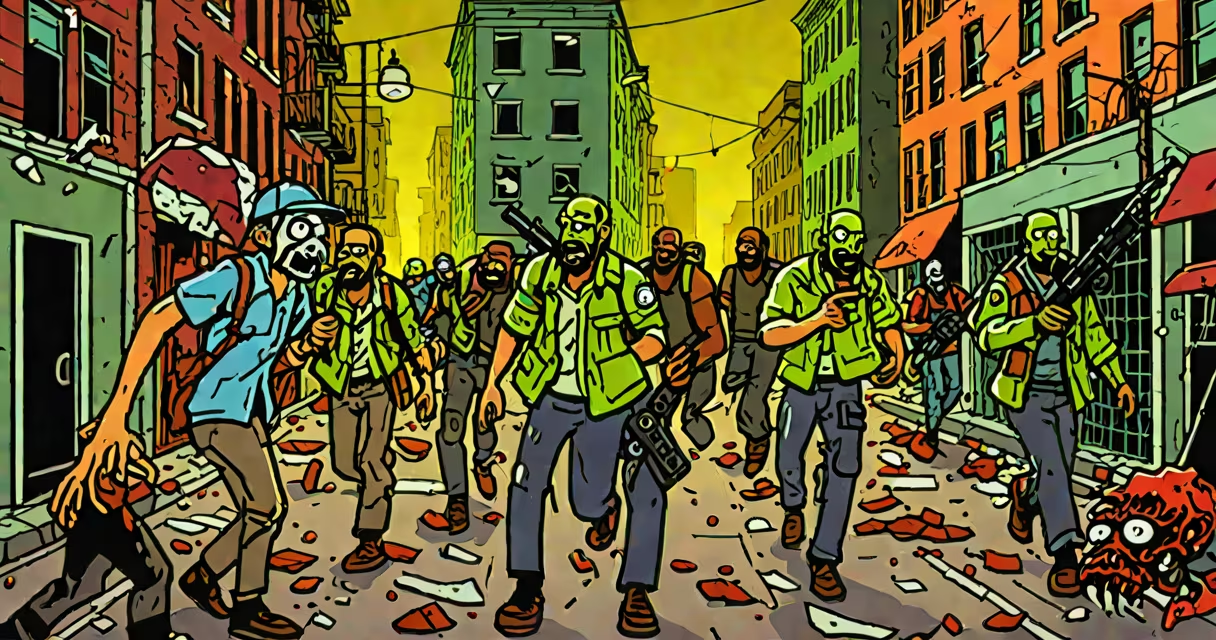
The Left 4 Dead outbreak is a fictional global pandemic in the Valve cooperative first-person shooter series, where players assume the roles of survivors battling waves of aggressive, zombie-like infected. The outbreak begins in New Orleans during Mardi Gras and rapidly spreads through North America via airborne transmission and violent host-to-host contact.
Set in a post-apocalyptic version of the United States, the outbreak is depicted as a rapid-onset neurological infection caused by a mutated strain of the Raccoon City virus (a reference to the Resident Evil franchise). Infected individuals exhibit extreme aggression, heightened strength, and a tendency to swarm in large numbers. The game's narrative frames the outbreak as a collapse of civil order, with military forces abandoning cities and infrastructure failing within days.
Valve designed the outbreak to serve both narrative and gameplay purposes. It explains the absence of civilians, the decay of urban environments, and the constant threat of ambushes. The infection's progression is intentionally ambiguous-no cure exists in-game, and the origin remains unconfirmed, allowing players to focus on survival rather than scientific detail.
In Left 4 Dead and Left 4 Dead 2, the outbreak operates through changing difficulty scaling known as the "AI Director." This system monitors player performance and adjusts enemy spawns, environmental hazards, and event pacing in real time. As players progress through a campaign, the AI increases the number of special infected-such as the Tank, Witch, and Boomer-to maintain tension and challenge.
For example, in the campaign "Dark Carnival" set in a flooded New Orleans, the outbreak causes structural collapses, blocked routes, and sudden appearances of infected in narrow alleys. The AI director may trigger a "special infected rush" when players linger too long near a safe house, simulating the unpredictability of a real pandemic's spread.
Each campaign ends with a "survival mode" segment where players defend a location against endless waves of enemies. These segments mirror real-world pandemic scenarios where containment fails and populations must hold positions under sustained pressure. The game uses this mechanic to simulate the exhaustion and desperation seen in prolonged crises.
The outbreak introduces several categories of infected, each representing different stages of infection and behavioral patterns:
| Type | Description | Behavior | Survival Challenge |
|---|---|---|---|
| Common Infected | Basic zombies with low health and speed | Swarm in groups, attack in waves | Require coordinated fire to clear |
| Special Infected | Highly dangerous variants with unique abilities | Boomer vomits toxic bile, Smoker pulls players into traps | Must be prioritized to prevent team wipe |
| Witch | Former human, highly sensitive to noise | Passive until provoked; then attacks with devastating melee | Requires stealth or distraction to avoid |
| Tank | Massive, armored survivor with high damage | Slow but relentless; can destroy cover | Needs focused fire and positioning |
These types reflect different stages of the outbreak's evolution. Early levels feature mostly Common Infected, while later campaigns introduce Special Infected to simulate escalating danger. The game's design assumes that the outbreak has progressed beyond initial containment, leading to widespread mutation and behavioral complexity among infected.
A non-obvious distinction: the infected do not die from disease-they are not weakened by illness. Instead, their physical degradation results from trauma and overexertion. This reflects a deliberate choice by Valve to treat the outbreak as a behavioral epidemic rather than a biological one. The infected aren't sick; they're driven by instinctual aggression.
Some players confuse the Left 4 Dead outbreak with real viral pandemics. Unlike actual outbreaks such as Ebola or SARS-CoV-2, which spread through bodily fluids or respiratory droplets, the Left 4 Dead infection spreads through bites and direct contact. The game's portrayal of rapid societal collapse mirrors historical fears of pandemics but exaggerates timelines for dramatic effect.
According to the CDC's guidelines on pandemic preparedness, real-world responses involve quarantine zones, medical triage, and public health messaging-all absent in the game. The absence of government coordination in Left 4 Dead underscores its focus on individual agency and teamwork. The game doesn't model policy decisions-it models survival under chaos.
I once played a co-op session with friends during a power outage. With only flashlight batteries and a single flashlight, we had to go through a dark hospital corridor filled with infected. The lack of visibility forced us to rely on audio cues and memory of map layouts. That experience revealed how the outbreak's design prioritizes sensory immersion over realism. The fear wasn't just from enemies-it was from uncertainty.
The Left 4 Dead outbreak serves as a narrative engine that drives mission structure, level design, and emotional pacing. Each campaign is structured around a "safe zone" to "escape point" arc, mirroring real evacuation routes during disasters. The game avoids exposition-heavy storytelling, instead using environmental storytelling-bloodstained walls, abandoned vehicles, and scattered notes-to convey the outbreak's impact.
Valve's approach contrasts with other zombie games that explain the origin of the infection in detail. Left 4 Dead never reveals who created the virus or how it was released. This ambiguity allows players to project their own fears onto the scenario. The outbreak becomes a metaphor for uncontrollable change, loss of control, and the fragility of civilization.
The Left 4 Dead outbreak is a narrative and mechanical structure that turns pandemic anxiety into interactive gameplay. It blends horror, cooperation, and escalating tension to create a compelling experience. Its success lies in treating the outbreak not as a science lesson, but as a story of human resilience under extreme pressure.