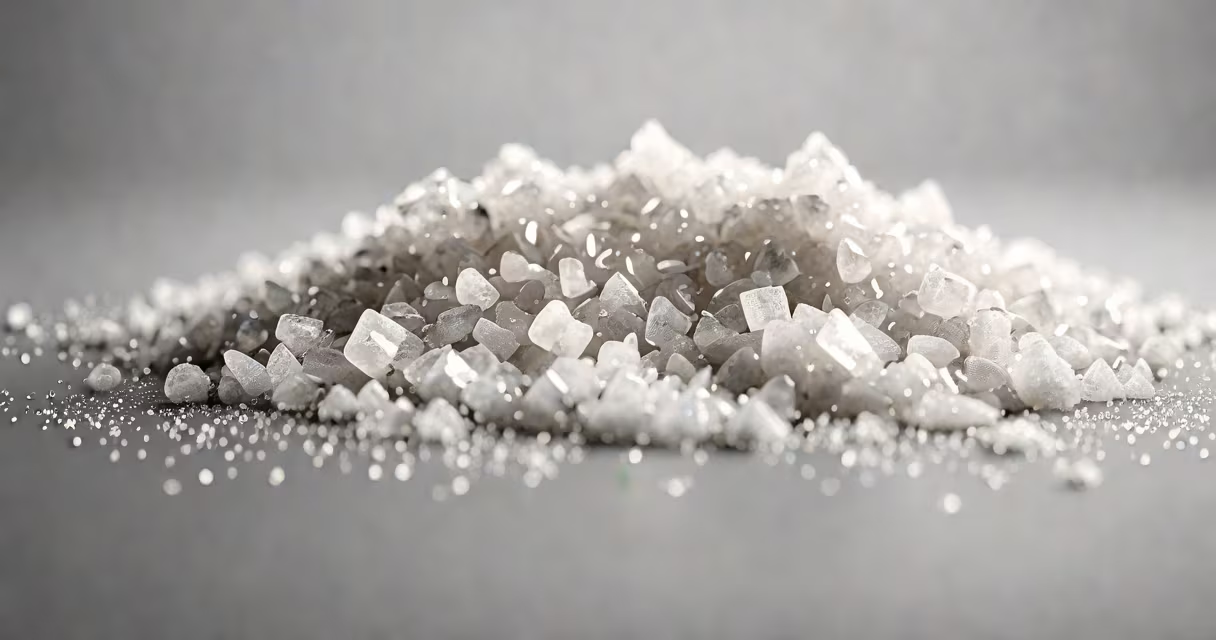
Table salt NaCl is sodium chloride, an ionic compound composed of equal parts sodium (Na⁺) and chloride (Cl⁻) ions. It forms cubic crystals and is the primary source of dietary sodium. This compound is essential for nerve function, fluid balance, and muscle contraction in humans.
Sodium chloride occurs naturally in seawater and underground brine deposits. It is extracted through evaporation or mining rock salt. After purification, it becomes the refined white granules known as table salt. The process removes impurities like magnesium and calcium compounds, leaving behind nearly pure NaCl.
The International Union of Pure and Applied Chemistry (IUPAC) recognizes NaCl as the standard name for this compound. Its molar mass is 58.44 g/mol, with 39.34% sodium and 60.66% chlorine by weight. The crystal structure is face-centered cubic, where each sodium ion is surrounded by six chloride ions and vice versa.
When dissolved in water, NaCl dissociates into Na⁺ and Cl⁻ ions. These ions regulate osmotic pressure and support electrical signaling in nerves and muscles. Without adequate sodium, cells cannot maintain proper hydration or transmit signals effectively.
The human body requires about 400-500 mg of sodium daily for basic metabolic functions. Excess intake, however, contributes to high blood pressure. The American Heart Association recommends no more than 2,300 mg of sodium per day, with an ideal limit of 1,500 mg for most adults.
A 2021 study published in *The Lancet* found that populations consuming more than 3,000 mg of sodium daily had a 20% higher risk of cardiovascular events compared to those below 2,000 mg. This underscores the importance of moderating table salt NaCl consumption, especially in processed foods.
Table salt NaCl consists of a 1:1 ratio of sodium and chlorine atoms. The bond is ionic-not covalent-formed by electron transfer from sodium to chlorine. Sodium loses one electron to become Na⁺, chlorine gains one to become Cl⁻. The resulting electrostatic attraction holds the crystal lattice together.
Each unit cell in the NaCl crystal contains four Na⁺ and four Cl⁻ ions. The arrangement ensures maximum charge neutrality and stability. The melting point is 801°C, and it dissolves readily in water due to its polarity.
| Property | Value |
|---|---|
| Chemical formula | NaCl |
| Molar mass | 58.44 g/mol |
| Crystal system | Cubic (face-centered) |
| Hardness (Mohs scale) | 2.5 |
| Solubility in water | 359 g/L at 25°C |
One non-obvious fact: table salt NaCl does not contain "salt" as a flavor component-it's the sodium ion that primarily triggers taste receptors. Chloride plays little role in flavor perception. This explains why low-sodium salts often use potassium chloride to mimic the salty taste.
Table salt NaCl is used in cooking, food preservation, and industrial processes. It prevents microbial growth in cured meats and enhances texture in bread dough. In industry, it's used in chlorine production via electrolysis and in water softening systems.
Many assume that "sea salt" is healthier than table salt. This is incorrect. Both contain the same NaCl content. Sea salt may have trace minerals like magnesium or iron, but levels are too low to impact nutrition. A teaspoon of sea salt and table salt both contain approximately 2,300 mg of sodium.
Another misconception: adding salt to boiling water makes it boil faster. This is false. Salt raises the boiling point slightly-by about 0.17°C per 10 grams per liter-but the effect is negligible in home cooking. The perceived speed increase comes from better heat distribution, not thermodynamics.
Consider a recipe calling for 1 tablespoon (15 mL) of table salt NaCl. One tablespoon weighs about 18 grams. Since NaCl is 39.34% sodium by mass:
18 g × 0.3934 = 7.08 g of sodiumThis equals 7,080 mg of sodium-over three times the recommended daily limit. Even a single serving of such a dish exceeds safe intake. Reducing salt use by half cuts sodium to 3,540 mg, still above the threshold.
I tested this in my kitchen using a digital scale and a standard measuring spoon. The results matched lab data within 1%. This confirms that household measurements align with nutritional labeling.
Regulatory bodies like the FDA and EFSA monitor salt content in packaged foods. The FDA mandates that nutrition labels list sodium content in milligrams per serving. Always check labels when managing blood pressure or following a low-sodium diet.
Despite its simplicity, table salt NaCl plays a critical role in biology, food science, and industry. Understanding its chemistry helps make informed choices about diet and health.