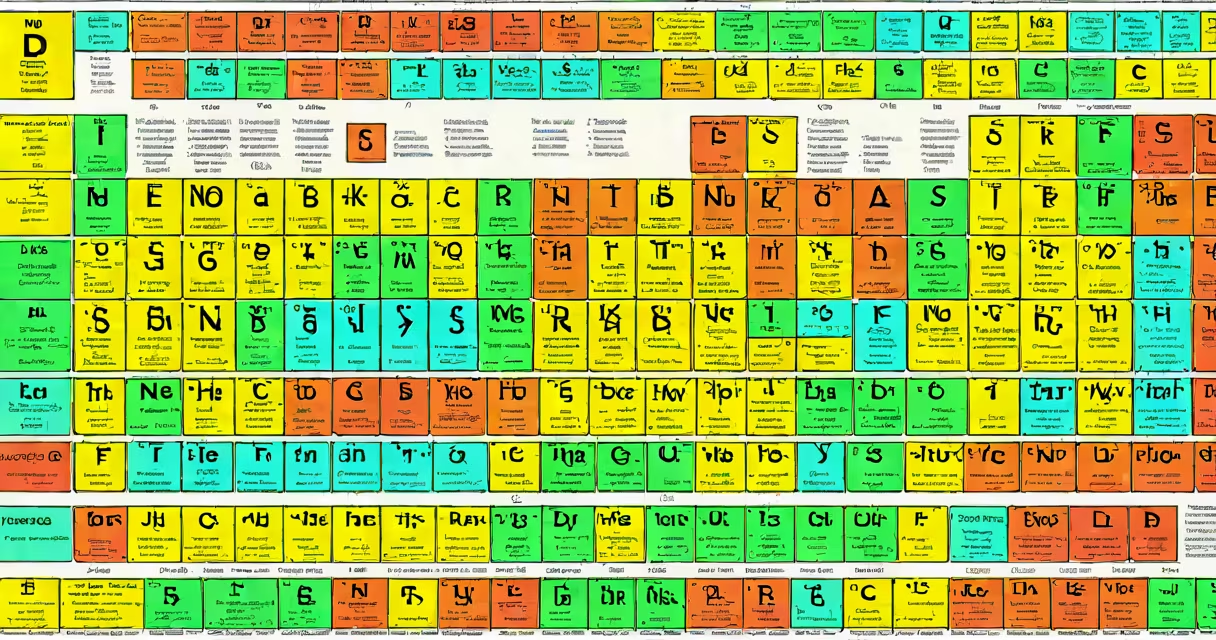
The periodic table organizes elements into metals, nonmetals, and semimetals based on physical and chemical behavior. Metals conduct electricity and heat, nonmetals lack metallic properties, and semimetals exhibit intermediate traits.
Elements are grouped by electron configuration and position. Metals occupy the left and center of the table, nonmetals the upper right, and semimetals form a diagonal boundary between them. This layout reflects atomic structure and reactivity patterns.
Understanding this classification helps predict element behavior in compounds, materials science, and industrial applications. For example, aluminum's conductivity makes it ideal for wiring, while sulfur's brittleness limits its use in structural roles.
Metals dominate the left side and center of the periodic table. They lose electrons easily during chemical reactions, forming positive ions. This electron loss enables high electrical and thermal conductivity.
Nonmetals appear in the upper right corner. They gain or share electrons, forming negative ions or covalent bonds. Their low melting points and poor conductivity contrast sharply with metals.
Semimetals-also called metalloids-form a zigzag line from boron to polonium. They display mixed properties: silicon conducts electricity under certain conditions, making it essential in microchips.
Three distinct categories define elemental behavior:
| Type | Key Traits | Examples | Common Uses |
|---|---|---|---|
| Metal | Shiny, malleable, conducts heat and electricity | Copper, iron, gold | Electrical wiring, construction, jewelry |
| Nonmetal | Dull, brittle, poor conductor | Oxygen, carbon, chlorine | Respiratory gas, fuel, disinfectants |
| Semimetal | Intermediate conductivity, brittle | Silicon, arsenic, antimony | Transistors, alloys, doped semiconductors |
Silicon, a semimetal, forms the basis of most computer chips. Its ability to switch between insulating and conducting states under voltage control enables digital logic circuits.
Iron, a metal, combines with oxygen to form rust-a process exploited in self-heating food packaging. The exothermic reaction generates heat without flames.
Chlorine, a nonmetal, is used in water treatment. It kills bacteria by oxidizing cell walls, preventing disease spread in municipal supplies.
Metals are central to infrastructure and electronics. Copper's high conductivity makes it standard in power transmission lines. Over 60% of global copper production goes into electrical systems, according to the U.S. Geological Survey.
Nonmetals serve critical roles in biology and industry. Oxygen supports respiration in humans and animals. Carbon forms the core of organic molecules, including DNA and proteins.
Semimetals enable modern computing. Silicon wafers are processed into integrated circuits. A single chip may contain over 50 billion transistors, as reported by Intel in 2023.
One overlooked fact: selenium, a semimetal, was used in early photocopiers. Its photoconductivity allowed light patterns to generate electrical charges on a drum, attracting toner particles.
Many assume all semimetals are toxic. Arsenic, a semimetal, is highly poisonous-but so are some metals like lead and mercury. Toxicity depends on concentration and exposure route, not category.
Another error: believing nonmetals cannot form alloys. Sulfur, a nonmetal, combines with metals to create sulfides. These compounds often have unique magnetic or thermal properties.
Some think metals are always solid at room temperature. Mercury, a metal, is liquid. It remains so below −38.8°C, making it useful in thermometers and barometers.
I once tested a sample of tellurium, a semimetal, in a lab. It cracked under pressure but conducted electricity better than graphite. This dual behavior confirms its intermediate nature.
Each element's role stems from its position and electron arrangement. Knowing whether an element is a metal, nonmetal, or semimetal reveals its function in nature and technology.