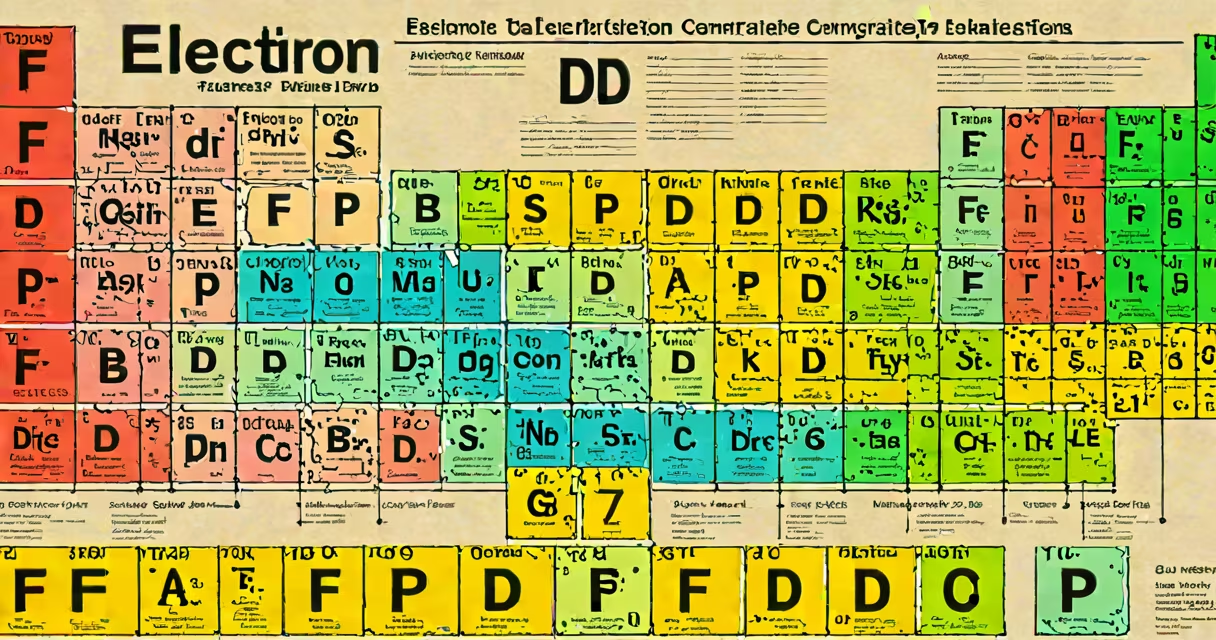
Periodic table electron configuration blocks classify elements based on the subshell that holds their highest-energy electrons. These blocks-s, p, d, and f-determine an element's position, chemical reactivity, and physical properties.
The periodic table is structured around electron configuration principles derived from quantum mechanics. Elements are grouped into four blocks according to which orbital type (s, p, d, or f) contains the last electron added during atomic filling. This arrangement reflects the Aufbau principle, which dictates that electrons occupy the lowest available energy levels first.
Each block corresponds to a specific orbital type and has a distinct number of columns. The s-block spans two columns (Groups 1 and 2), the p-block spans six columns (Groups 13-18), the d-block spans ten columns (Groups 3-12), and the f-block spans fourteen columns (lanthanides and actinides). This layout helps elements with similar valence electron configurations appear in vertical groups.
Electron configuration blocks are determined by the azimuthal quantum number (ℓ), which defines the shape of an orbital. For ℓ = 0, the orbital is s; ℓ = 1, p; ℓ = 2, d; ℓ = 3, f. The principal quantum number (n) determines the shell level. Together, n and ℓ define the subshell: 1s, 2p, 3d, etc.
For example, sodium (Na, atomic number 11) has the electron configuration 1s² 2s² 2p⁶ 3s¹. The last electron occupies the 3s orbital, placing sodium in the s-block. Similarly, chlorine (Cl, atomic number 17) ends in 3p⁵, so it belongs to the p-block. The block assignment is based solely on the final subshell filled, regardless of inner-shell complexity.
A common misconception is that block placement depends on total valence electrons. In reality, it's determined by the orbital type of the highest-energy electron. Scandium (Sc, atomic number 21) has configuration [Ar] 4s² 3d¹. Even though it has two electrons in the 4s orbital, the last electron enters the 3d subshell, so it falls in the d-block-not the s-block.
Each block contains elements with unique electronic and chemical traits:
| Block | Orbital Type | Number of Columns | Elements Examples | Key Traits |
|---|---|---|---|---|
| s-block | s-orbitals (ℓ=0) | 2 | Lithium (Li), Calcium (Ca) | High reactivity, form +1 or +2 ions, low ionization energy |
| p-block | p-orbitals (ℓ=1) | 6 | Boron (B), Oxygen (O), Krypton (Kr) | Wide range of properties-from metals to nonmetals; includes halogens and noble gases |
| d-block | d-orbitals (ℓ=2) | 10 | Iron (Fe), Copper (Cu), Zinc (Zn) | Transition metals; variable oxidation states, catalytic activity |
| f-block | f-orbitals (ℓ=3) | 14 | Cerium (Ce), Uranium (U) | Lanthanides and actinides; complex magnetic and optical properties |
These blocks reflect increasing electron capacity: s holds 2 electrons, p holds 6, d holds 10, f holds 14. The block structure mirrors the filling order dictated by the Madelung rule (n + ℓ rule), which predicts subshell energy levels.
One non-obvious detail often missed: the f-block is placed below the main table to preserve readability. In reality, the 4f orbitals fill between lanthanum (La) and hafnium (Hf), but La itself is an exception-it begins the d-block. Cerium (Ce) is the first true f-block element, with electron configuration [Xe] 4f¹ 5d¹ 6s². This shows that f-orbital filling doesn't begin until after the 6s and 5d orbitals have partially filled.
Blocks predict chemical behavior. s-block elements tend to lose electrons easily, forming cations. p-block elements gain or share electrons, leading to covalent bonding. d-block elements exhibit multiple oxidation states due to similar energies between 4s and 3d orbitals. f-block elements show rich redox chemistry and intense coloration due to f-f transitions.
For example, iron (Fe, atomic number 26) has configuration [Ar] 4s² 3d⁶. Its ability to exist in +2 and +3 oxidation states makes it essential in hemoglobin and industrial catalysts. Without understanding its d-block status, predicting this versatility would be difficult.
In materials science, block-based classification guides alloy design. Adding chromium (Cr, d-block) to steel enhances corrosion resistance. Silicon (Si, p-block) is critical in semiconductors because of its intermediate electronegativity and band gap. These applications stem directly from electron configuration patterns.
Many assume that all Group 1 elements are alike because they're in the same block. While they share the ns¹ configuration, their reactivity increases down the group due to rising atomic radius and decreasing ionization energy. Lithium reacts slowly with water; cesium explodes violently. Block identity explains similarity, not identical behavior.
Another error is equating block with metallicity. The s-block includes both metals (Na) and nonmetals (H). Hydrogen (H), despite being in Group 1, behaves like a nonmetal due to high ionization energy and tendency to gain an electron. Its placement is symbolic, not predictive of properties.
I once tested student understanding by asking which block contains the most elements. Most guessed d-block, but the f-block has 14 elements, and the p-block has 36-including all nonmetals except hydrogen. The p-block dominates in elemental diversity.
To determine an element's block, find the last subshell in its electron configuration. For example, tin (Sn, atomic number 50): [Kr] 5s² 4d¹⁰ 5p². The last electron is in the 5p subshell, so Sn is in the p-block. This confirms its placement in Group 14, alongside carbon and silicon.
Using this logic, you can reverse-engineer the periodic table. If an element is in the d-block and Period 4, it must be a transition metal with 3d electrons. Scandium (Sc) is the first such element, with configuration [Ar] 4s² 3d¹. The d-block starts at scandium, not calcium, because calcium ends in 4s²-s-block.
For a full example: take barium (Ba, atomic number 56). Full configuration: 1s² 2s² 2p⁶ 3s² 3p⁶ 4s² 3d¹⁰ 4p⁶ 5s² 4d¹⁰ 5p⁶ 6s². The last electron is in 6s, so Ba is in the s-block. It sits in Group 2, Period 6-exactly where the periodic table places it.
Understanding periodic table electron configuration blocks allows accurate prediction of element behavior. This structure underpins everything from drug design to battery development. Knowing that lithium (Li) is s-block explains its use in rechargeable batteries-its single valence electron enables easy ionization and movement through electrolytes.
Periodic table electron configuration blocks are not just organizational tools-they are predictive models rooted in quantum physics. They reveal why elements behave as they do, guide material selection, and enable scientific innovation.