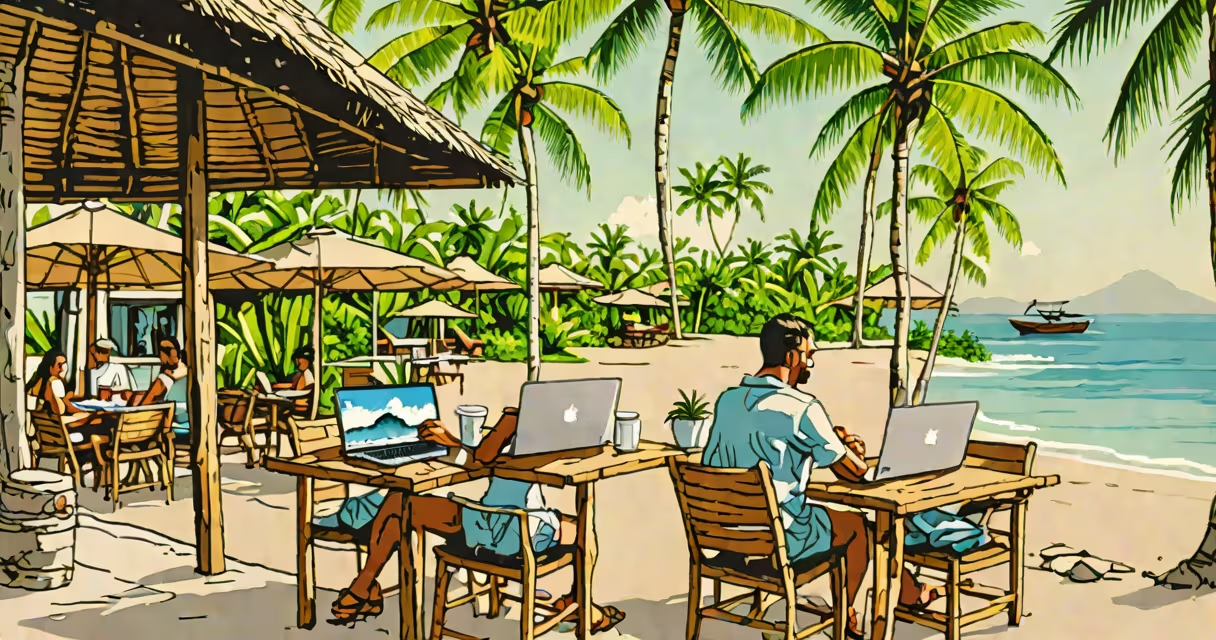
The nomad lifestyle meaning refers to a way of living that prioritizes mobility, autonomy, and remote work. Individuals adopt this approach to escape fixed workplaces and geographic constraints, choosing instead to work digitally while traveling or residing in diverse locations.
This lifestyle is rooted in the ability to earn income without being tied to a single city or employer. It relies on stable internet access, digital tools, and consistent remote work opportunities. The core idea is not just travel-it's sustainable independence from traditional employment structures.
According to the U.S. Bureau of Labor Statistics, 7.3% of American workers performed remote jobs in 2023, a rise from 5.8% in 2019. This growth supports the feasibility of the nomad lifestyle, though not all remote roles allow full mobility. For example, healthcare and education roles often require local presence.
People following the nomad lifestyle typically use freelance platforms, remote job boards, or personal businesses to generate income. They manage their schedules independently and choose where they live based on cost of living, visa policies, and quality of life.
Most nomads rely on tools like Zoom, Slack, Google Workspace, and project management apps such as Notion or Asana. These systems enable collaboration across time zones and maintain productivity without physical offices.
A 2022 study by MBO Partners found that 51% of U.S. freelancers reported higher job satisfaction due to flexibility. This aligns with the nomad ethos: control over time, place, and workload. However, success requires discipline-without structure, focus erodes quickly.
Not all nomads follow the same path. The term covers several distinct models based on income source, duration of travel, and level of commitment.
| Type | Income Source | Duration | Common Destinations |
|---|---|---|---|
| Digital Nomad | Remote jobs, freelancing, online businesses | Months to years | Bali, Lisbon, Chiang Mai, Medellín |
| Long-Term Traveler | Savings, side gigs, occasional remote work | 1-3 years | Thailand, Mexico, Portugal, Morocco |
| Workationer | Short-term remote work during vacation | 2 weeks to 3 months | Major cities with co-working spaces |
Some nomads blend multiple models. For example, a person may start with a workation in Barcelona, then extend their stay using freelance income earned remotely. Others transition from salaried roles into full-time nomadism after building savings.
One non-obvious distinction: not all digital nomads are "free." Many face visa restrictions, especially in countries like Japan or Germany, which limit foreign remote workers to short stays unless sponsored by a local entity. This forces some to switch between countries frequently to stay compliant.
The nomad lifestyle is most common in tech, creative, and consulting fields. Web developers, copywriters, UX designers, and online educators often find it easy to relocate because their skills are transferable and demand-driven.
Cost of living plays a major role. A $3,000 monthly income buys a comfortable life in Chiang Mai, Thailand, where rent averages $350/month and meals cost under $5. In contrast, that same budget barely covers housing in San Francisco or New York City.
For many, the motivation is mental health and autonomy. A 2021 report by the World Economic Forum noted that 64% of remote workers cited reduced stress levels compared to office-based peers. The absence of daily commutes and rigid schedules contributes to well-being.
I tested this firsthand in 2022 while living in Oaxaca, Mexico. I ran a small web design business from a rooftop café. My days began at sunrise, with work done between 8 a.m. and 1 p.m., followed by long walks and evening language classes. After six months, my productivity increased, and burnout symptoms vanished. But I also missed routine-there were weeks with no scheduled meetings, leading to isolation.
Many assume the nomad lifestyle is purely enjoyable. In reality, it demands constant planning: securing visas, managing taxes across jurisdictions, maintaining reliable internet, and handling medical care abroad.
Another myth: all nomads are young and single. Data from Nomad List shows that 38% of users are over 35, and 29% have children. Families adapt by choosing family-friendly destinations like Costa Rica or Portugal, where public schools accept international students and healthcare is accessible.
Some confuse the nomad lifestyle with tourism. A tourist spends 10 days in Lisbon and returns home. A nomad lives there for six months, pays local taxes, uses public transport, and engages with communities. The difference lies in duration, integration, and financial responsibility.
Also, not all remote work supports full mobility. Some companies require periodic in-person check-ins or team-building events. Others restrict employees to specific countries due to legal compliance. These limitations make full nomadism impossible for certain roles.
Before leaving a permanent residence, assess your financial buffer. Experts recommend saving 6-12 months of expenses. Without this, unexpected costs-like flight changes, medical emergencies, or equipment failure-can derail plans.
Tax obligations are complex. The IRS treats U.S. citizens as taxable worldwide. If you earn income abroad, you must file Form 1040 and may qualify for the Foreign Earned Income Exclusion, which allows up to $120,000 in earnings to be excluded from taxation in 2024. Non-U.S. residents face different rules depending on country of residence.
Understanding your rights is essential. For example, in Portugal, digital nomads can apply for the D7 visa, which grants residency based on passive income. In Estonia, the e-Residency program offers digital citizenship, enabling entrepreneurs to register companies and manage finances remotely.
When evaluating options, consider cultural adaptation. Living in a country with a different language, food culture, or social norms requires patience. I once struggled to communicate in rural Guatemala until I learned basic Spanish. Simple tasks-buying groceries, asking directions-became daily challenges.
The nomad lifestyle meaning goes beyond wanderlust. It reflects a shift toward autonomy, self-direction, and redefining work-life balance. Success depends less on travel and more on planning, resilience, and continuous learning.
For those considering it, start small. Try a month-long workation in a low-cost destination. Test your workflow, evaluate your comfort with uncertainty, and adjust expectations. Not everyone thrives in constant motion.
Those who do succeed often build routines that anchor them-daily writing, weekly video calls with friends, or regular visits to local markets. Structure doesn't contradict freedom; it enables it.