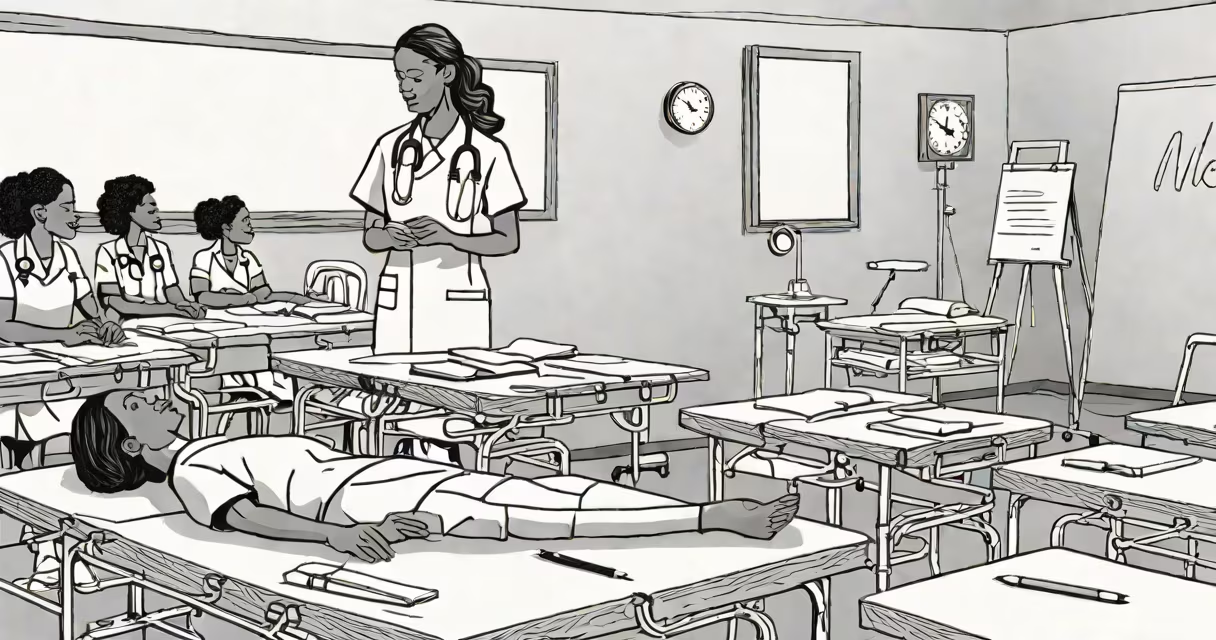
Nursing educators prepare future nurses through instruction in academic settings and clinical environments. They hold advanced degrees, often a Doctor of Nursing Practice (DNP) or PhD, and must meet state-specific licensing and certification standards. Their work includes curriculum development, student assessment, and leading simulation-based training.
Nurse educators teach in colleges, universities, and vocational programs. They design lesson plans, supervise clinical rotations, and evaluate student performance. Many also conduct research on teaching methods and patient outcomes. A typical role requires at least five years of clinical nursing experience before entering education.
The U.S. Bureau of Labor Statistics reports that employment for postsecondary nursing instructors is projected to grow 16% from 2021 to 2031-faster than average. This growth reflects a national shortage of registered nurses and increased demand for qualified educators to train them.
Nurse educators blend clinical expertise with pedagogical skill. They deliver lectures, lead lab sessions, and mentor students during field placements. In simulation labs, they use high-fidelity mannequins to replicate emergency scenarios, allowing students to practice decision-making under pressure.
For example, a nurse educator at a community college may teach a course on maternal-newborn care. They develop weekly modules covering prenatal screening, labor management, and postpartum complications. Students complete 120 hours of clinical time in local hospitals, supervised by the educator who evaluates their performance using standardized rubrics.
These professionals also assess learning outcomes. They analyze test scores, clinical evaluations, and student feedback to refine course content. Some contribute to accreditation processes, ensuring programs meet standards set by the Commission on Collegiate Nursing Education (CCNE).
Most institutions require a master's degree in nursing (MSN) for entry-level teaching positions. For tenure-track or leadership roles, a DNP or PhD in nursing is typically required. The National League for Nursing (NLN) notes that 78% of nursing faculty hold at least a master's degree, and 42% have a doctorate.
Certification through the National League for Nursing (NLN) enhances credibility. The Certified Nurse Educator (CNE) credential requires:
Obtaining CNE status signals expertise in educational theory and practice. According to the NLN, CNE-certified educators report higher job satisfaction and greater influence in program development.
| Requirement | Entry-Level Position | Advanced/Leadership Role |
|---|---|---|
| Education | MSN | DNP or PhD |
| Teaching Experience | 1-2 years | 5+ years |
| Certification | Optional | Required (CNE) |
| Research Output | None expected | Published work required |
Many assume that becoming a nurse educator means leaving clinical practice entirely. That is incorrect. Most nurse educators maintain clinical privileges and participate in hospital-based projects. For example, a professor at a university-affiliated medical center may spend 20% of their time in the ICU, providing direct patient care while supervising students.
Another misunderstanding is that all nurse educators teach in classrooms. In reality, many work in simulation centers or online platforms. During the pandemic, 62% of nursing programs shifted to hybrid models, requiring educators to adapt lecture delivery and virtual assessments.
It's also false that nurse educators don't need ongoing professional development. The NLN mandates 10 hours of continuing education annually for CNE recertification. Topics include trauma-informed teaching, cultural competence, and emerging technologies in health education.
Consider Dr. Elena Torres, a nurse educator at a public university in Texas. She holds a DNP and is CNE-certified. Her week includes:
She also serves as a mentor for new faculty members. Her dual role-teaching and advising-reflects the multifaceted nature of the profession.
I observed a nurse educator-led simulation session at a Midwest university. The instructor paused mid-scenario to ask students, "What's the priority action now?" After a pause, a student responded correctly. The educator didn't correct them immediately. Instead, she asked, "Why did you choose that?" This method builds critical thinking, not just memorization. It's a deliberate shift from traditional lecture-based teaching.
Once you meet eligibility criteria, take the CNE exam. The NLN provides study guides and sample questions. After certification, seek positions at accredited nursing schools. Consider joining the National League for Nursing for access to webinars, journals, and networking events.
Understanding how to become a nurse educator involves more than academic credentials. It demands commitment to lifelong learning, adaptability in teaching formats, and a passion for shaping the next generation of healthcare providers. With structured preparation and targeted experience, individuals can transition successfully into this important role.