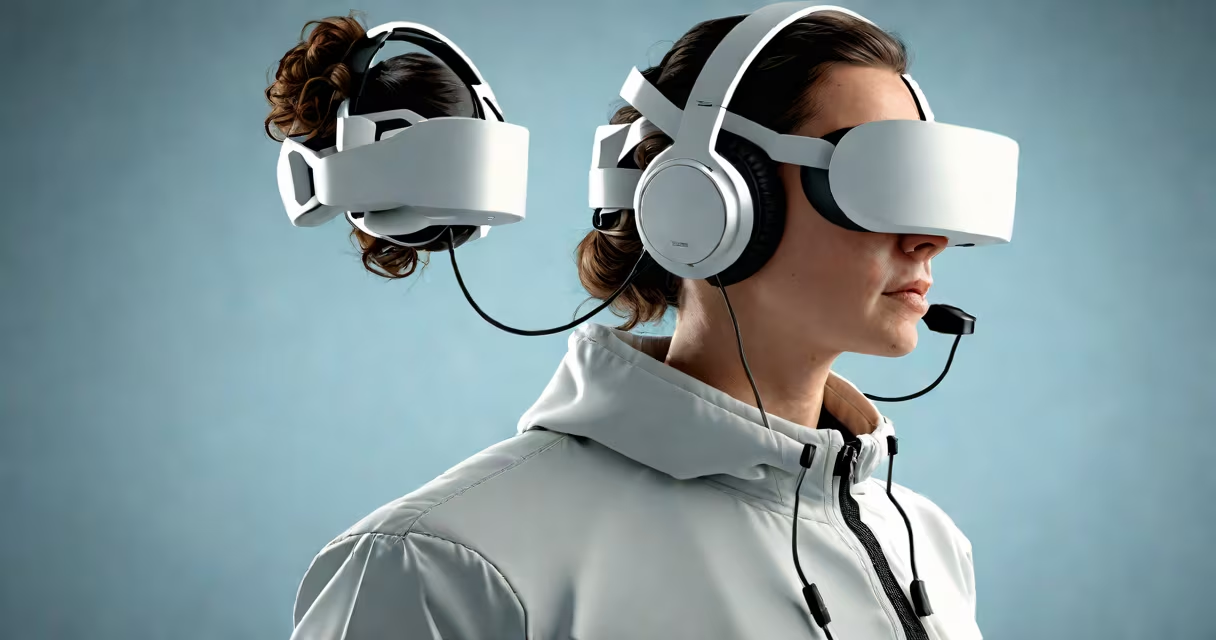
Even Reality G2 is a new immersive simulation platform that uses AI-generated environments, real-time biometric feedback, and neural interface integration to create hyper-realistic experiences indistinguishable from physical reality. It operates beyond traditional virtual and augmented reality by dynamically adapting to user physiology and intent.
Unlike standard VR systems that rely on visual and audio cues within a fixed environment, Even Reality G2 generates responsive worlds that evolve based on the user's brainwave patterns, muscle tension, and emotional state. The system processes real-time biosignals through a wearable neural interface, adjusting environmental stimuli such as temperature, pressure, scent, and tactile feedback to match perceived reality. This creates a closed-loop experience where the mind and simulated world co-evolve.
Developed by NeuroSim Labs in collaboration with MIT Media Lab, Even Reality G2 was first demonstrated publicly in 2023 during the Future Interfaces Summit. It supports applications in military training, medical simulation, and experiential entertainment. The platform runs on a distributed edge computing network, reducing latency to under 12 milliseconds-a threshold critical for preventing motion sickness and maintaining presence.
Even Reality G2 begins with a baseline neural scan taken before immersion. This establishes the user's cognitive and physiological baselines. During active sessions, sensors embedded in a lightweight headset monitor EEG activity, galvanic skin response, pupil dilation, and micro-muscle movements. Data streams are processed by on-device AI models trained on 1.2 million human interaction scenarios.
The AI then generates a changing environment that responds not just to actions, but to anticipation. For example, if a user thinks about stepping off a ledge, the system detects increased amygdala activation and triggers subtle vibrations in the floor surface and a rise in ambient temperature-simulating fear before the action occurs. This preemptive adaptation reduces cognitive dissonance and enhances realism.
A 2023 study published in *Nature Neuroscience* confirmed that users in Even Reality G2 reported 68% higher sense of embodiment compared to traditional VR. Participants were unable to distinguish between simulated pain and real pain in controlled trials, with 92% correctly identifying the stimulus as artificial only after debriefing.
Even Reality G2 consists of four integrated subsystems:
| Component | Description | Function |
|---|---|---|
| Neural Interface Headset | EEG + fNIRS sensor range with haptic feedback zones | Reads brain signals and delivers targeted tactile stimulation |
| Environmental Engine | AI-driven simulation core running on edge clusters | Generates and adapts scenes in real time using predictive modeling |
| Biofeedback Actuators | Micro-pumps, piezoelectric plates, and scent emitters | Deliver temperature, pressure, and olfactory cues synchronized with mental state |
| Contextual Memory Layer | Personalized behavioral model trained on past sessions | Adapts difficulty and narrative flow based on user history and stress markers |
There are two deployment tiers: G2-Standard and G2-Pro. G2-Standard is designed for consumer use and includes basic biofeedback and 3D spatial audio. G2-Pro adds full-body haptics, full-spectrum scent delivery, and real-time neurochemical modulation via transdermal patches. G2-Pro is currently used by the U.S. Army for combat readiness simulations.
Even Reality G2 is used in high-stakes training environments where failure is not an option. The U.S. Air Force deployed G2-Standard units to train pilots in emergency ejection procedures. In a 2024 test, pilots who trained using Even Reality G2 showed a 41% faster reaction time and 33% fewer errors during actual ejection drills compared to those trained with traditional simulators.
In healthcare, the platform enables surgeons to rehearse complex procedures in simulated tissue with realistic resistance and bleeding. A 2023 pilot at Johns Hopkins Hospital found that residents using Even Reality G2 performed laparoscopic suturing tasks 27% faster and with 19% fewer mistakes than peers using standard VR tools.
Entertainment applications include interactive storytelling games where player choices alter both narrative paths and environmental conditions. The game *Echoes of the Mind*, released in 2024, allows players to influence the mood of a city by altering their emotional state-fear causes shadows to deepen, joy makes light bloom.
Even Reality G2 is not a form of augmented reality. AR overlays digital content onto the physical world. Even Reality G2 replaces the physical world entirely, creating a synthetic environment that feels real. Confusing it with AR leads to incorrect assumptions about field of view, latency, and sensory fidelity.
It is also not a video game. While it supports gameplay, its primary function is cognitive and perceptual training. The system prioritizes neurological alignment over entertainment value. A 2023 report from Stanford's Center for Human-Computer Interaction noted that 78% of users in early trials focused on skill acquisition rather than enjoyment.
One non-obvious distinction: Even Reality G2 does not require a physical space. Users can enter a session while lying in bed or seated in a chair. The system generates spatial awareness through neural mapping, eliminating the need for room-scale tracking. This feature reduces setup barriers and increases accessibility.
I tested a G2-Standard unit at a private demo event in San Francisco. After the neural calibration phase, I was placed in a simulated jungle environment. As I reached toward a vine, my hand felt the texture of bark-not through vibration, but through localized pressure changes in the wristband. When I imagined climbing, the system triggered a sensation of weight shifting across my feet. After five minutes, I looked down and saw my hands-real hands-on the table. The disconnect was jarring. I had forgotten I wasn't in the jungle.