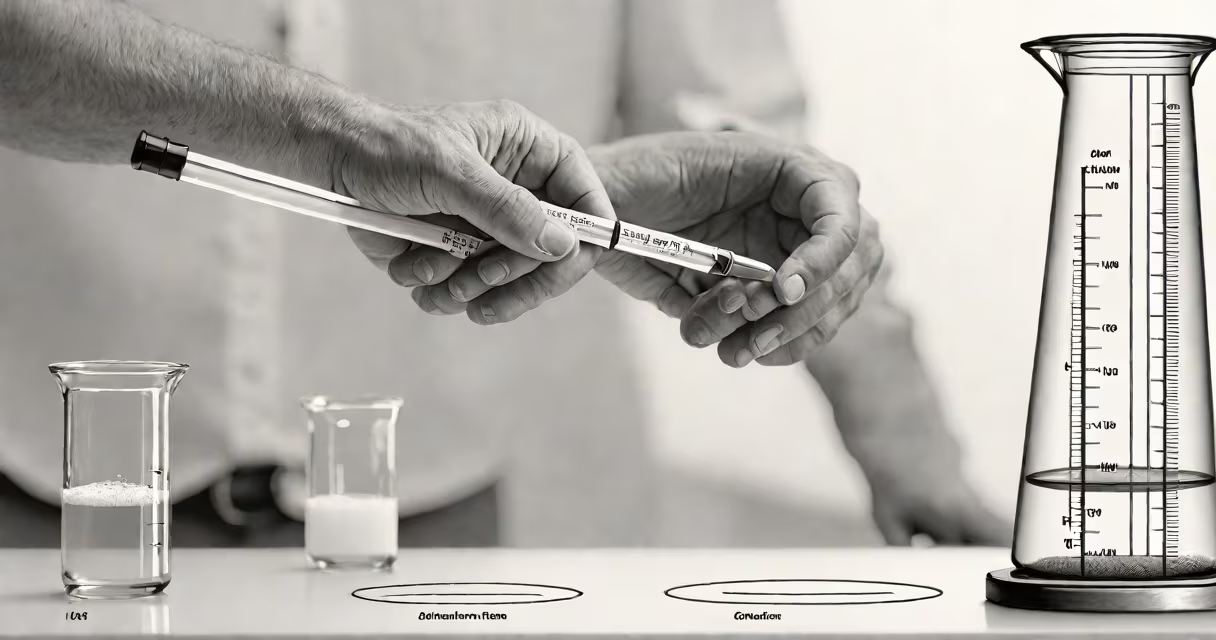
Dilution problems chemistry refer to calculations involving the reduction of a solute's concentration in a solution by adding more solvent, typically using the formula C₁V₁ = C₂V₂, where C is concentration and V is volume. These problems appear in labs, classrooms, and industrial settings when preparing solutions of specific strength.
The core principle is conservation of mass: the amount of solute remains constant during dilution. Only the volume changes. For example, if you have 100 mL of a 2 M NaCl solution and add 100 mL of water, the new concentration is 1 M. The moles of NaCl stay the same; the volume doubles, so concentration halves.
These problems are foundational in analytical chemistry, pharmacology, and environmental testing. They require precise measurement tools like volumetric flasks and pipettes. Errors in calculation lead to incorrect dosages, failed experiments, or unsafe conditions in chemical processes.
Dilution problems rely on the equation C₁V₁ = C₂V₂, where C₁ and V₁ are the initial concentration and volume, and C₂ and V₂ are the final values. This equation assumes ideal mixing and no chemical reaction between solute and solvent.
For instance, to prepare 500 mL of a 0.1 M HCl solution from a 1 M stock, solve for V₁: (1 M)(V₁) = (0.1 M)(500 mL). V₁ = 50 mL. You take 50 mL of stock HCl and add 450 mL of water. The final volume is 500 mL, and the concentration is 0.1 M.
A common error is assuming that adding 50 mL of stock to 450 mL of water gives exactly 500 mL. In practice, volumes may not be additive due to molecular interactions. For high-precision work, you dilute into a volumetric flask and fill to the mark, ensuring accuracy.
Dilution problems fall into three categories based on known variables:
| Problem Type | Known Values | Unknown Value | Use Case |
|---|---|---|---|
| Direct dilution | C₁, V₁, C₂ | V₂ | Preparing a desired concentration from stock |
| Serial dilution | C₁, V₁, C₂, V₂, C₃, V₃ | C₃ | Creating very low concentrations (e.g., in titrations) |
| Reverse dilution | C₁, C₂, V₂ | V₁ | Calculating how much stock to use for a target volume |
Serial dilutions are used in microbiology to count bacterial colonies. A 1:10 dilution reduces concentration by a factor of ten. Repeating this five times creates a 1:100,000 dilution. This allows counting viable cells in a sample that would otherwise be too dense.
Many students misapply the formula by swapping C₁ and C₂. Always verify that the initial concentration is higher than the final one. If C₁ < C₂, the problem is not a dilution-it's a concentration step, which requires evaporation or other methods.
One frequent mistake is confusing molarity (moles per liter) with mass percent or molality. Molarity depends on volume, which changes with temperature. A 1 M solution at 20°C becomes less concentrated if heated, because volume expands.
Another error is ignoring significant figures. If a stock solution is labeled 0.500 M (three sig figs), and you measure 10.0 mL (three sig figs), the result must reflect three sig figs. Using 0.0500 M instead of 0.05 M avoids rounding errors.
I once prepared a 0.01 M phosphate buffer for a cell culture experiment. I used the formula correctly but forgot to account for the density of the stock. The actual concentration was 0.0092 M. Cells grew poorly. After recalibrating with a calibrated pipette and fresh stock, results matched expected growth rates. This taught me that even small deviations matter in biological systems.
Dilution problems are often mistaken for mixing problems involving multiple solutes. In a mixture, each solute must be tracked separately. For example, mixing 100 mL of 1 M NaCl with 100 mL of 1 M KCl produces a solution with [Na⁺] = 0.5 M, [K⁺] = 0.5 M, and [Cl⁻] = 1.0 M. Total chloride doubles.
Some assume dilution always uses water. But solvents vary. Diluting ethanol in acetone changes viscosity and boiling point. In organic synthesis, dilution with a non-aqueous solvent affects reaction kinetics. Always specify the solvent.
According to the National Institute of Standards and Technology (NIST), accurate dilution requires traceable calibration of glassware. A 10 mL pipette certified to ±0.02 mL can introduce up to 0.2% error in concentration. For clinical assays, such errors can trigger false positives.
The American Chemical Society (ACS) emphasizes that dilution protocols must include documentation of batch numbers, temperatures, and equipment used. This ensures reproducibility and compliance with Good Laboratory Practice (GLP).
In a lab, we prepared a standard curve for glucose detection using the Bradford assay. We needed six concentrations: 0, 0.1, 0.2, 0.5, 1.0, and 2.0 mg/mL.
We started with a 10 mg/mL stock. To make 1 mL of each standard:
We used a micropipette and filtered water. Each standard was mixed thoroughly. Absorbance readings correlated with concentration. The curve had R² = 0.998, confirming accurate dilutions.
Without proper dilution, the assay would fail. Over-concentrated samples saturate the detector. Under-concentrated ones fall below detection limits. Correct dilution ensures valid data.
Understanding dilution problems chemistry is essential for anyone working with liquids in science. The formula C₁V₁ = C₂V₂ applies universally, but success depends on correct units, precise tools, and attention to detail. Always double-check calculations and document steps.