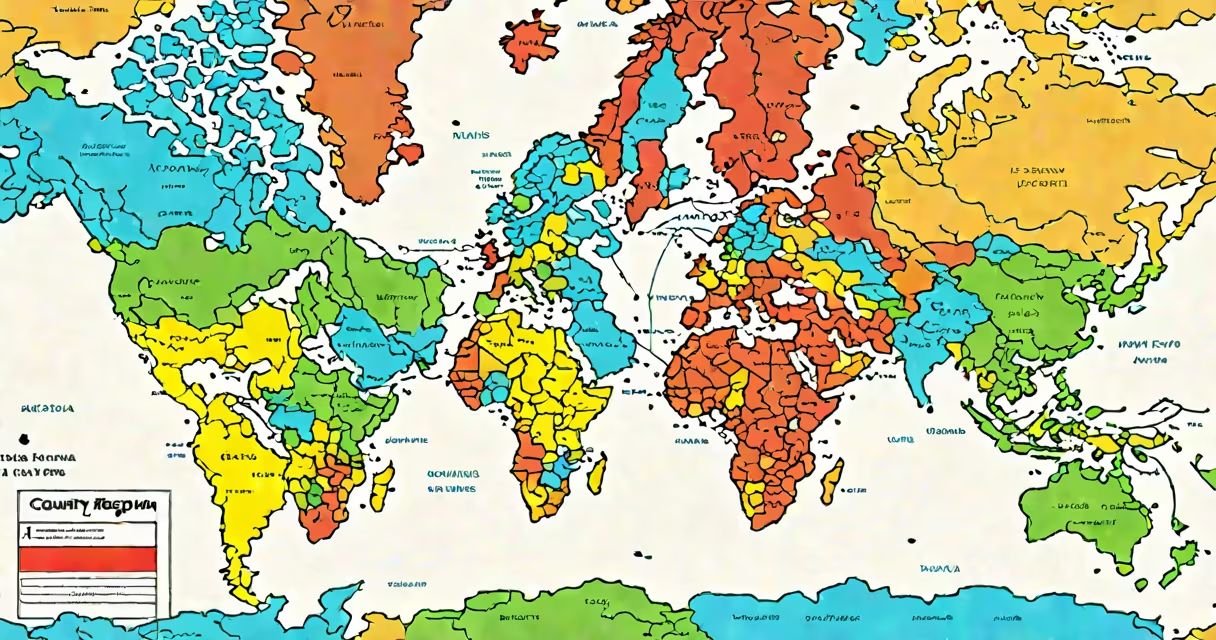
A country and region is a geopolitical unit that represents a sovereign state or a defined administrative subdivision within a larger national structure. Countries are independent nations with recognized borders, governments, and international standing. Regions are subnational divisions such as states, provinces, or territories, often governed under a central national authority.
Each country and region has a unique identifier used in databases, software, and international systems. These identifiers follow standards set by the International Organization for Standardization (ISO), including ISO 3166-1 alpha-2 codes (e.g., US for United States, DE for Germany) and ISO 3166-2 for subnational divisions (e.g., US-CA for California).
Understanding country and region distinctions prevents errors in shipping, compliance, and data filtering. For example, selecting "Germany" as a country ensures accurate tax calculations in e-commerce. Choosing "Bavaria" as a region within Germany adds precision for local delivery logistics.
Global systems rely on standardized country and region codes to route data, process transactions, and manage access. The ISO 3166 standard provides official designations for all recognized countries and their primary subdivisions. These codes appear in web forms, databases, and APIs.
When a user selects a country during checkout, the system validates the choice against ISO 3166-1. If the selection is invalid, the form rejects it. This prevents typos like "Frane" instead of "France." Subnational regions are validated using ISO 3166-2, which assigns codes like FR-75 for Paris in France.
Major platforms such as Google Maps, Stripe, and Amazon use these standards internally. A search for "Hamburg" returns results tied to Germany's federal structure. Hamburg is both a city and a state (Bundesland) in Germany-a rare dual status among urban centers.
There are two primary categories: sovereign countries and administrative regions. Sovereign countries have full independence and participate in international organizations like the United Nations. Administrative regions exist within countries and lack full sovereignty.
| Type | Definition | Examples | Source |
|---|---|---|---|
| Sovereign Country | Independent nation with recognized government and borders | Japan, Brazil, New Zealand | UN Member States |
| Subnational Region | Administrative division within a country | California (US), Bavaria (DE), Quebec (CA) | ISO 3166-1 |
| Special Administrative Region | Autonomous area under national jurisdiction | Hong Kong (China), Macau (China) | Hong Kong Special Administrative Region |
Some areas blur the line between country and region. Taiwan is administered by China under the "one country, two systems" model. While Taiwan operates independently in many domains, it is not recognized as a sovereign country by the UN. Its ISO code is TW, but it is listed under China's regional structure in most databases.
Another common confusion arises with island nations. The Maldives is a sovereign country. The Maldives also includes 26 atolls-geographic regions that serve as administrative units. Each atoll has a capital and population center, but none holds independent status.
Many assume that "region" implies a large area. In reality, regions can be small. The UK's "London" is a region with a population of 9 million, while "Scotland" is a country and a region within the UK. Scotland has devolved powers but remains part of the United Kingdom.
Another misconception is that all regions are equal. Some regions have special legal status. For example, Greenland is an autonomous territory of Denmark. It controls its own foreign policy and internal affairs but cannot make treaties with other nations. Its ISO code is GL, distinct from DK (Denmark).
One non-obvious fact: Not all countries have official region codes. Some nations do not publish ISO 3166-2 data. Nigeria, for example, uses a different internal system for its 36 states. Developers working with Nigerian addresses must rely on custom mappings rather than standardized codes.
Suppose you're building a shipping calculator for an online store. You need to validate a customer's address: "Hamburg, Germany."
Step 1: Validate the country. Use ISO 3166-1: DE for Germany. Confirm it's a valid entry.
Step 2: Validate the region. Hamburg is a federal state (Bundesland) in Germany. ISO 3166-2 code: DE-HB. Check against the database.
Step 3: Apply rules. If the store charges VAT based on location, Germany's rate applies. If shipping costs vary by region, Hamburg may fall into a specific zone.
This process ensures accuracy. Without proper validation, a customer in Hamburg might be charged rates for Berlin due to a mismatched region code.
I once encountered a bug in a payment gateway where a user from "Hamburg" was routed to a test environment because the region field was blank. The system defaulted to a sandbox region. Fixing it required mapping DE-HB to the correct production zone.
Country and region data underpin global operations. In healthcare, patient records must track nationality and residence for compliance with GDPR and HIPAA. In finance, cross-border transactions require country-level verification to prevent money laundering.
For developers, using the correct country and region codes avoids errors in localization. A date format like "12/03/2024" means December 3 in the US but March 12 in the UK. Proper region detection ensures clarity.
Travelers rely on country and region data too. Booking sites use country codes to show visa requirements. A traveler from India planning to visit Spain must see that Spain is in the Schengen Area. The country code ES (Spain) triggers this rule automatically.
Accurate country and region identification reduces risk, improves efficiency, and supports global interoperability. traveling, knowing the difference between a country and a region prevents costly mistakes.