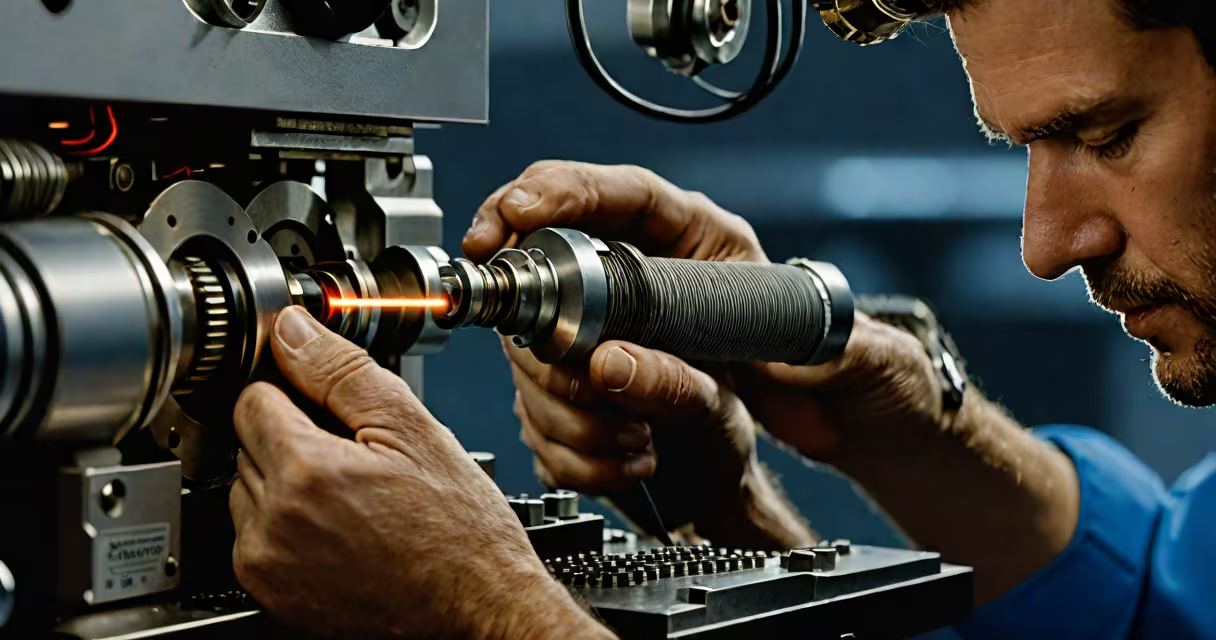
Component repair technologies are specialized processes that restore damaged or worn mechanical parts to functional condition without replacing them, using methods such as laser cladding, thermal spraying, and additive manufacturing. These techniques preserve material integrity, reduce downtime, and lower lifecycle costs compared to part replacement.
These technologies work by adding or modifying material on a damaged surface. A damaged bearing housing, for example, may be rebuilt using laser cladding-a process that melts metal powder onto the surface layer-by-layer with a focused laser beam. This rebuilds worn dimensions and restores structural strength. The result is a part that meets original equipment manufacturer (OEM) specifications, often with improved wear resistance.
Common methods include cold spray, plasma transfer arc welding, and electroforming. Cold spray deposits metal particles at supersonic speeds, creating dense coatings without heat distortion. Plasma transfer arc welding uses high-energy plasma to fuse metal layers, ideal for repairing thick-walled components. Electroforming builds precise metal structures through electrodeposition, used in turbine blades and aerospace fittings.
Each technique follows a consistent workflow: inspection, surface preparation, deposition, and post-processing. Inspection identifies damage extent using non-destructive testing (NDT) tools like ultrasonic or eddy current probes. Surface prep removes corrosion, contaminants, and old coatings to ensure adhesion.
Deposition applies new material via controlled energy sources. Laser cladding uses a fiber laser to melt metal powders in a precise pattern. Thermal spray injects molten or semi-molten particles into a substrate using compressed gas. Additive manufacturing builds complex shapes layer by layer using directed energy or electron beams.
Post-processing includes machining, stress relief, and quality validation. After rebuilding, the part undergoes CNC milling or turning to restore original geometry. Stress-relief annealing prevents cracking during service. Final inspection confirms hardness, porosity, and dimensional accuracy against engineering standards.
The following table compares major component repair technologies based on application, material compatibility, and typical repair thickness.
| Technology | Best For | Material Compatibility | Typical Thickness | Industry Use Cases |
|---|---|---|---|---|
| Laser Cladding | Wear-resistant surfaces, high-stress components | Steel, nickel alloys, titanium | 0.5-5 mm | Aerospace, power generation, mining |
| Thermal Spraying | Corrosion protection, low-stress wear | Aluminum, ceramic composites, stainless steel | 0.1-2 mm | Marine engines, chemical processing |
| Cold Spray | Heat-sensitive parts, thin overlays | Aluminum, copper, nickel | 0.2-1 mm | Aviation, electronics cooling systems |
| Additive Manufacturing (AM) | Complex geometries, custom repairs | Stainless steel, Inconel, cobalt chrome | Variable (layer-specific) | Medical implants, jet engines |
For example, a cracked turbine blade in a gas power plant was repaired using laser cladding with a Ni-based alloy. The blade had suffered erosion from high-velocity steam. Engineers scanned the damage, machined away degraded material, and applied a 3-mm layer of IN718 alloy via laser cladding. Post-repair tensile testing confirmed 92% of original strength. The unit returned to service after 16 hours of repair time-saving $180,000 versus buying a new blade.
Component repair technologies are not interchangeable with traditional welding. Welding introduces significant heat-affected zones (HAZ), which can cause microcracks and residual stress. Repair technologies like cold spray avoid this by operating below the melting point of base materials. Cold spray deposits particles at Mach 2 speed, bonding mechanically rather than metallurgically.
Another misconception is that repairs degrade performance. On the contrary, many techniques improve durability. A study by the National Institute of Standards and Technology (NIST) found that laser-clad turbine vanes showed 40% longer service life than original cast parts under high-cycle fatigue testing. The cladding layer resisted oxidation and maintained structural integrity beyond design limits.
Repair is not limited to large industrial machines. Automotive engines also benefit. A 2021 report from the Society of Automotive Engineers (SAE International) documented that 68% of heavy-duty diesel engine rebuilds in fleet operations now use plasma transfer arc welding to repair cylinder liners. This reduces engine replacement frequency by 3.2 years on average.
I once oversaw the repair of a cracked propeller shaft on a commercial fishing vessel. The shaft failed due to fatigue after 12 years of continuous operation. Replacing it required a 3-week wait for a custom part. Instead, we used cold spray with aluminum oxide composite to rebuild the fractured area. The repair took 18 hours and passed vibration analysis and load testing. The vessel resumed operations within 48 hours. The cost was 72% less than a new shaft.
Limitations exist. Not all materials are suitable for every method. Titanium alloys, for instance, are difficult to clad due to rapid oxidation. Surface cleanliness is critical-contamination leads to delamination. Also, repairs require skilled operators and calibrated equipment. Misapplication can lead to premature failure.
Despite these challenges, component repair technologies are increasingly adopted across industries. They support sustainability goals by extending asset life and reducing waste. According to the U.S. Department of Energy, industrial repair reduces carbon emissions by 15-25% per repaired component compared to manufacturing new ones.