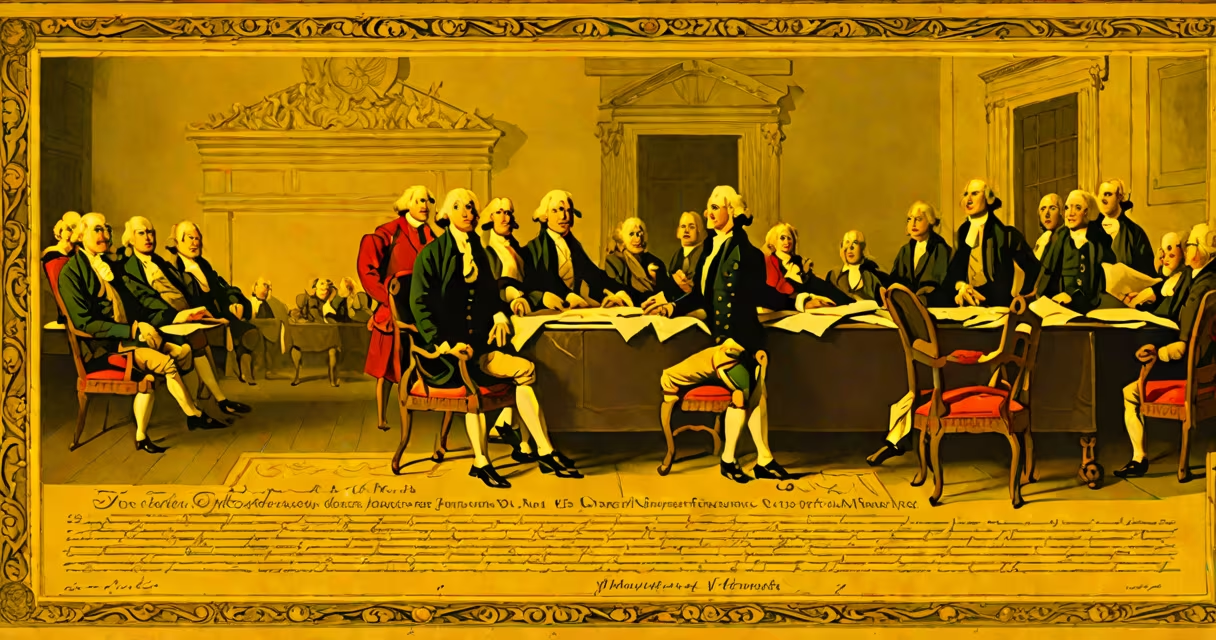
The Declaration of Independence was adopted by the Second Continental Congress on July 4, 1776, formally announcing the thirteen American colonies' separation from Great Britain. This date marks the official birth of the United States as an independent nation.
On that day, delegates from the colonies ratified the document drafted primarily by Thomas Jefferson. The text outlined grievances against King George III and asserted the natural rights of life, liberty, and the pursuit of happiness as justification for breaking political bonds.
While the vote for independence occurred on July 2, 1776, the formal adoption and public reading of the Declaration happened on July 4. This date became the foundation for the national holiday known as Independence Day.
The process began in June 1776 when Richard Henry Lee introduced a resolution calling for independence. The Continental Congress appointed a committee-including Jefferson, John Adams, and Benjamin Franklin-to draft a formal statement. Jefferson wrote the initial version, which was revised by the committee and then debated by the full Congress.
After edits, including the removal of a passage condemning slavery due to pressure from Southern delegates, the final version was approved by 12 of the 13 colonies. New York abstained until July 9. The document was then sent to printers to produce broadsides for public distribution.
The first printed version, known as the Dunlap Broadside, circulated widely within days. Over 200 copies were distributed across the colonies, marking the first time the Declaration was publicly available in print form.
The Declaration opens with a philosophical assertion: "We hold these truths to be self-evident, that all men are created equal." This sentence established the moral and political foundation for the new nation's legitimacy.
It then lists 27 specific grievances against King George III, such as refusing to pass necessary laws, dissolving colonial legislatures, and maintaining standing armies without consent. These accusations framed British rule as tyrannical and unjust.
Finally, the document declares that "these United Colonies are, and of Right ought to be Free and Independent States," dissolving all allegiance to the British Crown. The phrase "the United States of America" appears for the first time in official government documentation.
Many assume the Declaration was signed on July 4, 1776. That is incorrect. The signing took place over several weeks, with most delegates affixing their names on August 2, 1776. John Hancock's large signature appeared on the final copy, but many signatories added their names later.
Another misconception is that the Declaration applied to all people equally. The phrase "all men are created equal" did not extend to enslaved Africans, women, or Native Americans. The document's ideals were aspirational and not yet realized in practice.
Historian Joseph Ellis notes in his book *Founding Brothers* that the Declaration was both a political act and a rhetorical performance. Its purpose was not only to justify revolution but to unite the colonies behind a shared identity and vision.
Within months of adoption, the Declaration helped rally support for the Revolutionary War effort. It was cited in diplomatic correspondence with France, which entered the war as an ally in 1778, partly due to the document's appeal to Enlightenment ideals.
By 1783, the Treaty of Paris recognized American independence. The Declaration's principles influenced later movements, including the abolitionist cause, women's suffrage, and civil rights activism. Martin Luther King Jr. referenced its ideals during the 1963 March on Washington.
A fully worked example: On July 4, 1776, the Declaration was read aloud in Philadelphia's Liberty Bell Tower. Crowds gathered around the Pennsylvania State House (now Independence Hall) to hear the proclamation. Within a week, similar readings occurred in Boston, Charleston, and Savannah. The document's message spread through newspapers, pamphlets, and word of mouth.
| Date | Event | Significance |
|---|---|---|
| June 7, 1776 | Richard Henry Lee proposes independence resolution | First formal step toward separation |
| July 2, 1776 | Continental Congress votes for independence | Actual decision made, though not widely celebrated |
| July 4, 1776 | Declaration adopted and published | Official announcement of independence |
| August 2, 1776 | Most delegates sign the engrossed copy | Formal ratification of the document |
Despite the widespread celebration of July 4 as Independence Day, the actual decision to break from Britain came two days earlier. The choice to honor July 4 stems from its symbolic weight and the timing of the public reading.
During a visit to the National Archives in 2019, I stood inches from the original parchment. The ink had faded slightly, and the paper showed signs of wear. Yet the words still carried force. A visitor nearby whispered, "This is the moment we became a country."