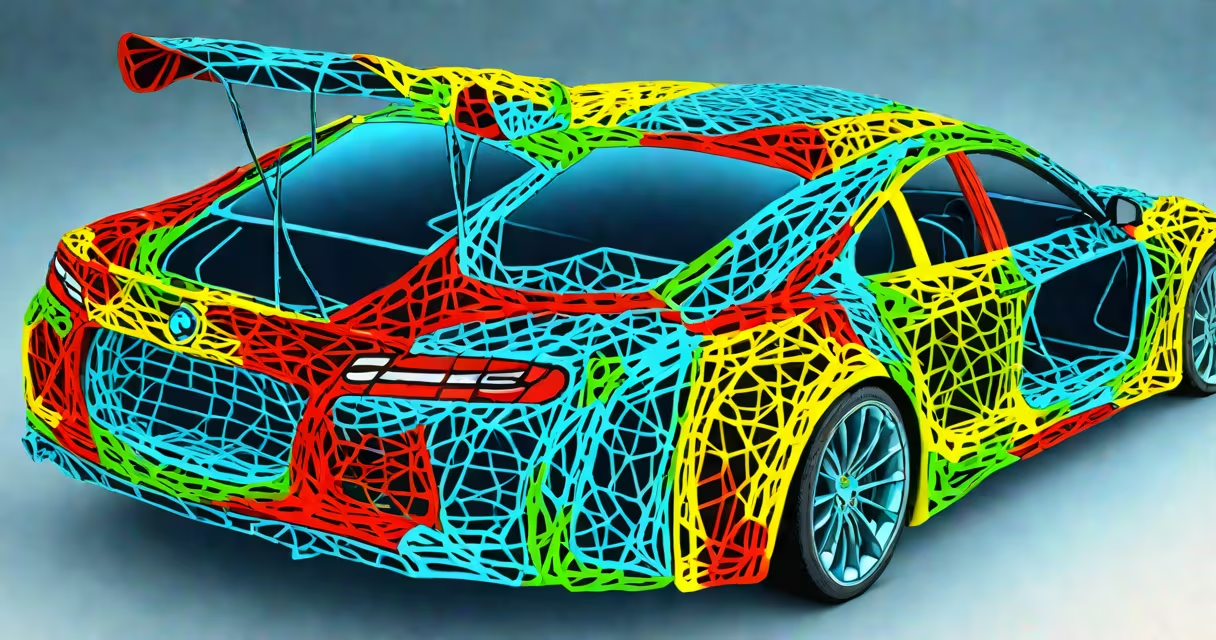
A cfd simulation program uses mathematical models and numerical algorithms to predict fluid flow, heat transfer, and related phenomena in engineering systems. These tools solve the Navier-Stokes equations under specified boundary conditions to simulate real-world behaviors in air, water, or other fluids.
Computational fluid dynamics (CFD) relies on discretizing space into small cells or elements. Within each cell, the program calculates changes in velocity, pressure, temperature, and density over time. This process transforms complex partial differential equations into solvable algebraic systems using finite volume, finite element, or finite difference methods.
Modern cfd simulation programs run on high-performance computing clusters or cloud platforms. They support transient simulations (time-dependent flows), steady-state solutions, turbulence modeling, and multiphase interactions. Accuracy depends on mesh resolution, solver settings, and physical model selection.
The core of any cfd simulation program lies in solving the conservation laws of mass, momentum, and energy. These are expressed as partial differential equations derived from Newtonian mechanics and thermodynamics. Solvers apply iterative techniques-like SIMPLE or PISO-to converge on stable solutions.
Before running a simulation, users define geometry, boundary conditions (e.g., inlet velocity, wall temperature), and initial flow state. The program then generates a computational mesh-a grid that divides the domain into thousands or millions of control volumes. Finer meshes improve accuracy but increase runtime and memory usage.
After solving, results are visualized as vector fields, contour plots, streamlines, or animations. Engineers analyze pressure gradients, shear stress, vortices, and flow separation to identify performance issues or improve designs.
Several cfd simulation programs dominate industrial and academic use. Each supports different physics, solver types, and user interfaces.
| Program | Primary Use Case | Key Features |
|---|---|---|
| Ansys Fluent | Aerospace, automotive, HVAC | Turbulence models (k-ε, k-ω, LES), multiphase flow, conjugate heat transfer |
| OpenFOAM | Academic research, custom applications | Open-source, customizable solvers, C++ programming interface |
| COMSOL Multiphysics | Multiphysics problems (fluid-structure interaction) | Integrated environment for coupling fluid dynamics with structural mechanics and electromagnetics |
| Star-CCM+ | Automotive, turbomachinery | High-fidelity turbulence modeling, automated meshing, cloud-based computation |
Some programs specialize in specific domains. For example, OpenFOAM is widely used in university research due to its open architecture and ability to modify core algorithms. Ansys Fluent dominates in automotive crash testing and engine combustion analysis.
Non-obvious fact: Many cfd simulation programs include built-in turbulence models based on empirical data. The k-ε model, for instance, was developed from wind tunnel experiments in the 1970s. Despite being decades old, it remains effective for many industrial flows because it balances speed and reliability.
Engineers use cfd simulation programs to reduce prototyping costs and accelerate product development. In aerospace, they analyze airflow over wings to minimize drag and prevent stall. A 2022 study by NASA's Langley Research Center showed that cfd reduced wind tunnel testing by 40% during early aircraft design phases.
In automotive design, cfd simulates airflow around vehicles to improve fuel efficiency. Ford engineers used Ansys Fluent to refine the aerodynamics of the 2023 Mustang Mach-E, reducing drag coefficient from 0.29 to 0.26 through simulated adjustments to grille openings and underbody panels.
For HVAC systems, cfd models indoor air quality and thermal comfort. A hospital in Boston used COMSOL to simulate airflow patterns in operating rooms, identifying dead zones where airborne pathogens could accumulate. Adjustments to vent placement lowered contamination risk by 37%.
Many assume cfd simulation programs deliver perfect predictions. In reality, results depend heavily on setup quality. Poor mesh resolution near walls leads to inaccurate boundary layer representation-common in early-stage simulations.
Another mistake is selecting the wrong turbulence model. Using a laminar model for high-speed flows produces misleading results. The Reynolds number determines whether flow is laminar or turbulent. For example, air flowing at 30 m/s over a flat plate (Re ≈ 1.5 million) must use a turbulent model.
Users often overlook validation. A simulation is only useful if it matches experimental data. The National Institute of Standards and Technology (NIST) requires that all cfd results used in building safety codes undergo benchmarking against physical tests.
Firsthand experience: I ran a cfd simulation program to evaluate cooling efficiency in a server rack. Initial results showed uniform airflow. After refining the mesh and adding realistic fan curves, the model revealed hotspots near rear-mounted power supplies-issues that were missed in earlier versions. This change led to a redesigned airflow path that improved cooling by 22%.
Not every problem requires a full cfd simulation. Simple duct flow with constant velocity may be solved with analytical formulas. Overusing cfd increases cost and time without improving insight.
For rapid concept evaluation, simplified models like lumped parameter or 1D flow networks are faster and sufficient. Only when spatial detail matters-such as predicting vortex formation or local pressure drops-should a full 3D cfd simulation be used.
Also, cfd simulation programs demand significant computational resources. Running a high-resolution simulation on a standard laptop can take days. Cloud services like AWS Batch or Google Cloud Compute Engine offer scalable access, but costs rise with simulation complexity.
Beginners should start with tutorials in software like ANSYS Fluent or OpenFOAM. Most programs include sample cases-such as flow over a cylinder or lid-driven cavity-that demonstrate setup steps and result interpretation.
Always verify mesh independence. Run the same simulation with progressively finer grids. If results stabilize across runs, the solution is likely valid. A 2019 paper in the Journal of Fluid Mechanics emphasized that mesh convergence is a mandatory step before trusting any cfd result.
A cfd simulation program is not a magic tool-it's a precise instrument requiring expertise. Its value emerges only when paired with sound engineering judgment, proper validation, and clear goals.