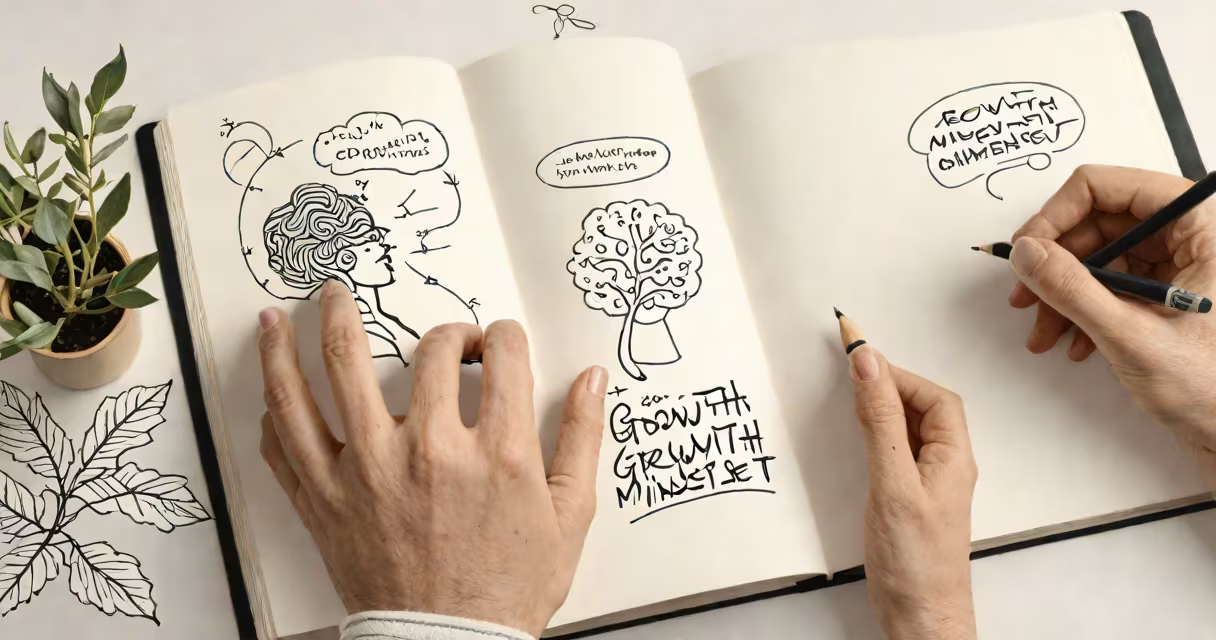
Having a growth mindset means believing abilities can improve through effort, learning, and persistence rather than being fixed traits. This mindset fosters resilience, adaptability, and continuous improvement in work, relationships, and personal goals.
Psychologist Carol Dweck introduced the concept in her 2006 book Mindset: The New Psychology of Success, where she contrasted fixed and growth mindsets. People with a fixed mindset assume intelligence and talent are innate and unchangeable. Those with a growth mindset see potential as developable through dedication and effective strategies.
Research from Stanford University shows students taught about brain plasticity-how the brain grows stronger with practice-improved grades over time compared to peers who weren't. A 2018 study published in Frontiers in Psychology confirmed that training individuals in growth mindset principles led to measurable gains in academic performance and motivation.
The core mechanism behind a growth mindset is the belief that effort leads to improvement. When someone encounters difficulty, they don't interpret failure as proof of inability. Instead, they see it as data: "I didn't succeed yet, but I can adjust my approach."
This shift changes behavior. For example, a student who fails a math test doesn't think, "I'm bad at math." They think, "I haven't mastered this yet-I'll review the material, ask for help, and try again." This response increases engagement and persistence.
A 2020 meta-analysis of 112 studies found that growth mindset interventions improved learning outcomes across age groups, especially in STEM subjects. The effect was strongest when combined with specific teaching methods like spaced repetition and metacognitive reflection.
Developing a growth mindset isn't about positive thinking-it's about adopting habits that support learning under pressure. The following practices form the foundation:
One non-obvious distinction: growth mindset isn't about constant positivity. It's about curiosity. You're not avoiding discomfort-you're engaging with it. A study in Journal of Experimental Psychology showed that people who viewed struggle as normal during learning were more likely to persist through difficult tasks than those who expected ease.
Many confuse a growth mindset with simply trying harder. That's not enough. Effort without strategy leads to burnout. A growth mindset requires reflection: adjusting methods based on results.
Another error is applying the mindset only to skills, not attitudes. You can't grow your personality overnight. But you can grow your awareness of patterns-like reacting defensively in conflict-and change them over time.
Some assume growth mindset means ignoring weaknesses. It doesn't. It means acknowledging gaps and designing a plan to close them. For example, a manager who struggles with public speaking doesn't hide. They enroll in a workshop, rehearse, and seek recordings to analyze their delivery.
| Fixed Mindset | Growth Mindset |
|---|---|
| "I'm not good at this." | "I'm not good at this yet." |
| "Why bother? I'll never get it." | "What's one small step I can take?" |
| "They're better than me." | "I can learn from them." |
Consider Sarah, a software developer promoted to team lead. She struggled with delegating tasks and often took on extra work herself. After receiving feedback, she felt defensive at first-"I'm not cut out for leadership."
She shifted her internal narrative. Instead of seeing the feedback as a flaw, she framed it as a skill gap. She read books on delegation, attended a leadership workshop, and asked a senior manager for regular check-ins.
After six months, her team reported higher morale and faster project completion. Her confidence grew-not because she became perfect, but because she treated each challenge as a chance to improve. This is how growth mindset functions in practice.
I observed this shift firsthand while mentoring junior engineers. One participant initially avoided feedback, interpreting it as criticism. After three weeks of reframing comments as "data points," he began asking follow-up questions and volunteering for stretch assignments. His performance reviews improved within a year.
Growth mindset applies across domains. In education, it correlates with higher retention rates. In business, teams with growth-oriented cultures report greater innovation and lower turnover. In personal life, it supports healthier relationships by reducing blame and increasing empathy.
For adults, the shift is especially valuable. A 2021 study in Developmental Psychology found that adults who adopted growth mindset principles showed increased cognitive flexibility and emotional regulation over 12 months. These benefits were visible in both professional settings and family interactions.
Research from the University of Pennsylvania confirms that growth mindset training reduces anxiety related to performance, particularly in high-stakes environments like exams or job interviews.
Begin with one daily habit: after a task, reflect on what you learned-even if the outcome wasn't successful. Ask, "What did I gain from this?" Write down one insight.
When facing a tough conversation, pause and rephrase: "I'm struggling with this" becomes "I'm still learning how to handle this well." Language shapes perception.
Understanding how to have a growth mindset is not theoretical. It's a set of actions you can begin today. leading a team, the mindset turns obstacles into stepping stones.