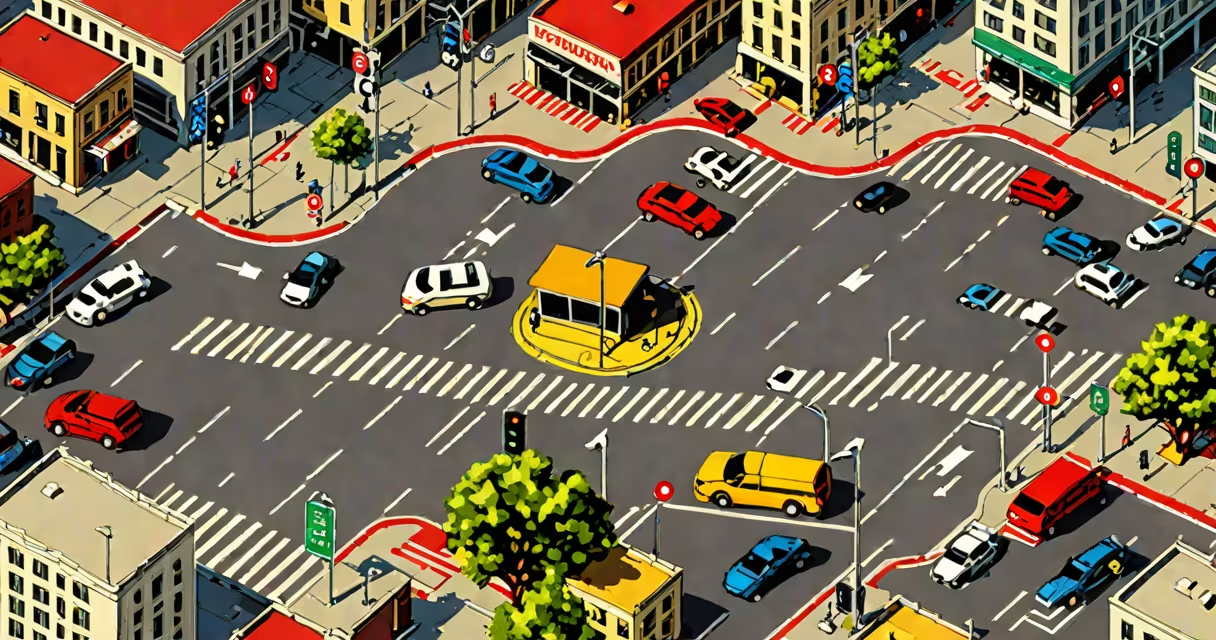
Road safety refers to the prevention of traffic collisions and injuries through engineering, enforcement, education, and emergency response. It is not a single factor but a system of interrelated elements designed to reduce harm on roads.
The World Health Organization identifies road traffic injuries as a leading cause of death among people aged 5-29. In 2022, nearly 1.3 million people died in road crashes globally, according to WHO's Global Status Report on Road Safety. These deaths result from a combination of human error, vehicle failures, and environmental conditions.
Understanding the causes of road safety means recognizing that safety isn't a feature-it's a process. It emerges from decisions made before a vehicle moves: how roads are designed, how drivers are trained, and how laws are enforced. A crash is rarely due to one cause; it results from multiple failures across this system.
Modern road safety relies on four pillars: engineering, enforcement, education, and emergency care. These form the "Safe System" approach endorsed by the U.S. Department of Transportation and the World Bank.
Engineering reduces risk by designing roads to minimize collision potential. Speed bumps, rumble strips, and median barriers lower crash severity. For example, installing a median barrier on a highway reduced head-on collisions by 70% in a 2019 study published in *Accident Analysis & Prevention*.
Enforcement ensures compliance. Automated speed cameras in cities like London have cut speeding violations by 60% and reduced fatal crashes by 40% over five years, per Transport for London data.
Education shapes behavior. Driver training programs that include scenario-based learning improve reaction times. A 2021 National Highway Traffic Safety Administration (NHTSA) study found that teens who completed such courses had 35% fewer at-fault crashes in their first year of driving.
Crashes stem from three overlapping categories: human, vehicle, and environmental. Each contributes to accident likelihood and severity.
| Category | Common Causes | Real-World Example |
|---|---|---|
| Human | Distracted driving, fatigue, speeding, impaired judgment | 2020 NHTSA report: 2,841 fatalities linked to distracted driving in the U.S. |
| Vehicle | Brake failure, tire blowouts, faulty lights | A 2018 recall of 1.4 million Ford F-150 trucks due to brake line corrosion. |
| Environmental | Weather, poor lighting, road surface defects | Winter crashes in Minnesota rose 28% during snowstorms in January 2023, per state DOT data. |
Human error accounts for over 90% of crashes, according to NHTSA. Distracted driving-using phones, adjusting GPS, or interacting with passengers-is the most common preventable cause. In 2022, 3,142 people died in crashes involving distracted drivers, a 12% increase from 2019.
Vehicle-related failures are less frequent but often more severe. A 2020 study in *Traffic Injury Prevention* found that mechanical issues contributed to 11% of fatal crashes, with brake failure being the top mechanical cause.
Environmental factors are often underestimated. Wet pavement increases stopping distance by 40%. Poorly maintained streetlights contribute to nighttime crashes. In rural areas, 60% of fatal crashes occur at night despite only 20% of travel happening then, per Federal Motor Carrier Safety Administration data.
Many assume road safety is about individual responsibility alone. That's incorrect. While driver behavior matters, systemic flaws amplify risks. A driver making a mistake in a poorly lit intersection with no guardrail is far more likely to die than one in a well-designed zone.
Another myth: "Only bad drivers cause crashes." This overlooks design flaws. A 2017 study in *The Lancet* showed that 40% of crashes occurred at locations with no history of prior incidents. These were often due to hidden hazards-like sharp curves with poor visibility-rather than driver error.
Some confuse road safety with vehicle safety ratings. A car with a 5-star crash test score still poses risks if driven at 80 mph on a rain-slicked curve. Safety ratings measure performance under controlled tests, not real-world conditions.
One non-obvious fact: the presence of a seatbelt doesn't guarantee survival. In frontal collisions, seatbelts reduce fatality risk by 45%, but only if properly worn. A 2021 NHTSA analysis found that 44% of belted occupants in high-speed crashes still suffered serious injury due to improper positioning-such as the belt crossing the neck.
In 2019, a stretch of Route 22 near Pittsburgh saw 12 fatal crashes in two years. Investigation revealed three root causes: sharp curves, inadequate signage, and high speeds. Local officials responded with a multi-phase plan.
Phase one: installed rumble strips and reflective signs. Phase two: lowered speed limits from 65 mph to 50 mph. Phase three: added median barriers and improved lighting.
Results: fatal crashes dropped 78% within 18 months. Non-fatal crashes fell by 55%. The project cost $2.3 million-less than the average medical cost of a single fatality ($1.2 million, per NHTSA).
This example shows that road safety is not passive. It requires proactive intervention based on data, not assumptions.
When evaluating causes of road safety, focus on patterns-not isolated events. A single crash may reflect a driver's mistake. Multiple crashes in one location signal a systemic issue. Addressing those patterns saves lives.