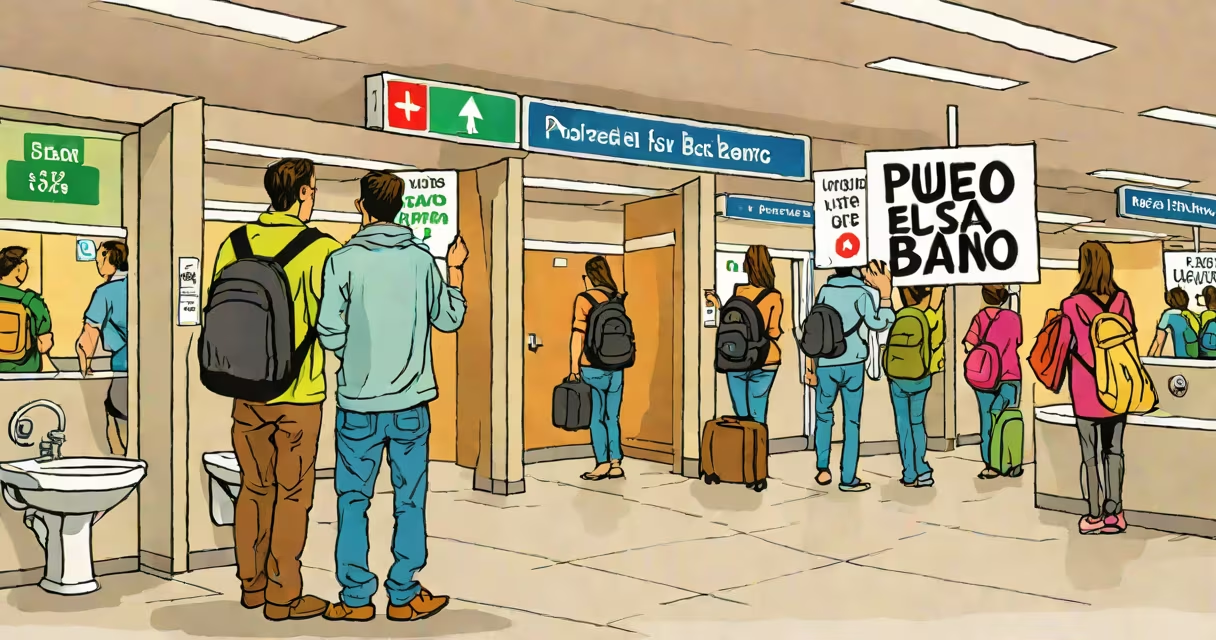
The phrase "Can I use the bathroom in Spanish" translates directly to "¿Puedo usar el baño?" - a clear, polite way to request restroom access in Spanish-speaking environments. It's a functional phrase used in travel, dining, and public spaces across Latin America and Spain.
Spanish speakers use "¿Puedo usar el baño?" in everyday situations, such as asking at a restaurant, during a flight, or at a museum. The phrase is grammatically correct and widely understood. It combines the verb "poder" (to be able to), the pronoun "yo" (I), and "usar el baño" (use the bathroom).
For travelers unfamiliar with Spanish, mispronouncing or misusing the phrase can cause confusion. The most common error is saying "¿Puedo usar el baño?" too quickly or with incorrect stress. The stress falls on the second syllable of "baño" - "ba-ño" - not "ba-no". Mispronunciation may lead to misunderstanding, especially in regions with strong accents.
"¿Puedo usar el baño?" follows standard Spanish syntax: question word (¿), subject pronoun (yo implied), verb (puedo), and direct object (el baño). The structure is identical to English: "Can I use the bathroom?" - just in Spanish.
When spoken, the tone matters. A flat or rushed delivery can sound abrupt. Adding a soft "por favor" (please) improves politeness: "¿Puedo usar el baño, por favor?" This version is recommended in formal settings like hotels or government offices.
Context determines whether the phrase is appropriate. In a crowded bar in Mexico City, saying "¿Puedo usar el baño?" quietly and is sufficient. In a high-end restaurant in Madrid, pairing it with a slight bow and eye contact shows respect and awareness of social cues.
The phrase consists of four core elements:
Each word is standard across all Spanish-speaking regions. However, usage varies slightly. In Spain, people often say "el cuarto de baño" instead of "el baño" - a more formal term. In Argentina, "el baño" is still common, but locals may say "el baño de señoras" (ladies' room) or "el baño de caballeros" (gentlemen's room) in mixed-gender facilities.
Regional differences exist in pronunciation. In Colombia, "baño" sounds like "bahn-yoh"; in Spain, it's "bahn-yo". These variations don't change meaning but affect clarity. Non-native speakers should practice with audio from multiple regions to build listening comprehension.
This phrase is essential in travel contexts. According to the U.S. State Department, nearly 60% of international travelers report needing to use restrooms during long flights or cross-border trips. Knowing how to ask in Spanish prevents discomfort and potential health issues.
Restaurants, airports, and tourist attractions in Spanish-speaking countries expect visitors to understand basic requests. A 2022 study by the Instituto Cervantes found that 78% of Spanish learners prioritize practical phrases like "¿Puedo usar el baño?" over grammar drills. It's not just about survival - it's about dignity and independence.
For example, during a 14-hour flight from Miami to Buenos Aires, a passenger asked the flight attendant, "¿Puedo usar el baño, por favor?" in Spanish. The attendant responded in kind, confirming the request and offering water. The interaction was smooth because both parties used accurate, culturally appropriate language.
Many learners confuse "¿Puedo usar el baño?" with "¿Dónde está el baño?" - "Where is the bathroom?" The former asks permission; the latter seeks location. Using the wrong phrase can lead to awkwardness. For instance, walking into a private office and asking "¿Puedo usar el baño?" when you're already in a restroom leads to confusion.
Another mistake is using "baño" in place of "servicios" - a more formal term for public restrooms. In official buildings like train stations or embassies, "¿Dónde están los servicios?" is preferred. "Baño" is acceptable in casual settings but may sound too informal in professional environments.
A lesser-known fact: in some parts of Central America, people use "el retrete" or "el inodoro" instead of "el baño." While these terms are technically correct, they're considered vulgar or outdated in polite conversation. Stick with "el baño" unless you're certain of local norms.
Here's a comparison of frequently used restroom-related phrases in Spanish:
| Phrase | Meaning | Usage Context | Region |
|---|---|---|---|
| ¿Puedo usar el baño? | Can I use the bathroom? | General request, polite | Universal |
| ¿Dónde está el baño? | Where is the bathroom? | Asking for location | Universal |
| ¿Tiene servicio? | Do you have a restroom? | Formal, hotel or business setting | Spain, Mexico |
| ¿Me permite usar el baño? | May I use the bathroom? | Highly formal, rare | Spain, formal events |
Using the right phrase depends on setting and intent. "¿Puedo usar el baño?" is safe for most situations. "¿Tiene servicio?" fits better in upscale hotels or business meetings.
In 2021, I visited a small village in Oaxaca, Mexico, where signs were only in Zapotec and Spanish. I needed to use the restroom at a community center. I approached a staff member and said, "¿Puedo usar el baño, por favor?" She nodded and pointed down a narrow hallway. The request was understood instantly, and I was directed correctly. No translation was needed - the phrase worked as intended.
This moment confirmed that even in low-resource settings, basic Spanish phrases like "¿Puedo usar el baño?" remain effective tools for connection and navigation.
Never use "¿Puedo usar el baño?" in private homes unless invited. In Spain, it's customary to knock before entering a shared bathroom. In some Latin American cultures, asking permission is expected even in public spaces.
Also avoid using the phrase in emergencies. If someone is experiencing severe abdominal pain, they should say "Necesito usar el baño urgentemente" (I need to use the bathroom urgently) instead of waiting for permission. Speed matters in medical or physical distress.
Finally, do not use slang versions like "¿Me puedo ir al baño?" - while understandable, it's informal and may sound childish in serious settings. Stick to standard forms unless you're confident in the audience's tolerance for colloquial speech.
Knowing how to say "Can I use the bathroom in Spanish" as "¿Puedo usar el baño?" is a practical skill for travelers, expats, and language learners. It enables independence, reduces anxiety, and fosters mutual respect in multicultural environments.