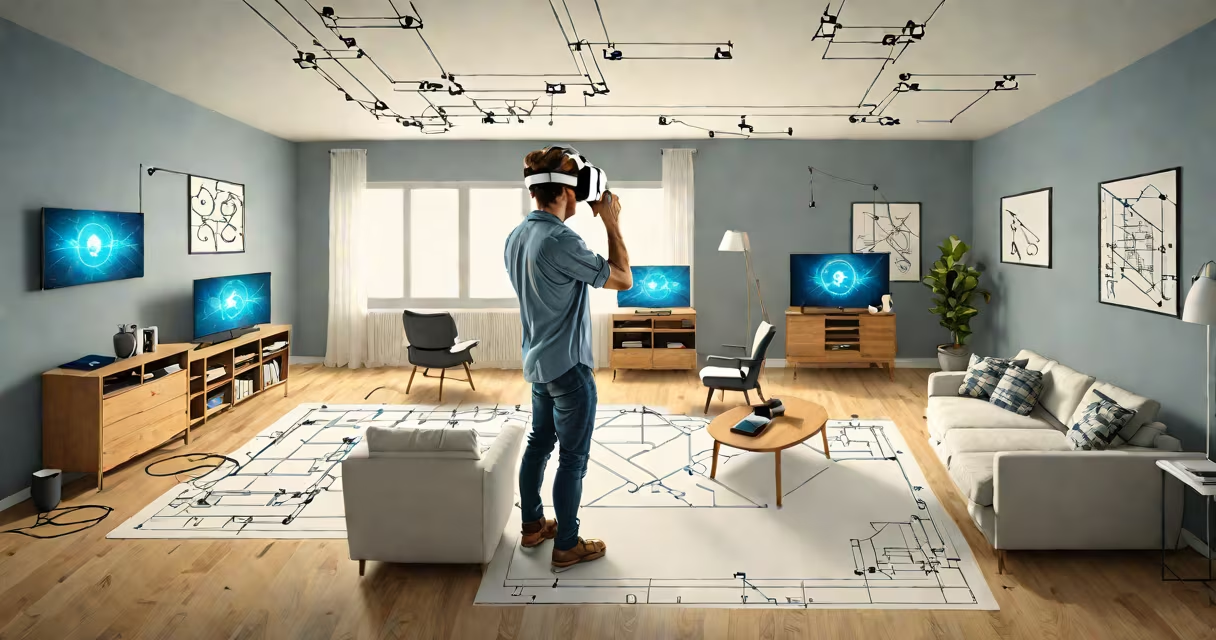
Invest in virtual reality means allocating capital to technologies, platforms, or companies that create or deliver immersive digital environments through headsets, software, and interactive systems. This includes funding hardware development, content creation, enterprise applications, and infrastructure supporting persistent virtual worlds.
Virtual reality (VR) simulates sensory experiences using head-mounted displays and motion tracking. Users enter 3D environments where they interact with digital objects and people in real time. Unlike traditional screens, VR replaces the user's field of view entirely, creating presence-a psychological sense of being physically inside a simulated space.
The core components of VR systems include high-resolution displays, inertial sensors for head movement, spatial audio, and hand-tracking controllers. Modern headsets like Meta Quest 3 and Apple Vision Pro integrate eye and hand tracking, reducing the need for handheld controllers. These devices run applications ranging from games and social platforms to medical simulations and architectural walkthroughs.
Investors in virtual reality engage through public equities, private equity, venture capital, or direct participation in startups. Public markets offer exposure via companies such as Meta Platforms (parent of Oculus), Sony (PlayStation VR), and HTC (Vive). Venture capital funds back early-stage developers building VR-specific tools, AI-driven avatars, or spatial computing platforms.
Private equity firms often invest in mature VR hardware manufacturers or content studios. For example, in 2023, SoftBank invested $1.5 billion in a Japanese VR startup focused on remote collaboration tools for industrial design teams. Such investments target scalability and integration into existing workflows rather than consumer novelty.
Early-stage investors look for technical moats-unique patents, proprietary algorithms, or exclusive partnerships. A company developing low-latency neural rendering for VR could secure Series A funding based on benchmarks showing 40% faster frame rates than current solutions. These metrics matter because motion sickness in VR correlates strongly with latency above 20 milliseconds.
Investment opportunities fall into four categories: hardware, software/content, infrastructure, and platform ecosystems.
| Type | Examples | Key Metrics |
|---|---|---|
| Hardware | Meta Quest 3, Apple Vision Pro, HTC Vive Focus 3 | Weight (< 600g), resolution (> 4K per eye), battery life (> 2 hours) |
| Software/Content | Half-Life: Alyx, Beat Saber, VRChat | Monthly active users (MAU), average session duration (> 45 minutes), retention rate (≥ 30% after 30 days) |
| Infrastructure | Cloud rendering services, 5G edge networks, spatial audio engines | Bandwidth efficiency (≤ 10 Mbps per user), server response time (< 15ms) |
| Platform Ecosystems | Meta Horizon Worlds, Roblox VR, NVIDIA Omniverse | Developer adoption rate, number of user-generated experiences, API availability |
Hardware investors focus on manufacturing cost, power efficiency, and form factor. A headset under 500 grams with a 120Hz refresh rate and integrated eye tracking is preferred for extended wear. Software investors prioritize engagement and monetization models-free-to-play games with in-app purchases generate higher lifetime value than one-time purchases.
Infrastructure plays a growing role. Real-time rendering of complex scenes requires distributed compute. NVIDIA's RTX technology enables ray-traced lighting in VR, but demands GPU clusters in data centers. Investors in cloud-based rendering services benefit from recurring revenue tied to usage volume.
Consumer applications drive initial interest. Gaming remains the largest segment, accounting for 58% of global VR spending in 2023 according to Statista. Titles like Half-Life: Alyx demonstrate narrative depth and physics interaction unachievable on flat screens. Players report heightened emotional responses during story moments-measured via biometric feedback in controlled trials.
Enterprise use cases offer stronger long-term returns. Medical schools use VR to simulate surgeries. A 2022 study published in *The Lancet Digital Health* found that surgical residents trained in VR performed procedures 30% faster and with 25% fewer errors compared to traditional methods. Hospitals investing in VR training see reduced complication rates and shorter recovery times.
Training and simulation are expanding into logistics, aviation, and emergency response. Walmart uses VR to train employees in customer service scenarios. After implementation, store managers reported a 15% improvement in employee performance during live audits. These results validate VR as a tool for behavior change, not just entertainment.
Metaverse projects represent speculative bets on persistent virtual spaces. Decentraland and The Sandbox allow users to buy virtual land, build experiences, and trade NFTs. While prices fluctuate, the underlying infrastructure-blockchain-based ownership, decentralized identity-has investor appeal beyond hype.
Many assume VR is limited to gaming. In reality, 62% of corporate VR deployments in 2023 were for training, design, or remote collaboration, per PwC's Global VR Survey. The technology supports complex tasks requiring spatial reasoning-such as assembling machinery or going through construction sites-where visual memory and motor coordination improve under VR conditions.
Another myth is that VR causes widespread motion sickness. While nausea affects 10-15% of users during first exposure, modern headsets reduce this to under 3% with optimized frame rates and adaptive motion smoothing. The human brain adapts quickly when latency stays below 20ms and field of view exceeds 100 degrees.
A lesser-known fact: VR can improve mental health treatment. Stanford University's Virtual Human Interaction Lab found that participants who practiced empathy-building exercises in VR showed 40% greater perspective-taking ability than those using video or text. This effect persisted for at least six weeks post-exposure.
In 2022, a mid-sized engineering firm in Austin, Texas, adopted VR for cross-team design reviews. They purchased 15 Meta Quest 3 units and developed a custom application to load CAD files in a shared virtual workspace. Engineers from New York, Berlin, and Tokyo joined a 3D model review simultaneously.
Results after one year: 37% reduction in project delays due to miscommunication, 22% faster approval cycles, and a 14% drop in travel costs. The firm recouped its initial investment within 18 months. The success led to a follow-up round of funding from a regional venture fund focused on immersive tech in professional services.
This case shows that VR investment isn't just about flashy gadgets-it delivers measurable ROI when aligned with workflow needs. The same firm later expanded to VR-based client presentations, increasing win rates by 29% in competitive bids.
When evaluating opportunities to invest in virtual reality, prioritize use cases with clear outcomes. Avoid chasing trends without validation. Look for evidence of user retention, technical differentiation, and alignment with real-world problems.
Invest in virtual reality not as a fad, but as a platform for sustained innovation. The most successful ventures combine compelling content, accessible hardware, and practical utility-proving that immersion can solve real challenges.