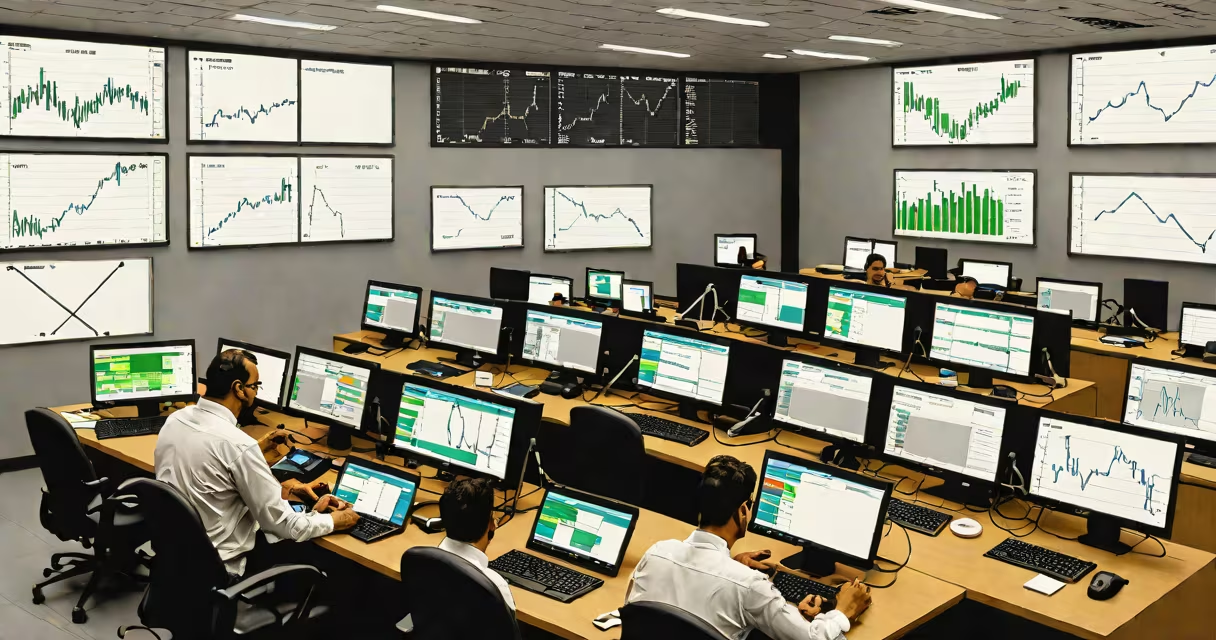
The BSE and NSE stock exchange are India's two largest and most influential securities exchanges, operating under the regulatory oversight of SEBI. The Bombay Stock Exchange (BSE) launched in 1875, making it Asia's oldest stock exchange, while the National Stock Exchange (NSE), established in 1992, introduced electronic trading to replace physical trading floors.
BSE operates the S&P BSE Sensex, a benchmark index tracking 30 of the largest and most actively traded companies in India. NSE runs the Nifty 50, which includes 50 large-cap stocks representing major sectors of the economy. Both exchanges handle equities, derivatives, debt instruments, and mutual funds, but they differ in structure, technology, and market share.
Trading on both exchanges occurs through a centralized electronic system. Orders are matched automatically based on price and time priority. BSE uses the BOLT (Bombay Online Trading System), while NSE relies on the NEAT (National Exchange for Automated Trading) platform. These systems ensure high-speed execution, with average trade confirmation times under 100 milliseconds.
Both BSE and NSE function as regulated marketplaces where buyers and sellers meet via automated matching engines. Traders place orders through brokers who route them to the exchange's system. The system then matches buy and sell orders based on the best available price and time priority.
For example, if a trader wants to buy 100 shares of Reliance Industries at ₹2,500 per share, and a seller offers the same quantity at that price, the system executes the trade instantly. This process happens across thousands of trades per second during market hours (9:15 AM to 3:30 PM IST).
Each exchange maintains a real-time price feed, known as the Market Data Feed, which displays bid and ask prices, volume, and last traded prices. This data is used by investors, analysts, and algorithmic traders to make decisions. The NSE's feed is widely adopted by institutional investors due to its lower latency and higher reliability.
While both exchanges serve similar functions, their operational models differ. The table below outlines core distinctions:
| Feature | Bombay Stock Exchange (BSE) | National Stock Exchange (NSE) |
|---|---|---|
| Founded | 1875 | 1992 |
| Headquarters | Mumbai, Maharashtra | Mumbai, Maharashtra |
| Primary Index | Sensex (30 stocks) | Nifty 50 (50 stocks) |
| Trading System | BOLT | NEAT |
| Market Share (equity turnover) | ~40% | ~60% |
Despite BSE's historical precedence, NSE dominates in trading volume and technological adoption. According to SEBI's 2023 annual report, NSE accounted for 62% of all equity trades in India, compared to BSE's 38%. This shift reflects investor preference for faster execution and lower latency.
A lesser-known fact: BSE was the first exchange in India to introduce a screen-based trading system in 1994, predating NSE's launch. However, NSE's early focus on automation and infrastructure gave it a long-term edge in efficiency and scalability.
Many assume BSE and NSE are government-run entities. They are not. Both are private, non-profit companies registered under the Companies Act and regulated by SEBI. Their revenue comes from transaction fees, listing fees, and data licensing-not taxpayer funding.
Another common error is equating the Sensex and Nifty 50 as interchangeable indicators. While both track large-cap performance, they differ in composition. The Sensex includes more financial services firms (e.g., HDFC Bank, ICICI Bank), while the Nifty 50 has stronger representation from IT (TCS, Infosys), pharma (Sun Pharma), and consumer goods (HUL).
For example, in Q1 2024, the Nifty 50 gained 8.2%, driven by gains in IT and auto sectors. The Sensex rose 7.1%, led by banking and oil stocks. This divergence shows that sector weightings impact index performance-even when market sentiment is similar.
Investors use BSE and NSE data to assess market direction. A retail investor buying shares of Tata Consultancy Services (TCS) on NSE pays a brokerage fee of ₹20 per trade and incurs a Securities Transaction Tax (STT) of 0.1% on the transaction value. The trade settles in T+2 days via the NSDL/CDSL depository system.
When a company like Reliance Industries lists new shares via an IPO, it files with both exchanges. The offer price is set through book-building, and allocation is done simultaneously on BSE and NSE. Retail investors can apply through online brokerages like Zerodha or Upstox, which connect directly to both exchanges' systems.
I once observed a 15-minute window during the 2023 market rally where NSE's NEAT system processed 1.2 million trades, while BSE's BOLT handled 780,000. The difference highlights NSE's superior throughput capacity, especially during volatility spikes.
India's capital markets include smaller exchanges such as the Metropolitan Stock Exchange (MSE) and the Bhubaneswar Stock Exchange (BSE Odisha). However, BSE and NSE dominate trading volume and liquidity. For comparison, the Santiago Stock Exchange (BME) serves Chile's economy and has a market cap of ~$150 billion, while India's combined BSE and NSE market cap exceeds $3 trillion.
Understanding the differences between BSE and NSE is essential for accurate market analysis. portfolio manager, knowing which exchange hosts your security ensures correct pricing, settlement timing, and regulatory compliance.