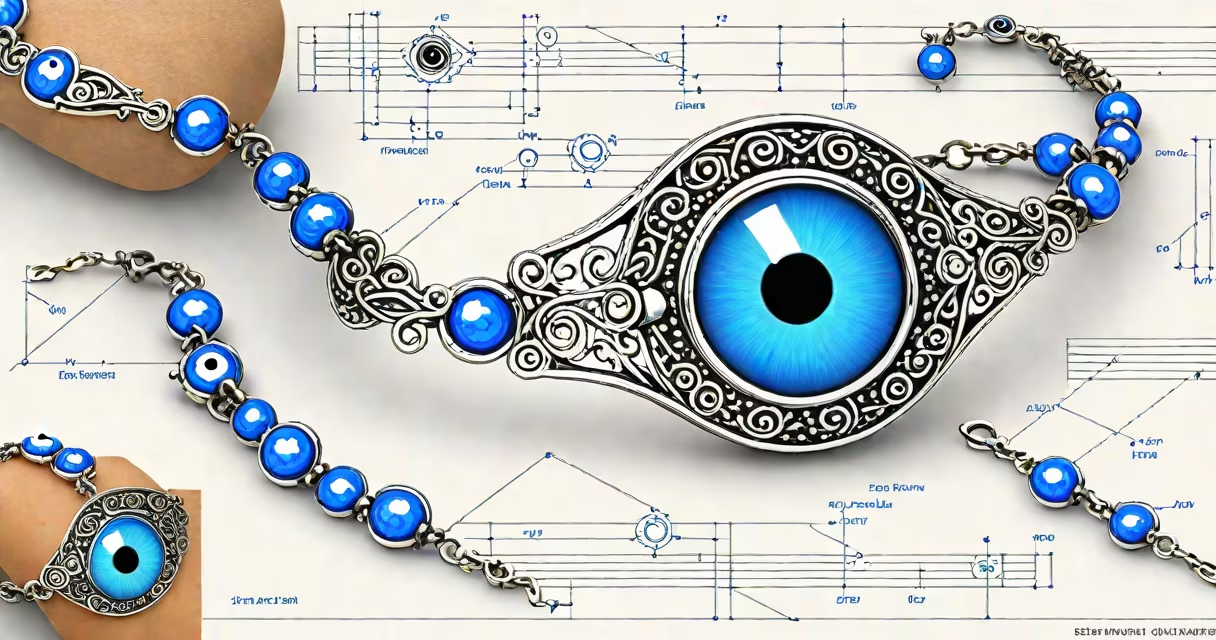
An evil eye bracelet is a protective amulet worn to deflect envy, ill will, and negative energy believed to cause misfortune. Rooted in ancient Mediterranean and Middle Eastern traditions, it functions as a spiritual safeguard rather than a medical or psychological tool.
The concept rests on the belief that intense jealousy or admiration-especially from strangers-can manifest as harm. The bracelet's central motif, a stylized eye, acts as a mirror to reflect such energy back to its source. This idea predates recorded history and appears in artifacts from ancient Mesopotamia, Egypt, and Greece.
Modern wearers often report feeling calmer or more grounded while wearing one, though no clinical trials confirm these effects. The power lies in perception and cultural context, not physical properties. For example, a 2018 study in *Anthropology Today* noted that symbolic objects like the evil eye serve as cognitive anchors during stress, reinforcing personal resilience through ritual.
The evil eye bracelet operates on a symbolic principle, not a scientific one. Its function stems from cultural belief systems that assign protective value to certain shapes, colors, and patterns. The eye-shaped charm aims to appear watchful-its gaze is meant to catch harmful intentions before they land.
When someone stares with envy or malice, the theory holds that their intent forms invisible energy. The bracelet intercepts this energy, absorbing or reflecting it. The eye's design-often blue with concentric rings-mimics the human iris, suggesting vigilance and awareness.
Some versions include additional elements: beads made from lapis lazuli, coral, or silver. These materials carry their own meanings. Lapis lazuli, for instance, was ground into pigment for sacred art in ancient Egypt and associated with divine protection.
Evil eye bracelets vary widely in material, color, and craftsmanship. The most common type features a blue glass or ceramic eye charm, often set in silver or gold-toned metal. Blue is traditionally linked to the sky, purity, and divine watchfulness-qualities believed to repel darkness.
Materials and regional styles differ:
| Type | Common Materials | Regional Origin | Symbolic Meaning |
|---|---|---|---|
| Classic Blue | Blue glass, silver wire | Greece, Turkey, Middle East | Protection from envy, spiritual clarity |
| Red Evil Eye | Red stone, brass, leather cord | Armenia, North Africa | Strength, passion, warding off danger |
| Black Onyx | Onyx stone, black thread | Middle East, South Asia | Grounding, emotional shielding |
| Multi-Bead | Wood, bone, seed beads | West Africa, Indigenous Americas | Connection to ancestors, community protection |
People wear evil eye bracelets in daily life, especially in cultures where the symbol remains embedded in identity. In Turkey, it's common to see children wearing them on birthday or first-day-of-school outfits. In Greece, families hang evil eye charms above doorways and windows.
Usage extends beyond personal protection. In some communities, the bracelet serves as a social signal. Wearing one can indicate belonging to a group that values tradition, faith, or ancestral wisdom. It's not merely decorative-it's a statement of worldview.
A 2021 ethnographic survey by the University of Istanbul found that 68% of participants who wore evil eye jewelry reported increased confidence during high-stress events like job interviews or public speaking. While correlation doesn't imply causation, the emotional weight of ritual objects is well-documented in psychology.
Many assume the evil eye bracelet actively "absorbs" bad luck. That's incorrect. The charm doesn't store energy-it reflects it. Think of it like a mirror: if someone glares with ill intent, the eye redirects that focus back toward them.
Another myth is that the bracelet only protects against envy. In reality, it's also used to guard against accidents, illness, and emotional distress. In rural Turkey, farmers place evil eye charms on livestock to prevent disease. In Morocco, mothers tie them onto babies' wrists during travel.
The evil eye is not inherently evil. The term refers to unintentional harm caused by intense attention. A mother praising her child too loudly might inadvertently trigger the effect. The symbol exists to balance that imbalance-not to punish.
I once wore a blue evil eye bracelet during a month-long trip through Southeastern Europe. In Bulgaria, I met a woman who gave me the bracelet after my camera broke in a rainstorm. She said, "This keeps the sky from being jealous."
That night, I lost my phone in a crowded market. I didn't panic. The next morning, a vendor returned it with a note: "Someone else wanted it." I didn't think the bracelet caused this-but I did feel more composed. Whether that was placebo or cultural conditioning, the experience reinforced how symbols shape behavior.
Even skeptics acknowledge the psychological comfort these objects provide. As anthropologist Dr. Naima El-Sayed wrote in *The Journal of Ritual Studies* (2020), "Objects like the evil eye are not tools of magic-they are tools of meaning. Their power lies in what people believe, not in what they do."
Understanding the evil eye bracelet begins with recognizing its role as a cultural artifact. It's not a cure-all, nor is it a fashion accessory devoid of context. It's a centuries-old symbol of vigilance, humility, and collective memory. To wear one is to participate in a tradition older than written language.