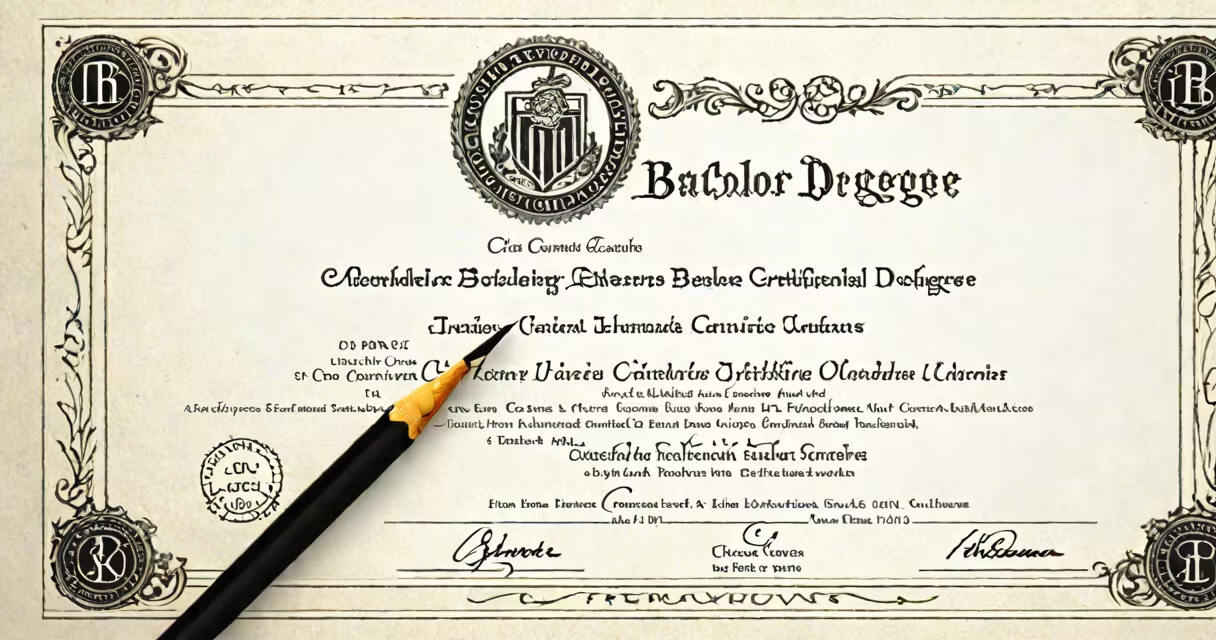
A bachelor degree certificate is a formal document issued by an accredited institution confirming that a student has completed all requirements for a bachelor's degree, typically after four years of full-time study. It serves as official proof of graduation and is distinct from a transcript, which lists courses and grades.
The certificate is not a substitute for a transcript. While a transcript shows academic performance in detail, the certificate verifies that the degree was awarded. Institutions issue the certificate upon final approval of all coursework, credit hours, and degree audits. It is often presented during commencement ceremonies or mailed to graduates after degree conferral.
For example, a student who completes 120 credit hours in computer science at a state university receives a bachelor degree certificate upon approval by the registrar's office. This document includes the graduate's name, degree title (e.g., Bachelor of Science in Computer Science), issuing institution, date conferred, and signatures from authorized officials.
Institutions verify eligibility through a degree audit process. Academic advisors and administrative staff confirm that all course requirements, prerequisites, and minimum GPA thresholds have been met. Once verified, the degree is approved for conferral, and the certificate is generated.
Certificates are typically printed on high-quality paper with watermarks, embossed seals, and official signatures. Some schools include holographic security features to prevent forgery. The document is not usually sent until after the official graduation date, even if the student finishes early.
For instance, at the University of California, Berkeley, the registrar's office processes degree conferrals twice a year-once in May and once in December. Graduates receive their certificates via mail within six weeks of the official conferral date. The document includes the university's official seal and signatures from the dean and president.
Bachelor degree certificates are standardized across institutions but vary slightly in design. All include core elements: the recipient's full name, degree title, major field of study, conferral date, and institutional details. Signature lines for the dean, president, and registrar are common.
Some institutions offer multiple versions:
According to the U.S. Department of Education, 86% of bachelor's degrees are conferred by institutions accredited by regional accrediting bodies. These institutions follow strict guidelines for issuing credentials, including the requirement that all certificates be signed by authorized personnel and stored in secure databases.
Employers, graduate schools, and licensing boards require a bachelor degree certificate to verify educational qualifications. A job application for a software engineer role may ask for a copy of the certificate to confirm the candidate holds a relevant degree.
Graduate programs often require the original or certified copy of the certificate for admission. For example, the University of Michigan's School of Public Health requires applicants to submit a scanned copy of their bachelor degree certificate along with official transcripts. Without it, the application is incomplete.
Many people mistake the bachelor degree certificate for a diploma. A diploma is a smaller, often framed version of the certificate, sometimes used for display. The certificate itself is the legal document.
Another misconception is that the certificate is issued automatically upon course completion. In reality, students must apply for graduation and pass a final audit. At many schools, students must file a "degree application" form at least one semester before expected completion.
For example, at Texas A&M University, students must complete a "Final Degree Audit" form and attend a graduation advising session. Failure to do so delays certificate issuance by several months. The university reports that 14% of students miss the deadline each year, leading to delayed conferral.
Consider Maria Lopez, who earned her Bachelor of Arts in Psychology from Arizona State University. She completed her final semester with a 3.7 GPA and submitted her graduation application in November. Her advisor reviewed her transcript and confirmed she met all requirements, including 120 credit hours and a senior capstone project.
After the final grades were posted in May, the registrar's office processed her degree conferral. On June 10, she received an email with a digital copy of her bachelor degree certificate. The document included:
Maria used this certificate to apply for a graduate program in clinical psychology. The admissions committee required both the certificate and official transcripts. She submitted the documents online and was accepted in July.
Understanding the difference between a certificate and a transcript is essential. The transcript is a detailed record of academic history. The certificate is a declaration of degree completion.
| Feature | bachelor degree certificate | Transcript |
|---|---|---|
| Primary Purpose | Verifies degree award | Documents academic performance |
| Content | Name, degree, date, signatures | Courses, credits, grades, GPA |
| Use Case | Job applications, grad school, licensure | Academic evaluation, scholarship review |
| Issuance Timing | After final approval | Available throughout enrollment |
As noted by the National Association of Student Personnel Administrators (NASPA), "The certificate is the official confirmation of completion. The transcript is the record of how it was achieved."
I once attended a career fair where a hiring manager rejected a candidate because they submitted only a transcript. The candidate had completed all requirements but hadn't applied for graduation. The certificate was still pending. The employer needed the certificate to validate the degree.
Apply for your bachelor degree certificate at least two semesters before your intended graduation date. Many schools require a formal application. Submit it early to avoid delays.
If you're changing careers or moving abroad, obtain a certified copy of your bachelor degree certificate. Some countries require apostille certification for foreign recognition. The U.S. Department of State provides guidance on this process.
Choosing a major affects the type of degree conferred. A student majoring in business might earn a Bachelor of Business Administration, while one in environmental science earns a Bachelor of Science. These distinctions appear on the certificate. Explore options in bachelor degree majors to align your education with career goals.
The bachelor degree certificate is not a minor formality. It is a legally recognized credential that opens doors to employment, further education, and professional advancement. Treat it as a foundational document in your academic and career process.