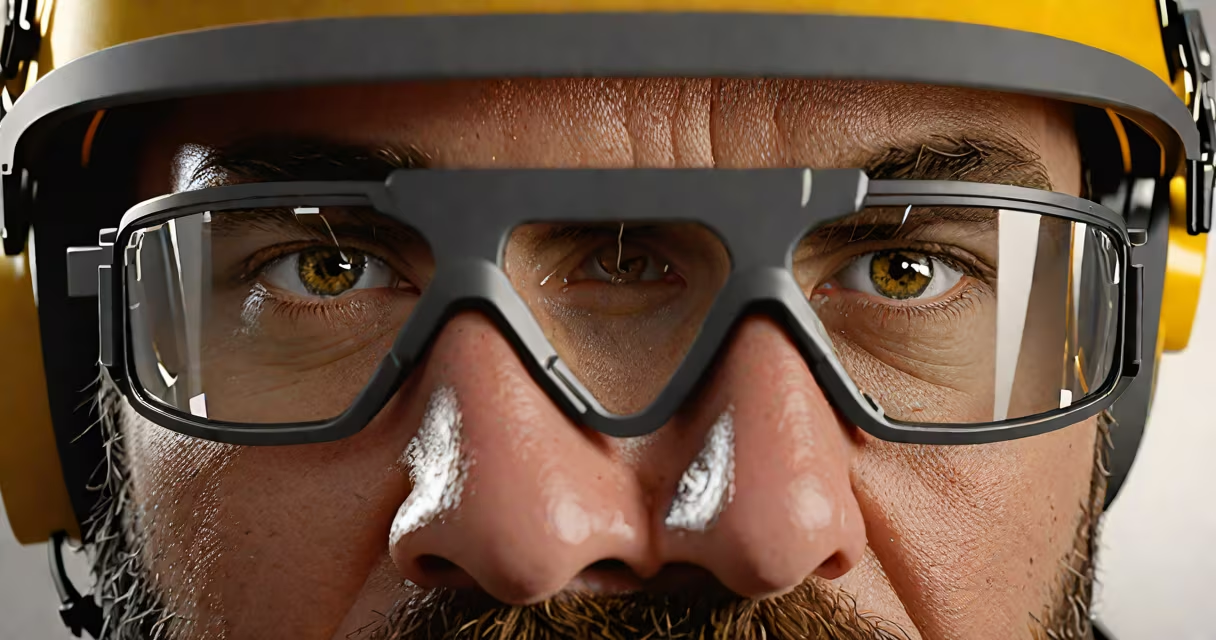
arc flash eyes describes corneal and conjunctival damage caused by exposure to intense ultraviolet (UV) and infrared (IR) radiation during an electrical arc flash event. This injury occurs within milliseconds and can result in severe pain, temporary vision loss, and long-term ocular complications if protective eyewear is not worn.
Arc flashes occur when a high-voltage electrical fault causes a rapid release of energy through ionized air. The resulting plasma can reach temperatures exceeding 35,000°F (19,400°C)-hotter than the surface of the sun. This extreme heat produces broad-spectrum radiation, including UV and IR, which can burn the cornea and retina even at a distance.
The American National Standards Institute (ANSI) Z87.1 standard requires that industrial safety eyewear meet specific optical density ratings for UV and IR protection. Without proper certification, standard safety glasses offer little defense against arc flash radiation. A single incident can cause permanent vision impairment, especially if the eyes are exposed without protection.
When an electrical arc forms-commonly due to equipment failure, improper maintenance, or accidental contact-ionized gases emit intense radiation. The UV component can cause photokeratitis, a condition similar to "welder's flash" or "snow blindness." Symptoms appear within 2 to 6 hours after exposure and include burning pain, redness, tearing, light sensitivity, and blurred vision.
Infrared radiation penetrates deeper into the eye, potentially damaging the lens and retina. Unlike UV, IR effects may not be immediate. Retinal burns can lead to permanent scotomas (blind spots) or reduced visual acuity. According to the National Fire Protection Association (NFPA) 70E, arc flash incidents account for approximately 10% of all electrical injuries in industrial environments, with eye injuries comprising a significant subset.
Even indirect exposure poses risk. Reflections off metal surfaces or polished tools can redirect radiation toward unprotected eyes. A 2018 study published in the Journal of Occupational and Environmental Medicine found that 32% of arc flash incidents involving eye injuries occurred when workers were more than 3 feet away from the source-highlighting that proximity is not the sole determinant of risk.
Protective eyewear must be rated for arc flash exposure. The ANSI Z87.1 standard defines optical density (OD) requirements based on expected incident energy levels. For example:
| Incident Energy Level | Required Optical Density (OD) | Common Eyewear Type |
|---|---|---|
| 1.2 cal/cm² | 4.0 | Standard safety goggles with UV/IR filters |
| 4.0 cal/cm² | 6.0 | Full-face arc flash helmets with shaded lenses |
| 12.0 cal/cm² | 8.0 | Multi-layered composite visors with automatic darkening |
Eye protection must be worn in conjunction with other personal protective equipment (PPE), including flame-resistant clothing and hearing protection. The NFPA 70E mandates that all personnel working on or near energized electrical systems wear appropriate PPE, including certified eye protection, regardless of voltage level.
Non-certified eyewear-such as prescription glasses or sunglasses-offers no meaningful protection. Even clear polycarbonate lenses can transmit harmful UV wavelengths. A 2020 report from the Occupational Safety and Health Administration (OSHA) cited multiple cases where workers sustained arc flash eye injuries while wearing unapproved eyewear, leading to citations and fines.
Many assume that arc flash injuries only affect skin or cause immediate blindness. However, the most common outcome is delayed-onset corneal damage. Photokeratitis often presents as mild discomfort initially, leading individuals to delay seeking medical care. By the time symptoms worsen, irreversible tissue damage may have occurred.
Another misconception is that arc flash events are rare. In reality, the NFPA estimates that a worker in the U.S. experiences an arc flash incident every 1.5 hours. Most occur during routine maintenance on switchgear, motor control centers, or distribution panels. A 2021 OSHA audit found that 68% of facilities had at least one arc flash incident in the past five years, with 41% reporting eye injuries.
Some believe that wearing a helmet with a face shield is sufficient. While helmets reduce risk, they do not eliminate it. Gaps around the visor allow radiation to enter. Proper fit and seal are critical. A single gap of 1 mm can allow up to 15% of incident radiation to reach the eye, according to a 2019 study by the University of Illinois at Urbana-Champaign.
In 2022, a maintenance technician at a chemical plant opened a 480V motor control center to replace a relay. He was wearing standard safety glasses and a face shield. An arc flash occurred when a tool accidentally bridged two terminals. The flash lasted 0.02 seconds but released 15.2 cal/cm² of incident energy.
He reported immediate stinging and watering of both eyes. Over the next four hours, his vision deteriorated. He was treated at a hospital emergency department for photokeratitis and corneal abrasions. His vision returned to baseline after 72 hours, but he experienced persistent light sensitivity for six weeks. The incident was documented in the facility's safety log, and the technician later confirmed he had not received arc flash hazard training prior to the event.
This case underscores that even brief exposure can cause lasting harm. The facility later implemented mandatory arc flash risk assessments and upgraded PPE requirements. All personnel now undergo annual training and must pass a competency test before accessing energized equipment.
Preventing arc flash eyes begins with engineering controls. De-energizing equipment before work, using lockout/tagout (LOTO) procedures, and installing arc flash warning labels are required by OSHA and NFPA 70E. These steps reduce the likelihood of an incident occurring in the first place.
If exposure happens, immediate action is essential. Workers should rinse eyes with sterile saline or clean water for at least 15 minutes and seek medical evaluation within one hour. Delaying treatment increases the risk of infection and chronic pain. The American Academy of Ophthalmology recommends that all arc flash eye exposures be evaluated by an ophthalmologist, even if symptoms seem minor.
Employers must provide regular training, maintain PPE inventory, and conduct hazard analyses using arc flash studies. These studies calculate incident energy levels and determine safe working distances. They also inform the selection of appropriate PPE, including eye protection.
arc flash eyes is not a rare occurrence. It is a preventable occupational hazard. With correct PPE, training, and procedural discipline, industrial workers can avoid permanent eye damage. The cost of prevention is far lower than the cost of recovery.