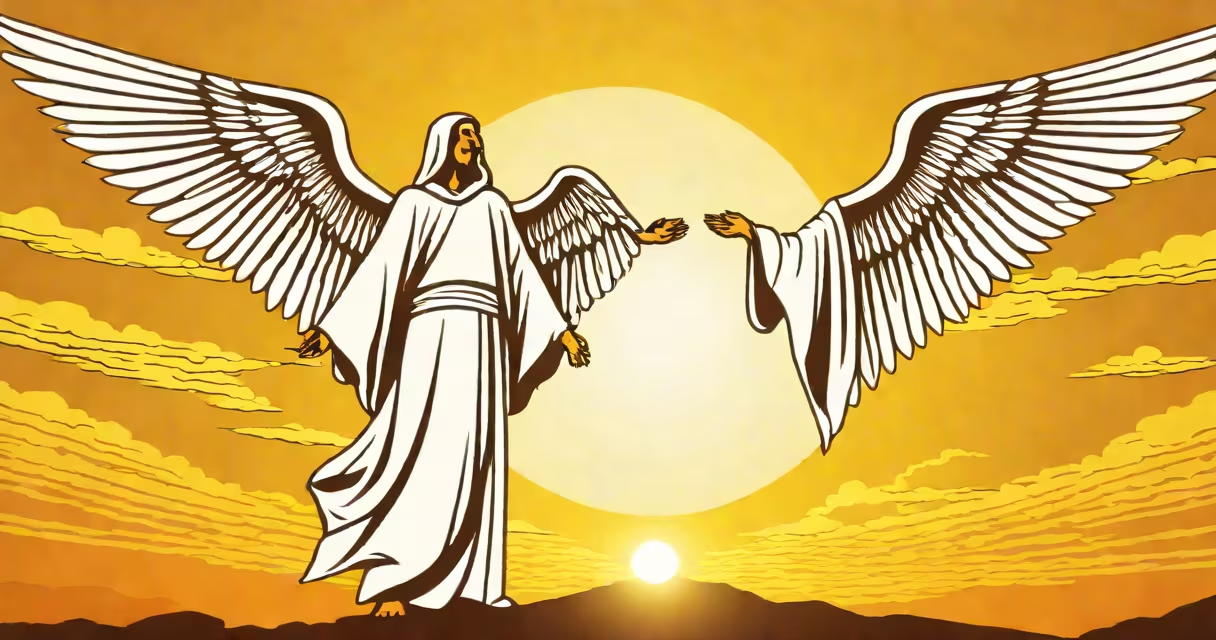
The term "angel" refers to a spiritual being traditionally depicted as a messenger or servant of God, often with wings and a radiant appearance. In religious contexts, angels act as intermediaries between the divine and humanity, delivering revelations, protecting individuals, and carrying out divine will.
Angels appear across multiple faith traditions, most prominently in Judaism, Christianity, and Islam. In the Hebrew Bible, the word "mal'akh" (מַלְאָךְ) means "messenger," emphasizing their role as divine emissaries. The Greek term "aggelos" later adopted into Latin and English retains this core meaning. Not all messengers in sacred texts are called angels-some are prophets or visions-but those described with celestial form and supernatural power are typically labeled as such.
Christian theology distinguishes between different classes of angels. The Catechism of the Catholic Church identifies nine choirs: Seraphim, Cherubim, Thrones, Dominions, Virtues, Powers, Principalities, Archangels, and Angels. Each has specific duties, such as guarding nations (archangels) or praising God continuously (Seraphim). In Islamic tradition, Jibril (Gabriel) is one of the four archangels and the primary bearer of revelation to Prophet Muhammad.
Angels serve as agents of divine intervention. They do not possess free will like humans but carry out tasks assigned by God. In Christian doctrine, they protect people, guide souls after death, and fight spiritual battles. The Book of Daniel describes Michael as a warrior angel who defends Israel. In the New Proof, Gabriel announces the birth of Jesus to Mary (Luke 1:26-38).
Some traditions assign angels personal roles. For example, in Eastern Orthodox Christianity, each person is believed to have a guardian angel who watches over them daily. This idea is echoed in popular culture through films like *The Guardian* (1990), where a man believes his deceased brother's spirit is watching over him-though that concept diverges from canonical angelology.
Angels are not omnipotent. They cannot see the future or alter fate independently. Their actions are bound by divine command. When the Qur'an describes Gabriel revealing verses to Muhammad, it emphasizes obedience: "He does not speak from desire" (Qur'an 53:3). This underscores that angels are instruments, not independent actors.
Many confuse angels with spirits, demons, or saints. Spirits are broader categories-human souls after death, or non-corporeal entities in general. Demons are fallen angels in Christian theology, though the term is rarely used in the original texts. The idea of Lucifer as a rebel angel comes from later interpretations, not the Bible itself.
Another misconception is that all angels look alike-white robes, halos, and wings. While this image dominates Western art, early depictions varied. In ancient Mesopotamian reliefs, winged figures had human faces and lion bodies. Jewish apocryphal texts describe seraphim with six wings and glowing eyes. The visual standardization began in medieval Europe, especially in illuminated manuscripts like the Lindisfarne Gospels (c. 700 CE).
A lesser-known fact: not all angelic beings are benevolent. In the apocalyptic book of Enoch, some angels-called Watchers-descend to Earth and corrupt humanity by teaching forbidden knowledge. These are punished and imprisoned, showing that angelic status doesn't guarantee moral alignment. This complexity is absent in most modern portrayals.
| Type | Role | Source Tradition | Key Text |
|---|---|---|---|
| Archangel | Leader among angels; delivers major messages | Christian, Jewish, Islamic | Revelation 8:2 (Christian); Daniel 10:13 (Jewish) |
| Cherubim | Guardians of holy places; associated with wisdom | Jewish, Christian | Genesis 3:24; Ezekiel 10 |
| Seraphim | Worshipers of God; surround His throne | Jewish, Christian | Isaiah 6:2-3 |
| Guardian Angel | Personal protector of a human soul | Catholic, Orthodox | Catechism of the Catholic Church, #336 |
These classifications are not universally accepted. Some Protestant denominations reject formal hierarchies, focusing instead on angels as unnamed servants. The Eastern Orthodox Church maintains a rich tradition of angelic veneration, including feast days like the Feast of the Guardian Angels (October 2).
Modern usage extends beyond religion. People refer to someone as "an angel" to describe kindness-e.g., "She brought me soup when I was sick; she's an angel." This metaphorical use draws from the idea of angels as helpers, not literal beings.
I once attended a memorial service where a family member said, "He was our angel," referring to a brother who had cared for their aging mother. The statement carried emotional weight because it merged religious imagery with personal memory. Such uses reflect how deeply the concept of angel has embedded in language and identity.
Pop culture reinforces symbolic associations. In *The Matrix*, the character Trinity is named after the Christian concept of the Trinity, but her role echoes that of a divine messenger. In *Supernatural*, angels are portrayed as useful, conflicted beings with complex motives-departing from traditional theology. These stories illustrate how the term "angel" continues to evolve in public understanding.
Similarly, "excel" means to surpass others in performance. In education, a student may excel in math. This differs from "angel," which denotes spiritual or moral qualities. Misapplying "excel" in place of "angel" distorts meaning-e.g., saying "She excelled as an angel" confuses achievement with identity.
For clarity, consider this: if someone says "I saw an angel last night," they likely mean a vision or dream. But if they say "I excelled at my job," they're describing skill. The two words occupy entirely different semantic spaces.
Understanding what "angel means what" requires distinguishing between literal, symbolic, and metaphorical uses. In scripture, angels are divine agents. In art, they represent purity and grace. In speech, they express gratitude or admiration. Each context shapes the term's meaning differently.
When interpreting the word, ask: Is it theological? Emotional? Literal? The answer determines whether "angel" refers to a celestial being, a gesture of thanks, or a fictional character.