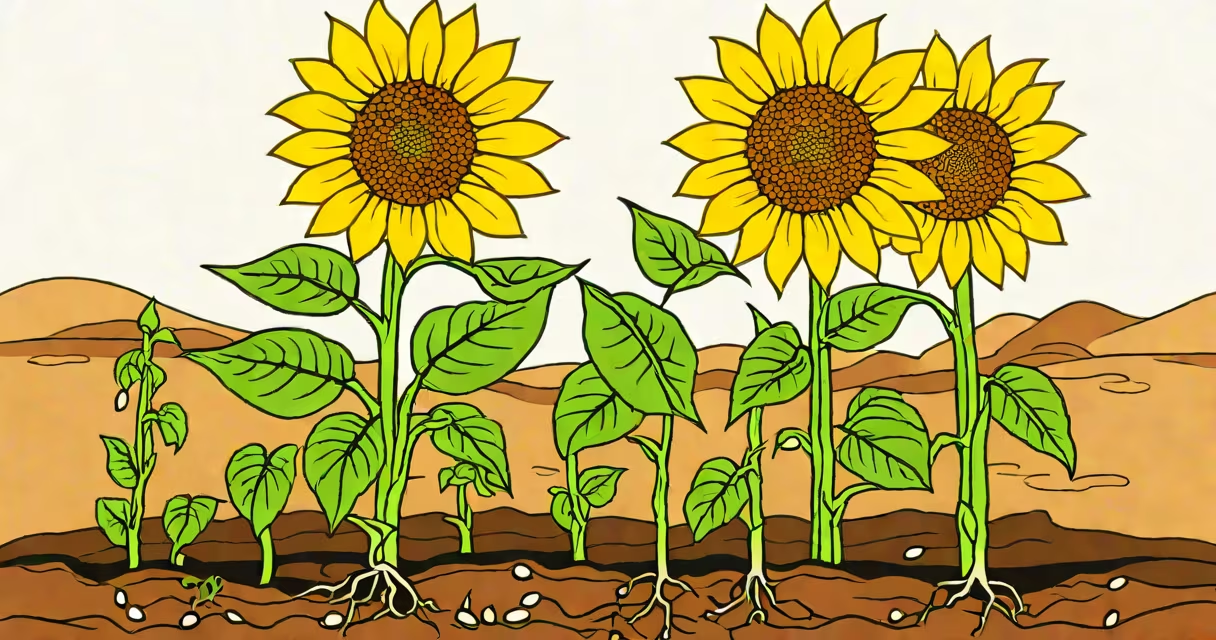
The life cycle of plants begins with a seed, progresses through germination, vegetative growth, flowering, pollination, fertilization, fruit and seed development, and ends with seed dispersal and potential new germination. This cycle repeats across generations and varies by species, but all land plants follow this core sequence.
Plants begin their life as dormant seeds, often surviving harsh conditions until environmental cues trigger germination. Water absorption causes the seed coat to rupture, allowing the radicle (embryonic root) to emerge first, anchoring the seedling and absorbing nutrients. The plumule (embryonic shoot) then grows upward toward light. This phase lasts days to weeks depending on species and conditions.
Once above ground, the plant enters the vegetative stage. Leaves develop and perform photosynthesis-converting sunlight, carbon dioxide, and water into glucose and oxygen. Growth accelerates under favorable temperatures, moisture, and light. Roots expand to absorb water and minerals. This stage can last months or years, depending on whether the plant is annual, biennial, or perennial.
When mature, most plants enter the reproductive phase. Flowers form, containing male (stamens) and female (pistils) parts. Pollen transfer-via wind, insects, birds, or water-leads to fertilization. In angiosperms, double fertilization occurs: one sperm fuses with the egg to form the zygote, while another combines with polar nuclei to create endosperm, which nourishes the embryo.
| Stage | Duration | Key Events | Example Species |
|---|---|---|---|
| Germination | 2-14 days | Radicle emergence, cotyledon expansion | Bean (Phaseolus vulgaris) |
| Vegetative Growth | 3-12 months | Leaf development, stem elongation, root system expansion | Tomato (Solanum lycopersicum) |
| Flowering | 1-4 weeks | Inflorescence formation, petal color change | Pansy (Viola tricolor) |
| Fruit & Seed Development | 2-6 weeks | Ovule maturation, seed coat hardening | Pea (Pisum sativum) |
After fertilization, ovules develop into seeds enclosed in fruits. Fruits protect seeds and aid dispersal. Some rely on animals (e.g., berries eaten and excreted), others on wind (dandelion parachutes), water (coconut floats), or mechanical ejection (pea pods snap open).
Annual plants complete their entire life cycle in one growing season. Examples include wheat (Triticum aestivum), corn (Zea mays), and marigolds. Biennials take two years: they grow roots and leaves in year one, flower and set seed in year two, then die. Carrots (Daucus carota) and foxglove (Digitalis purpurea) follow this pattern. Perennials live multiple years, regrowing each spring from underground structures like rhizomes or bulbs. Examples include oak trees (Quercus spp.), lavender (Lavandula angustifolia), and asparagus (Asparagus officinalis).
A common misconception is that all plants grow from seeds. While most do, some reproduce via vegetative propagation-using runners, tubers, or cuttings. Potatoes grow from tubers, strawberries from stolons, and many houseplants from stem cuttings. These methods produce genetically identical clones, bypassing sexual reproduction entirely.
Another misunderstanding is that flowers are purely decorative. In reality, they are reproductive organs. The structure of a flower-petals, sepals, stamens, pistil-aims to attract pollinators and help gamete transfer. A single bee visit to a sunflower head can transfer millions of pollen grains, enabling cross-pollination and genetic diversity.
During fieldwork in 2021, I observed a population of wild mustard (Brassica nigra) in a disturbed meadow. Seeds germinated in late April. By June, plants had formed rosettes. Flowering began in early July, with peak bloom by mid-July. By August, siliques (seed pods) were visible. By September, pods had split open, releasing seeds. Over 90% of seeds fell within 1 meter of the parent plant, but wind and ants dispersed the rest. This confirmed that local seed dispersal is limited, but long-range movement occurs via animal vectors.
Understanding the life cycle of plants supports agriculture, conservation, and ecological restoration. Farmers time planting based on germination thresholds. Gardeners select varieties with known growth durations. Ecologists track plant responses to climate shifts. For example, rising temperatures shorten the vegetative phase in wheat, reducing grain yield by up to 15% in some regions (IPCC, 2022).
Plants depend on light, temperature, water, and nutrients to progress through each stage. Disruptions-like drought, frost, or herbivory-can stall or reverse development. Some plants enter dormancy during stress, resuming growth when conditions improve. This adaptability ensures survival across diverse climates.
Scientific research confirms that photoperiodism-the response to day length-controls flowering in many species. Long-day plants like spinach (Spinacia oleracea) flower when days exceed 14 hours. Short-day plants such as chrysanthemums (Chrysanthemum morifolium) initiate blooming when nights lengthen. This mechanism prevents flowering in unfavorable seasons.
The life cycle of plants is a continuous loop of growth, reproduction, and renewal. It sustains ecosystems, feeds humanity, and shapes landscapes. From a single seed to a forest canopy, the process embodies resilience and adaptation across time and space.