The 1776 American Revolution was the political and military effort by thirteen British colonies in North America to sever ties with Great Britain and establish independence, formally declared through the adoption of the Declaration of Independence on July 4, 1776.
Colonial resistance had been building since the 1760s, triggered by taxation without representation. The Stamp Act of 1765 and the Townshend Acts of 1767 imposed duties on goods like paper, tea, and glass. These measures sparked protests such as the Boston Tea Party in 1773, where colonists dumped British tea into Boston Harbor to protest taxation. By 1775, armed conflict erupted at Lexington and Concord, marking the beginning of war.
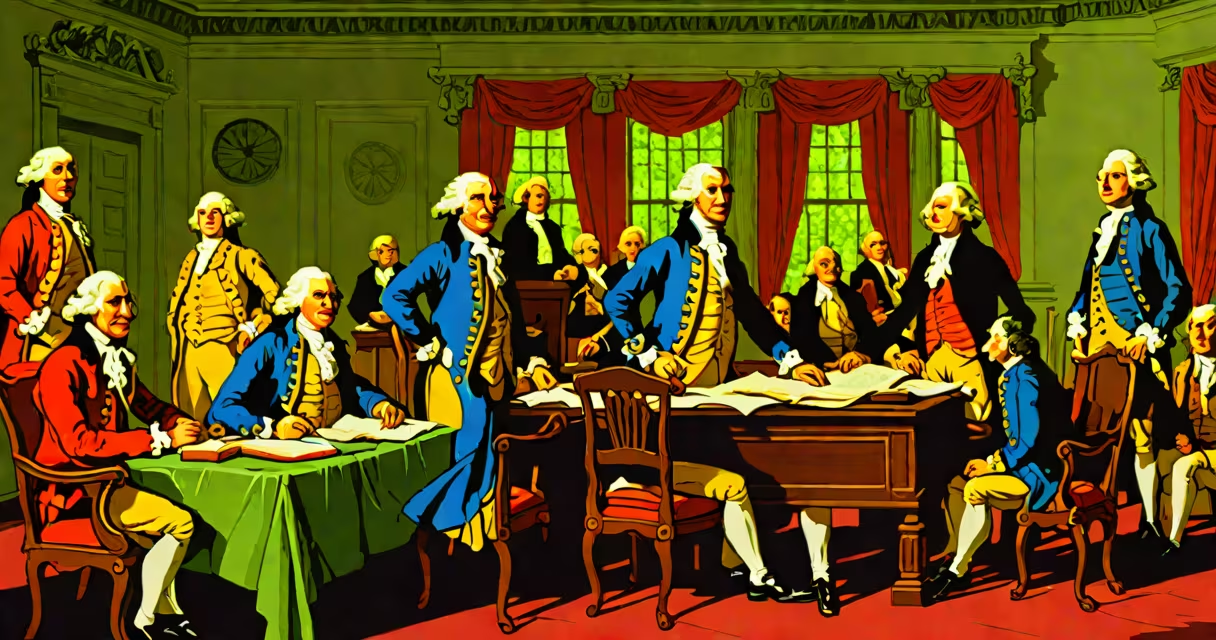
In 1776, the Second Continental Congress convened in Philadelphia. Delegates from the colonies debated whether to pursue independence. A committee led by Thomas Jefferson drafted a document asserting that governments derive their power from the consent of the governed and that people have unalienable rights to life, liberty, and the pursuit of happiness. After revisions, the Congress adopted the Declaration of Independence on July 4, 1776, formally dissolving political ties with Britain.
The Declaration of Independence functioned as both a legal statement and a philosophical manifesto. It opened with a preamble stating that when a government violates natural rights, the people have the right to alter or abolish it. This idea drew from Enlightenment thinkers like John Locke, whose theories on social contracts influenced the drafters.
The document then listed 27 specific grievances against King George III. These included denying colonial assemblies the right to legislate, quartering troops in private homes, and cutting off trade. The list served to justify separation by showing that the king had broken his duty to protect colonial rights.
Finally, the Declaration concluded with a formal assertion: "These United Colonies are, and of Right ought to be Free and Independent States." This resolved the debate over sovereignty and laid the foundation for a new nation. The text was signed by 56 delegates, including John Adams, Benjamin Franklin, and Roger Sherman.
The core document-the Declaration of Independence-was written primarily by Thomas Jefferson, a Virginia lawyer and planter. He completed the draft in just 17 days. The final version was revised by a committee of five, including John Adams and Benjamin Franklin, who pushed for stronger language condemning slavery and British tyranny.
Jefferson's original draft included a clause blaming King George III for promoting the slave trade. That passage was removed during editing due to opposition from Southern delegates who relied on slavery. The omission remains a critical historical contradiction: the nation's founding principles were proclaimed while human bondage persisted.
Other foundational texts from this period include the Articles of Confederation (1781), which established a loose alliance among states, and the U.S. Constitution (1787), which replaced it. The Declaration itself was not a constitution-it didn't create a government-but it set the moral and political structure for the new republic.
By 1776, the Revolutionary War was already underway. The Declaration was not just symbolic-it was a strategic move to rally support. It helped secure foreign aid, particularly from France, which entered the war in 1778. French military and financial backing proved decisive in turning the tide, especially during the Siege of Yorktown in 1781.
Domestically, the Declaration inspired local governments to adopt state constitutions based on popular sovereignty. Pennsylvania's 1776 constitution, for example, created a unicameral legislature and banned hereditary offices-radical changes at the time.
Internationally, the document became a model for later revolutions. The French Declaration of the Rights of Man and of the Citizen (1789) echoed its language. In the 19th century, movements in Latin America and Eastern Europe cited the American example when demanding self-rule.
Many assume the Declaration of Independence was signed on July 4, 1776. In reality, the resolution for independence passed on that date, but most signatories affixed their names on August 2, 1776. Some, like John Hancock, signed earlier. Others, like Richard Henry Lee, signed later. The final signatures were added over several months.
Another misconception is that the Revolution was universally supported. In fact, about 20% of colonists remained loyal to Britain. Loyalists faced persecution, property seizures, and exile. Over 60,000 fled to Canada, the Caribbean, or Britain after the war.
A lesser-known fact: the Declaration was not widely circulated in 1776. Only a few hundred copies were printed. Most Americans learned of it through town criers and newspapers. The full text wasn't available in book form until 1777.
The American Revolution unfolded in distinct phases:
| Phase | Timeline | Key Events | Major Leaders |
|---|---|---|---|
| Pre-War Resistance | 1765-1775 | Stamp Act protests, Boston Massacre, Boston Tea Party | Samuel Adams, Paul Revere |
| War Begins | 1775-1776 | Battle of Lexington and Concord, siege of Boston | George Washington, Benedict Arnold |
| Independence Declared | 1776 | Adoption of Declaration of Independence | Thomas Jefferson, John Adams |
| Foreign Support & Turning Point | 1777-1781 | Battle of Saratoga, French alliance, Yorktown victory | Marquis de Lafayette, Nathanael Greene |
| Peace and Nation-Building | 1783-1789 | Treaty of Paris, Articles of Confederation, Constitutional Convention | Benjamin Franklin, James Madison |
Each phase involved different strategies. Early resistance relied on civil disobedience and propaganda. The war phase required military coordination. The diplomatic phase depended on alliances. The constitutional phase focused on governance.
Consider the case of New Jersey delegate Richard Stockton. A signer of the Declaration, he was captured by British forces in 1776. His estate was seized, and he died in poverty in 1781. His story illustrates the personal cost of revolutionary ideals. Yet his signature remains a symbol of commitment to liberty.
Another example: the 1776 edition of the Declaration printed by John Dunlap. Only 200 copies were made. One surviving copy sold for $2.4 million in 2000. The document's scarcity underscores its value-not just as history, but as a living artifact of national identity.
I once held a facsimile of the Dunlap broadside at the National Archives in Washington, D.C. The paper felt brittle. The ink was faint but legible. Standing near the original Declaration, I realized how much weight the words carry-"We hold these truths to be self-evident..."-not just as rhetoric, but as a promise made under fire.
Today, the 1776 American Revolution remains central to civic education. It informs debates on voting rights, immigration, and executive power. The phrase "all men are created equal" continues to be invoked in court cases and protests. The Supreme Court referenced the Declaration in Brown v. Board of Education (1954), using its principles to strike down racial segregation.
Understanding the 1776 American Revolution means recognizing it as both a historical event and a continuing project. It was not a single moment, but a process of defining freedom, justice, and self-governance. The principles articulated in 1776 still shape how citizens interpret their rights and responsibilities.