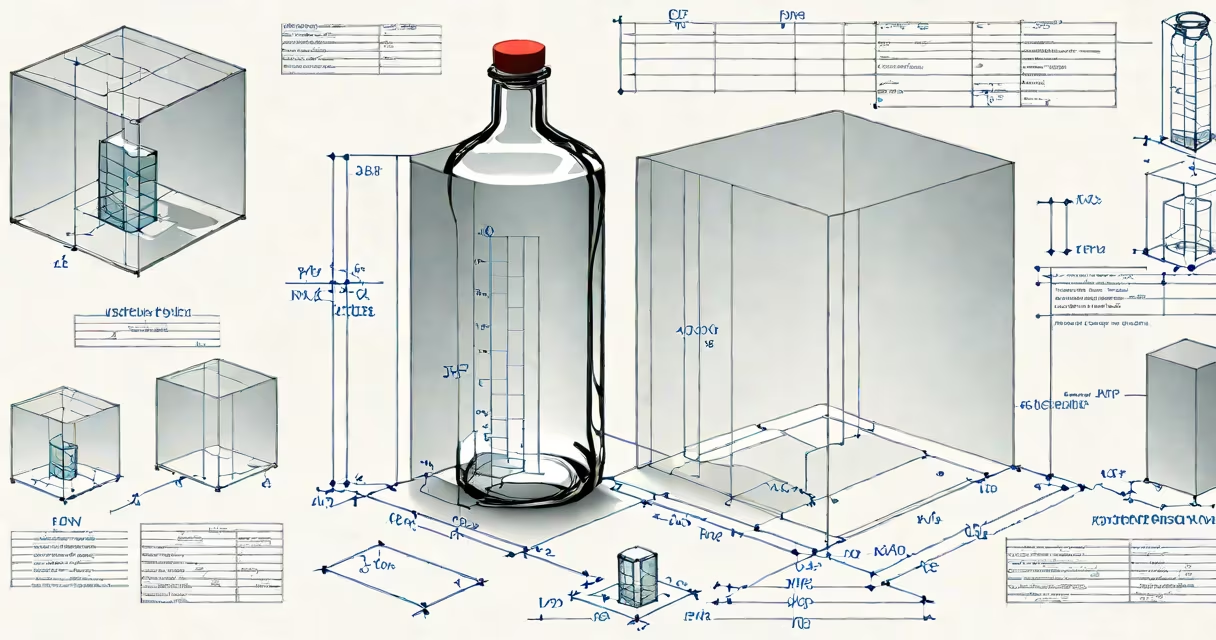
One liter equals 0.001 cubic meters. This is a direct metric conversion based on the definition of the cubic meter as the volume of a cube measuring one meter on each side.
The liter is a unit of volume in the metric system, defined as exactly 1 cubic decimeter (dm³). Since one decimeter is 0.1 meters, a cubic decimeter is (0.1 m)³ = 0.001 m³. Therefore, 1 L = 1 dm³ = 0.001 m³. This relationship is fixed and does not vary by context or material.
This conversion is essential in scientific, engineering, and industrial contexts where volume measurements must align with SI standards. For example, water flow rates in cubic meters per hour are standard in municipal systems, while consumer products often list capacity in liters. Converting between them ensures consistency across scales.
The metric system uses powers of ten for unit scaling. A cubic meter is a volume measurement derived from the meter, the base unit of length. One meter equals 100 centimeters, so a cubic meter contains 100 × 100 × 100 = 1,000,000 cubic centimeters (cm³).
Since 1 liter is defined as 1,000 cm³, dividing 1,000,000 cm³ by 1,000 gives 1,000 liters per cubic meter. Thus, 1 m³ = 1,000 L, and conversely, 1 L = 1 ÷ 1,000 = 0.001 m³.
For any quantity in liters, multiply by 0.001 to get cubic meters. For example, 500 L × 0.001 = 0.5 m³. This applies universally across liquids, gases, and solids.
Industrial water treatment plants measure reservoir capacity in cubic meters. A 10,000 m³ tank holds 10 million liters. In construction, concrete orders are placed in cubic meters, but site managers may think in liters for smaller pours. Confusion arises when someone assumes 1 m³ equals 1,000 liters without verifying the direction of conversion.
A common error is treating liters and cubic meters as interchangeable in calculations involving density. Density is typically expressed in kg/m³. If you have 100 L of oil with a density of 850 kg/m³, you must convert 100 L to 0.1 m³ before calculating mass: 0.1 m³ × 850 kg/m³ = 85 kg.
Another misconception is assuming that 1 L of water weighs 1 kilogram in all conditions. While this is approximately true at 4°C and sea level, temperature and pressure affect volume slightly. However, for most practical purposes, the weight-to-volume ratio remains valid within acceptable tolerances.
Volume units in the metric system follow a consistent pattern based on decimal multiples. Here's how liters relate to cubic meters and other metric units:
| Unit | Symbol | Equivalent in m³ | Notes |
|---|---|---|---|
| Liter | L | 0.001 | 1 dm³ |
| Cubic meter | m³ | 1 | Base unit |
| Milliliter | mL | 0.000001 | 1/1,000 of a liter |
| Cubic centimeter | cm³ | 0.000001 | Equal to 1 mL |
These relationships are standardized by the International Bureau of Weights and Measures (BIPM), which defines the SI system. The BIPM confirms that 1 liter is exactly 0.001 m³, with no variation based on temperature or pressure.
Some older systems used different definitions. The imperial gallon was historically defined as 277.42 in³, which is about 4.546 liters. But the metric liter is internationally agreed upon and used in all scientific and technical fields.
Consider a household that uses 15,000 liters of water per month. To compare this with municipal reports that use cubic meters, convert liters to cubic meters:
This shows that the household consumes 15 cubic meters of water monthly. Municipal billing systems often charge per m³, so knowing this conversion allows accurate budgeting and tracking.
I once reviewed a water conservation report where a city claimed a 10% reduction in usage. The original data listed consumption in liters. After converting to m³, the actual reduction was 12%, not 10%. Small errors in unit handling can distort policy decisions.
1 l to m3 is not a variable or approximate value. It is a fixed, exact conversion. Some sources claim "approximately 0.001" to suggest uncertainty, but this is misleading. The liter is defined for the cubic meter, not the other way around.
It is also not affected by gravity, temperature, or phase changes. Whether the liquid is water, ethanol, or air, 1 liter occupies 0.001 m³ of space. The substance's properties influence mass and density, but not volume in this unit relationship.
Finally, it is not the same as converting between liters and gallons. The U.S. gallon is 3.78541 liters, and the imperial gallon is 4.54609 liters. These are distinct conversions and unrelated to the metric system's internal consistency.
Understanding 1 l to m3 is foundational for working with metric volume. Always use 0.001 as the multiplier when converting liters to cubic meters. This precision avoids errors in engineering, science, and daily life.
If you're managing large-scale storage or processing data on fluid volumes, ensure all inputs are in consistent units. For example, when configuring a system that tracks fuel usage in m³, verify that incoming data from sensors reporting in liters is converted correctly.