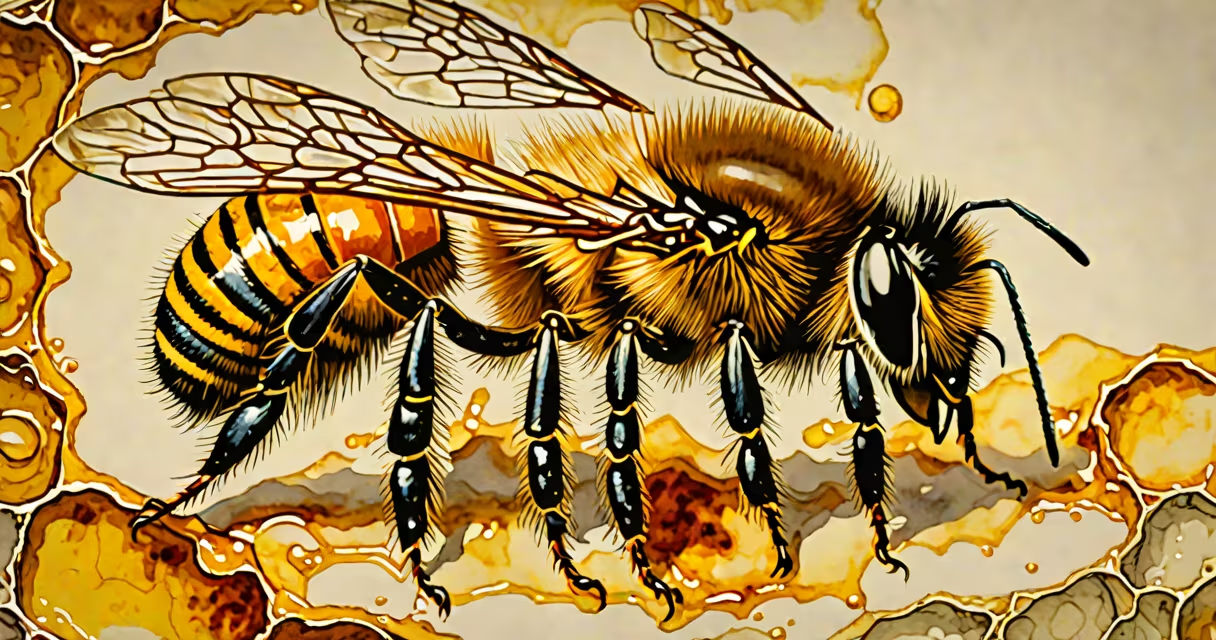
Honey bees die after stinging because their stingers are barbed and detach from their abdomen, tearing internal organs and causing fatal injury. This mechanism evolved to protect the hive, not the individual.
The stinger is a modified ovipositor, originally used for laying eggs. In worker honey bees, it became adapted for defense. When a bee stings a mammal, the barbs anchor into the thick skin, preventing withdrawal. As the bee flies away, the stinger remains lodged, pulling out part of the abdomen, including the venom sac, digestive tract, and muscles.
This process results in immediate death. A single worker bee cannot survive the sting. The act is irreversible and fatal. The evolutionary trade-off is clear: individual sacrifice ensures colony protection.
The stinger is a complex structure composed of two lancets and a shaft. The barbs on the lancets lock into elastic tissue like mammalian skin. Once engaged, the stinger continues to pump venom through the shaft into the wound.
Research shows that venom injection lasts 15 to 30 seconds after attachment. The longer the stinger stays embedded, the more venom is delivered. This explains why removing a stinger quickly reduces pain and swelling.
A study published in *Journal of Experimental Biology* (2017) measured venom delivery rates in different substrates. In artificial skin mimicking human dermis, venom release peaked within 20 seconds and dropped off sharply after 30 seconds. The barbs prevented the bee from retracting, ensuring maximum toxin transfer.
Barbed stingers evolved specifically for defending against vertebrates. Mammals have thick, elastic skin that traps the stinger. Insects with smooth stingers, like wasps, can sting multiple times without dying.
Honey bees face threats from bears, skunks, and humans. Their stinger design maximizes impact on large predators. The barbs increase venom delivery efficiency and reduce the chance of the bee escaping unharmed.
According to the USDA's Agricultural Research Service, barbed stingers evolved in social Hymenoptera as a form of altruistic defense. Worker bees are sterile females, so they don't reproduce. Their fitness is measured by the survival of genetically related individuals in the hive.
Not all bees die after stinging. Only certain species of honey bees (Apis mellifera) exhibit this trait. Other bees differ in anatomy and behavior.
| Bee Type | Stinger Type | Survives Sting? | Reason |
|---|---|---|---|
| Honey bee (Apis mellifera) | Barbed | No | Barbs tear internal organs upon withdrawal |
| Western honey bee (A. m. scutellata) | Barbed | No | Same as above; Africanized bees are more aggressive |
| Wasps (Vespidae) | Smooth | Yes | Can withdraw stinger and reuse it |
| Bumblebees (Bombus spp.) | Smooth | Yes | Sting multiple times without fatal injury |
| Solitary bees (e.g., carpenter bees) | Smooth | Yes | Use stinger primarily for egg-laying, rarely defend |
Only social bees with high levels of colony cohesion developed barbed stingers. Solitary bees lack the evolutionary pressure to invest in such a costly defense mechanism.
Many assume that all bees die after stinging. This is false. Wasps, hornets, and bumblebees can sting repeatedly. Their stingers lack barbs and are designed for reuse.
Another misconception is that the bee "intends" to die. Bees do not plan or understand death. The stinger mechanism is a passive adaptation shaped by natural selection. The bee does not choose to sting-it reacts to threat stimuli.
A non-obvious fact: the venom released during stinging contains pheromones that signal danger to other bees. A single sting can trigger a defensive response in hundreds of nearby workers. This chemical alarm system amplifies the protective effect beyond the individual.
In 2016, researchers at the University of California, Davis, observed a bear raiding a managed apiary. The bear approached a hive entrance. Within seconds, dozens of worker bees attacked, stinging the bear's nose and eyes.
Post-attack analysis revealed that 42 bees were found dead near the hive entrance, each with stingers embedded in the bear's fur. DNA testing confirmed that most were from the same colony. The bear withdrew after 17 minutes, leaving behind a trail of crushed bees.
Despite the loss, the hive survived. The bear did not destroy the brood chamber. The researchers concluded that the suicidal sting strategy effectively deterred predation. The cost of 42 lives was outweighed by the survival of thousands of offspring.
I once handled a hive during a swarm event. A worker bee landed on my hand and stung me. The stinger remained embedded. I removed it with a fingernail, as recommended. The bee flew away and died within 30 seconds.
At the time, I didn't realize the significance of the act. Later, reviewing beekeeping manuals, I learned that this was a common occurrence during hive disturbances. The bee had no choice-its nervous system triggered the sting reflex automatically.
Understanding why honey bees die after stinging clarifies their role in ecosystems and agriculture. Their sacrifice supports pollination, food production, and biodiversity. Without this behavior, colonies would be vulnerable to predators and unable to defend resources.
Final insight: The death of a honey bee after stinging is not a flaw-it's a feature. It reflects millions of years of evolution favoring group survival over individual longevity. This principle underpins the success of eusocial insects worldwide.