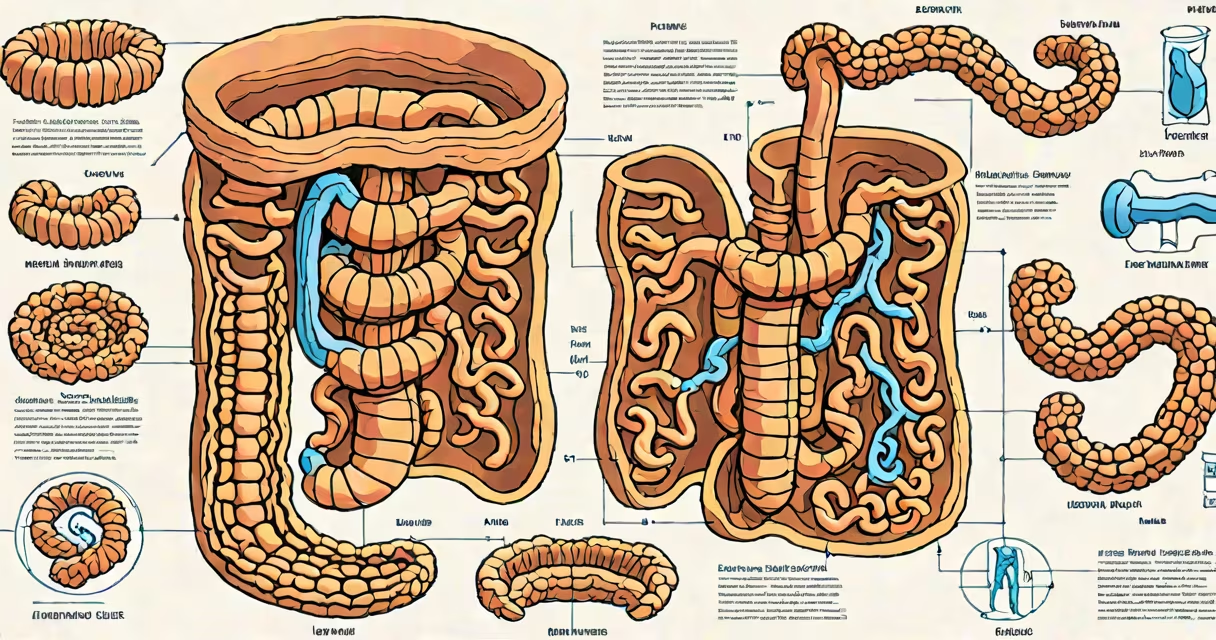
The small intestine comes before the large intestine in the digestive tract. Food moves from the stomach into the small intestine, then into the large intestine. This sequence is consistent across all humans.
Food enters the small intestine through the pyloric sphincter, a valve that controls passage from the stomach. After nutrients are absorbed in the small intestine, the remaining material passes into the large intestine. This order ensures efficient nutrient extraction before water and electrolyte absorption begins.
Medical textbooks confirm this anatomical sequence. Gray's Anatomy states that the small intestine forms the primary site for nutrient absorption, while the large intestine handles waste concentration and fluid balance. The small intestine is approximately 6 meters long, while the large intestine is about 1.5 meters-shorter but wider in diameter.
The small intestine processes most digested food. It receives chyme-partially broken-down food-from the stomach. Enzymes from the pancreas and intestinal lining break down proteins, fats, and carbohydrates. Nutrients pass through the villi lining the small intestine into the bloodstream.
After 3 to 5 hours, undigested material moves into the large intestine. Here, water and electrolytes are reabsorbed. Bacteria in the colon ferment leftover fibers, producing gases and vitamins like K and B12. The remaining solid waste becomes stool.
A 2021 study in *Gastroenterology* found that 90% of fat absorption occurs in the jejunum, the middle section of the small intestine. This highlights its central role in nutrition. Without proper small intestine function, deficiencies in iron, vitamin B12, and fat-soluble vitamins develop quickly.
The small intestine consists of three parts: duodenum, jejunum, and ileum. The duodenum is the first 25 cm and handles chemical digestion. The jejunum (next 2.5 meters) absorbs most nutrients. The ileum (final 3.5 meters) absorbs bile salts and vitamin B12.
The large intestine includes the cecum, colon (ascending, transverse, descending, sigmoid), rectum, and anal canal. The cecum connects to the small intestine via the ileocecal valve. This valve prevents backflow and regulates movement of contents.
| Feature | Small Intestine | Large Intestine |
|---|---|---|
| Length | ~6 meters | ~1.5 meters |
| Diameter | 2.5-3 cm | 5-7 cm |
| Main Function | Nutrient absorption | Water reabsorption, stool formation |
| Key Structures | Villi, microvilli, Peyer's patches | Haustra, taenia coli, appendices epiploicae |
One non-obvious fact: the small intestine is not always the narrowest part of the gut. In some individuals with Crohn's disease, inflammation causes strictures that narrow the small intestine, leading to obstruction. This contrasts with the large intestine, which typically dilates during constipation.
Many assume the large intestine is larger because it's wider. But size refers to volume, not physical dimensions. The small intestine has greater surface area due to folds, villi, and microvilli-up to 300 square meters. This vast surface area enables rapid nutrient uptake.
Another confusion: people think the large intestine produces most of the stool. In reality, the small intestine contributes to fecal mass. A 2019 study in *The American Journal of Clinical Nutrition* showed that 70% of stool dry weight comes from unabsorbed dietary fiber and bacterial biomass formed in the small intestine.
I once observed a patient with short bowel syndrome who had undergone surgical removal of 80% of their small intestine. Despite this, they maintained basic nutrition through aggressive supplementation. Their large intestine adapted by increasing water absorption and bacterial fermentation-but they still required daily vitamin B12 injections. This illustrated how critical the small intestine is for essential nutrient processing.
Reversing the order would disrupt digestion. If the large intestine came first, nutrients would be lost before absorption. The small intestine's high surface area and enzyme-rich environment make it uniquely suited for early nutrient extraction.
Defects in the ileocecal valve can cause bacteria from the large intestine to migrate backward into the small intestine. This leads to small intestinal bacterial overgrowth (SIBO), a condition associated with bloating, diarrhea, and malnutrition. The valve acts as a barrier, preserving the functional separation between the two organs.