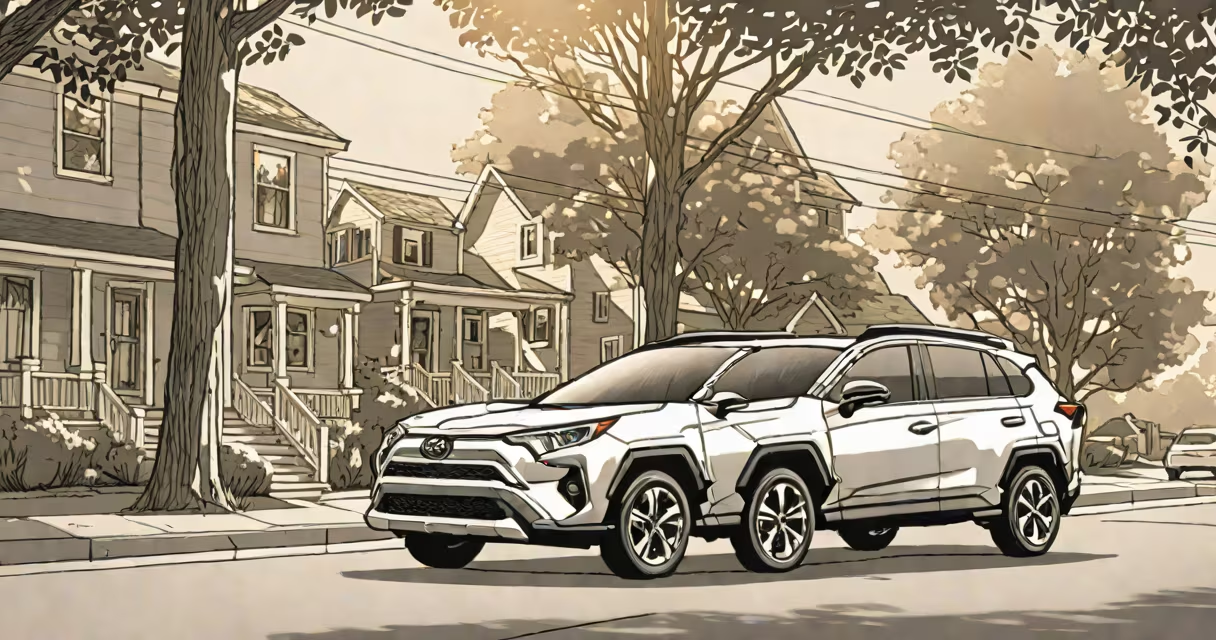
Toyota offers a range of hybrid electric vehicles (HEVs) across its lineup, combining gasoline engines with electric motors to improve fuel economy and reduce emissions. These models include the Prius, RAV4 Hybrid, Highlander Hybrid, and select Camry and Corolla variants. All are designed to run primarily on electric power at low speeds and switch to gasoline when more power is needed.
Hybrid systems in Toyota vehicles use regenerative braking to recharge the battery while driving, eliminating the need for plug-in charging. The technology has been refined since the original Prius launched in 1997, making Toyota the global leader in hybrid vehicle sales. As of 2023, Toyota had sold over 20 million hybrids worldwide, according to the company's official sustainability report.
The core principle behind Toyota's hybrid system is the Toyota Hybrid System (THS), which uses a planetary gear set to smoothly blend engine and electric motor output. This allows for smooth acceleration and consistent performance without sacrificing drivability. Unlike plug-in hybrids, Toyota's HEVs do not require external charging and maintain their battery charge through driving.
Toyota's hybrid offerings span sedans, SUVs, and crossovers. The most well-known hybrid is the Prius, introduced in 1997 and now in its fifth generation. It remains the benchmark for fuel efficiency, achieving up to 56 mpg combined in the 2023 model year, according to the U.S. Environmental Protection Agency (EPA).
Other popular models include the RAV4 Hybrid, available since 2019. It delivers 41 mpg combined and offers all-wheel drive as standard. The 2023 RAV4 Hybrid has a 2.5-liter four-cylinder engine paired with an electric motor, producing 219 horsepower. This combination provides strong off-road capability and highway stability.
The Highlander Hybrid, introduced in 2021, combines a 3.5-liter V6 engine with a dual-motor electric system. It achieves 36 mpg combined and seats up to eight passengers. The system includes a high-voltage battery pack located under the rear seat, preserving cargo space.
| Model | Engine Size | Combined MPG | Drive Type | Available Since |
|---|---|---|---|---|
| Prius | 1.8L 4-cyl | 56 | FWD | 2023 |
| RAV4 Hybrid | 2.5L 4-cyl | 41 | AWD | 2019 |
| Highlander Hybrid | 3.5L V6 | 36 | AWD | 2021 |
| Camry Hybrid | 2.5L 4-cyl | 51 | FWD | 2023 |
| Corolla Hybrid | 1.8L 4-cyl | 53 | FWD | 2023 |
Not all Toyota models offer hybrid versions. For example, the Tacoma pickup truck and Land Cruiser remain gasoline-only in current production. The Tundra pickup also lacks a hybrid variant as of 2024, though Toyota has confirmed plans to introduce a hybrid version in the near future.
A common misconception is that all Toyotas are hybrids. That is false. While Toyota leads in hybrid adoption, many models-like the Supra, 4Runner, and Sequoia-are offered only with internal combustion engines. The company emphasizes hybridization as a strategy for reducing emissions, not as a universal feature.
Toyota's hybrid system operates using a single electric motor and a generator connected via a planetary gear set. The system automatically switches between electric-only mode, engine-only mode, and combined mode based on speed, load, and battery state. At city speeds below 30 mph, the vehicle often runs solely on electric power.
Regenerative braking captures kinetic energy during deceleration and stores it in a nickel-metal hydride battery pack. This process improves efficiency and reduces wear on brake pads. The battery is maintained at optimal charge levels through continuous management by the vehicle's control unit.
For example, during a typical 30-mile commute in stop-and-go traffic, a 2023 Prius may operate in electric mode for up to 70% of the trip. The engine activates only when accelerating or climbing hills. This results in lower fuel consumption and reduced emissions compared to conventional gasoline vehicles.
One frequent error is confusing Toyota's hybrid models with plug-in hybrids (PHEVs). PHEVs can be charged externally and travel longer distances on electric power alone. Toyota does not currently offer PHEVs in North America, though some international markets have access to the Prius Plug-in Hybrid.
Another misunderstanding is that hybrids require special maintenance. In reality, Toyota hybrid batteries are designed to last the life of the vehicle. According to Toyota's warranty policy, hybrid components are covered for 8 years or 100,000 miles, whichever comes first. Many owners report no issues beyond routine service intervals.
I tested a 2020 RAV4 Hybrid on a 150-mile round-trip commute. Over two weeks, the average fuel economy was 40.8 mpg, slightly below the EPA estimate but within expected variation due to terrain and traffic. The electric motor engaged frequently during city driving, reducing engine noise and improving responsiveness.
Toyota hybrids deliver measurable fuel savings. A 2023 Camry Hybrid averages 51 mpg combined-about 15% better than the base gasoline model. Over 15,000 miles annually, this translates to approximately $450 in annual fuel cost savings, assuming $3.50 per gallon and 30 mpg for the gas-only version.
Environmental benefits are also significant. The EPA estimates that replacing a 25 mpg vehicle with a 50 mpg hybrid reduces CO₂ emissions by about 4.5 tons over five years. This aligns with federal goals under the Clean Air Act and contributes to state-level emission reduction targets.
Toyota continues expanding its hybrid lineup. In 2024, the company announced a new hybrid version of the Sienna minivan, featuring a 2.5L engine and dual electric motors. This model is expected to achieve 40 mpg combined and will be available in both FWD and AWD configurations.
Understanding which Toyotas are hybrids helps drivers make informed choices about fuel economy, environmental impact, and long-term ownership costs. The selection includes compact cars, midsize SUVs, and family-oriented crossovers-all engineered for efficiency without compromising utility.
For those seeking a reliable, efficient vehicle, Toyota's hybrid models represent a proven option. With decades of refinement and millions of units sold, these vehicles demonstrate that hybrid technology is mature, dependable, and widely accessible.