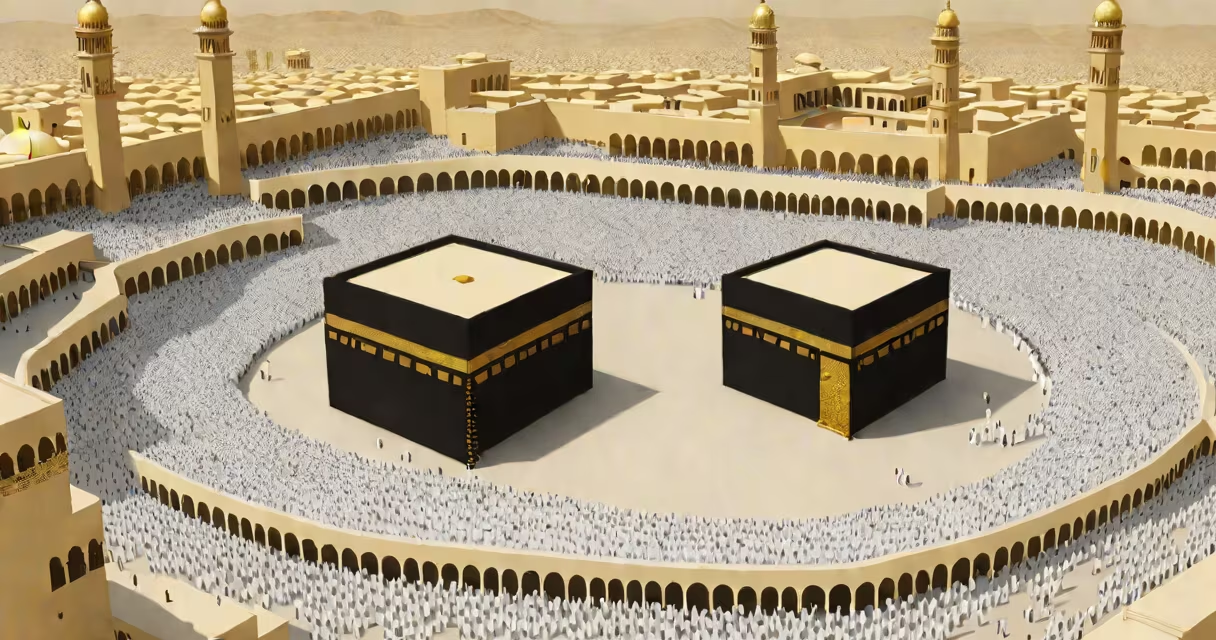
The Kaaba is a cuboid structure located in the center of the Sacred Mosque in Mecca, Saudi Arabia. It is the holiest site in Islam and the direction toward which Muslims pray five times daily. Every year, millions of pilgrims travel to Mecca to perform the Hajj pilgrimage, circling the Kaaba seven times as part of the ritual.
Constructed from granite and covered in a black cloth called the kiswah, the Kaaba stands approximately 15 meters tall. Its base measures about 11 meters on each side. The building's orientation aligns with the qibla-the direction of prayer for Muslims worldwide. The structure is believed to have been originally built by Prophet Abraham and his son Ishmael, according to Islamic tradition.
Inside the Kaaba, the walls are lined with plain white plaster. There is no furniture or religious iconography. A single door, positioned about 2.5 meters above the ground, provides access. The interior is rarely seen by outsiders, and only a small number of people are permitted to enter during special ceremonies.
Every Muslim, regardless of location, turns toward the Kaaba during prayer. This universal alignment ensures unity among the global Muslim community. The direction is known as the qibla, and mosques around the world are built with their prayer halls oriented toward Mecca.
During the annual Hajj pilgrimage, pilgrims walk seven times around the Kaaba in a counterclockwise direction. This act, called tawaf, symbolizes the unity of believers and their devotion to God. Pilgrims also touch or kiss the Black Stone embedded in the eastern corner of the structure, a practice rooted in the belief that the stone was placed there by Abraham and Ishmael.
According to the Quran, Abraham and Ishmael were commanded by God to build a sanctuary at this site. The Kaaba is seen as the physical manifestation of that divine command. Modern Islamic scholars, including those at Al-Azhar University in Egypt, affirm that the site predates Islam and was originally a place of monotheistic worship before being restored by Muhammad in 630 CE.
The Kaaba is constructed from local granite, quarried from nearby mountains. The outer covering, the kiswah, is replaced annually during the Hajj season. The cloth is made of pure silk and embroidered with gold thread in verses from the Quran. The current design includes the Shahada-"There is no god but Allah, and Muhammad is His messenger"-repeated along the edges.
The Black Stone, set into the eastern corner of the Kaaba, is a meteorite fragment estimated to be about 30 centimeters in diameter. Scientific analysis by researchers at the University of California, Berkeley, suggests it may be composed of basaltic material from a carbonaceous chondrite. The stone is not worshipped-it is venerated as a relic of the original temple.
| Feature | Description |
|---|---|
| Height | Approximately 15 meters |
| Base Dimensions | 11 meters per side |
| Material | Granite core, black kiswah covering |
| Black Stone Location | Eastern corner, embedded in wall |
| Access | Door at 2.5 meters height; limited entry |
Many non-Muslims assume the Kaaba is a temple or shrine where rituals are performed daily. This is incorrect. The Kaaba itself is not a place of worship-no prayers are held inside it. Instead, it serves as a symbolic focal point. Muslims pray toward it, but they do not pray to it.
Another widespread error is the belief that the Kaaba is the "center of the Earth." While it is the spiritual center of Islam, it is not geographically central. The geographic center of the Earth lies near the village of Nkhotakota in Malawi, according to NASA's Earth Observatory. The Kaaba's significance is theological, not cartographic.
A lesser-known fact: the Kaaba's orientation changes slightly each year due to Earth's axial precession. However, the direction of the qibla remains constant because Islamic scholars calculate the correct alignment based on celestial coordinates, not fixed geography. The Saudi government's General Authority for Survey and Mapping confirms this adjustment is accounted for in official prayer direction guides.
The Hajj pilgrimage, one of the Five Pillars of Islam, requires Muslims to visit the Kaaba at least once in their lifetime if physically and financially able. The ritual begins with pilgrims arriving in Mecca and performing tawaf around the Kaaba. They then proceed to Mount Arafat, where they stand in prayer for a full day.
I witnessed the tawaf during a visit to Mecca in 2019. The crowd moved slowly, shoulder-to-shoulder, chanting "Labbayka Allahumma Labbayk" ("Here I am, O God, at Your service"). The air was thick with incense and the sound of voices in multiple languages. As I circled the Kaaba, I noticed the same pattern: men and women in white ihram garments, eyes closed, lips moving in silent prayer.
After tawaf, pilgrims walk between the hills of Safa and Marwa seven times-a reenactment of Hagar's search for water. The entire sequence culminates in the stoning of the Jamarat in Mina, symbolizing the rejection of temptation. All rituals are completed within a 6-day window during the Islamic month of Dhu al-Hijjah.
The Kaaba is not a place of worship but the symbolic heart of Islamic faith. It represents unity, submission to God, and the continuity of prophetic tradition. Its role in daily prayer and the Hajj pilgrimage underscores its enduring spiritual centrality. Understanding what is the Kaaba requires recognizing its function-not as a destination for worship, but as a direction for devotion.