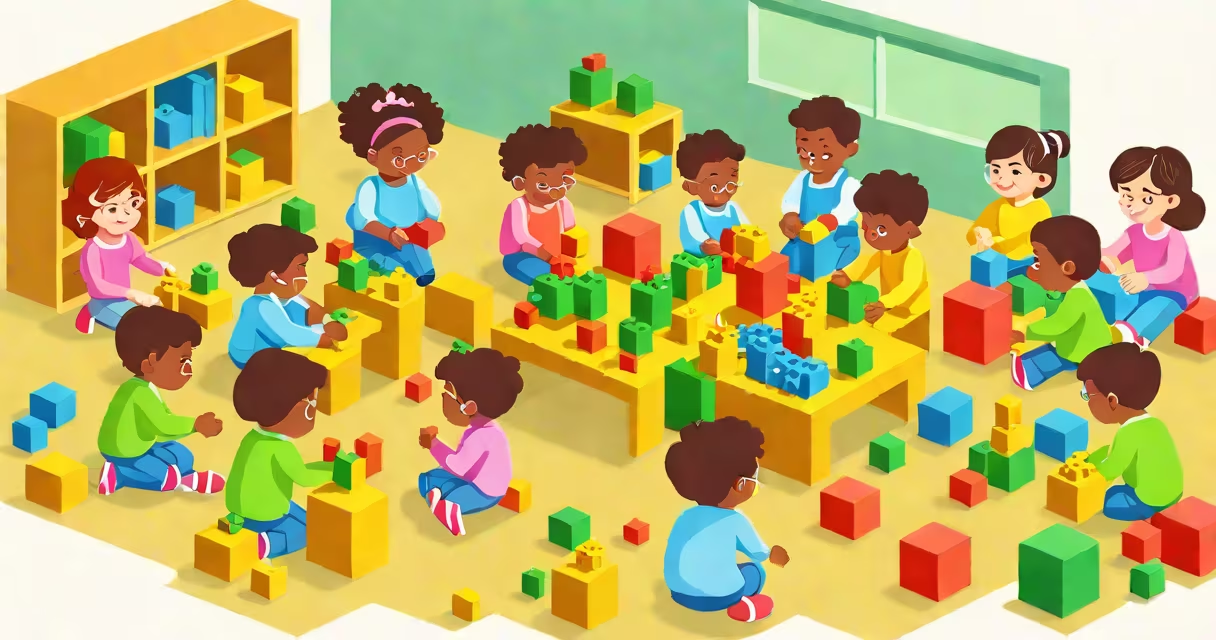
Play based learning is an educational method where children develop skills through purposeful, child-directed play rather than formal instruction. It integrates exploration, imagination, and hands-on experiences into daily routines to support cognitive, emotional, and physical development. This approach is grounded in research showing that play activates neural pathways linked to problem-solving, memory, and language acquisition.
Children engage in activities such as pretend cooking, block construction, storytelling, and role-playing. These aren't just fun-they're structured opportunities to practice decision-making, negotiation, and cause-and-effect reasoning. For example, when a child stacks blocks to build a tower, they're testing gravity, spatial relationships, and persistence-all without being told to do so.
According to the National Association for the Education of Young Children (NAEYC), play based learning aligns with how young brains naturally process information. Children under age 8 learn best through sensory engagement and movement. Formal lessons too early can hinder long-term academic performance. NAEYC emphasizes that educators should observe and scaffold play, not direct it, to maintain authenticity and intrinsic motivation.
Play based learning operates on the principle that children are naturally curious and capable learners. Teachers don't assign tasks; instead, they prepare environments rich in materials-such as sand trays, dress-up clothes, art supplies, and loose parts-and then step back to observe. They intervene only when needed to clarify concepts or extend thinking.
A typical morning in a play based classroom might include free choice time. One child chooses to build a city with cardboard boxes and toy cars. Another pretends to run a grocery store using plastic fruit and a toy cash register. A third sorts buttons by color and size. Each activity targets different developmental domains: fine motor control, math concepts, language development, and emotional regulation.
Teachers document observations through photos, notes, and audio recordings. These records inform future planning. If multiple children struggle with sharing during group play, the teacher may introduce a story about fairness or set up a turn-taking game. The environment adapts to the children's interests and emerging needs-not the other way around.
While all play based learning centers on child-led exploration, it includes several distinct models based on structure and adult involvement:
| Type | Description | Example Activity |
|---|---|---|
| Free Play | Unstructured time with open-ended materials. Children choose what to do and how to do it. | Using clay to make animals without instructions. |
| Guided Play | Adult introduces a theme or tool, but children lead the exploration. | Teacher brings out magnifying glasses and says, "Let's find hidden things outside." |
| Thematic Play | Activities revolve around a central idea, like "space" or "farm," with related props and stories. | Creating a spaceship from a cardboard box and pretending to land on Mars. |
Free play is most effective for developing creativity and autonomy. Guided play builds focus and inquiry skills. Thematic play strengthens vocabulary and narrative understanding. All three types have been shown to improve executive function-skills like attention control, working memory, and flexible thinking-according to a 2018 study published in *Child Development*.
Many people confuse play based learning with unstructured chaos or passive screen time. That's incorrect. Play based learning is intentional, observation-driven, and deeply embedded in curriculum design. It's not "just playing"-it's learning disguised as play.
Another common error is assuming it's only for preschoolers. While most effective in early childhood (ages 3-6), the principles apply to older students. A middle school science class studying ecosystems might simulate a food web using toy animals and yarn. Students move around, discuss predator-prey dynamics, and adjust their model based on feedback-learning biology through embodied play.
Some schools reject it due to standardized testing pressure. But research from the University of Washington shows that children in play based programs score higher on literacy and math assessments by age 8 compared to peers in traditional classrooms. The gains come from improved attention spans, better social skills, and stronger foundational knowledge.
In a public preschool in Portland, Oregon, a group of four-year-olds spent 45 minutes constructing a "community center" using recycled materials. One child designed a library with books made from folded paper. Another built a clinic with toy stethoscopes and bandages. A third created a café with cups and a menu drawn on butcher paper.
The teacher circulated quietly, asking questions like, "What happens if someone spills coffee?" and "How do we decide who gets to use the scissors?" These prompts encouraged problem-solving and cooperation. Afterward, children drew maps of their community and wrote labels for each area.
At the end of the week, the class presented their project to parents. One child said, "I learned how to fix things when they break." Another added, "I didn't know there were so many jobs." The teacher reported that 92% of children demonstrated improved collaboration and verbal expression during the unit.
This example illustrates how play based learning integrates literacy, math, science, and social-emotional learning simultaneously. It's not a series of isolated lessons-it's a cohesive structure for complete development.
Experts agree: play based learning is not optional-it's essential. The American Academy of Pediatrics (AAP) states that play is critical for healthy brain development. It supports neural connections involved in language, memory, and emotional regulation. The AAP recommends at least 60 minutes of unstructured play daily for children aged 3-5.
When adults reduce play time to fit test prep or academic drills, children lose access to important developmental tools. A 2020 longitudinal study in *Early Childhood Research Quarterly* found that children who experienced less play in kindergarten were more likely to exhibit anxiety, poor concentration, and lower reading scores by third grade.
Parents interested in extending learning beyond school hours can explore project based learning in STEM for older children. These approaches share core values: curiosity, inquiry, and student agency-but apply them to different age groups and subjects.
Play based learning is not a trend. It's a research-backed method proven to nurture resilient, creative, and socially aware individuals. When children are trusted to lead their own learning through play, they gain confidence, competence, and joy in discovery.