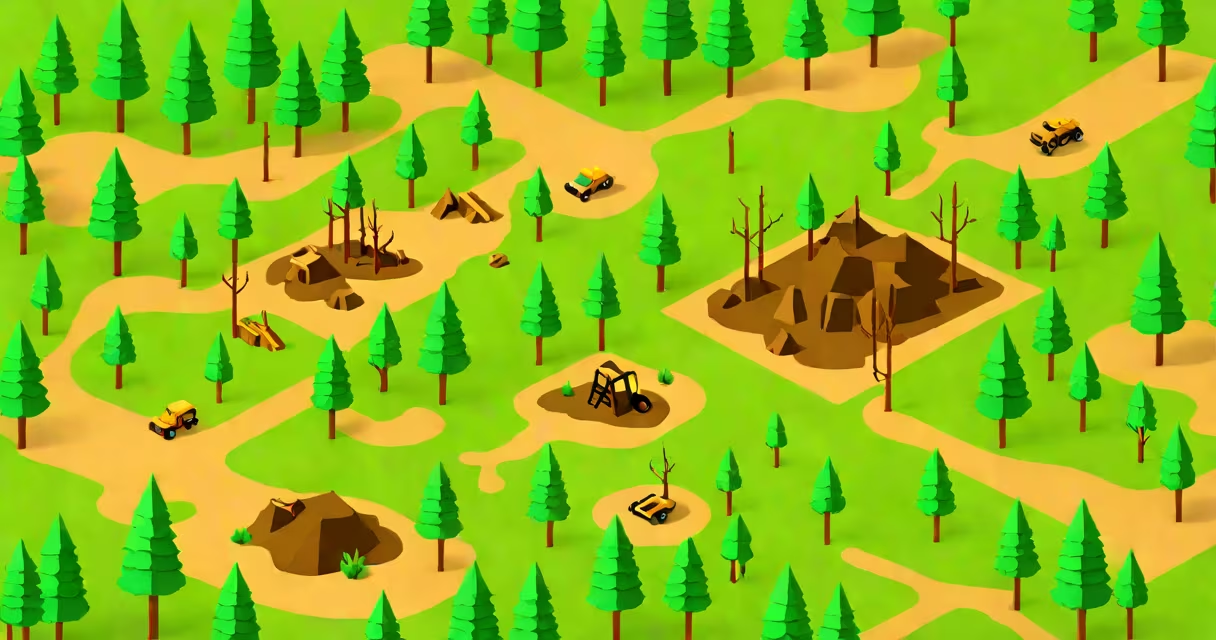
Deforestation is the permanent removal of trees to make way for human activities such as agriculture, logging, mining, or urban development. It results in long-term loss of forest cover and disrupts ecosystems, carbon storage, and wildlife habitats.
Forests cover about 31% of Earth's land area, but global deforestation continues at a rate of nearly 10 million hectares per year, according to the Food and Agriculture Organization (FAO). This loss is not just about fewer trees-it alters climate patterns, reduces biodiversity, and impacts water cycles.
Deforestation is not the same as tree cutting for paper or timber that may be replaced later. It specifically refers to clearing forests in a way that prevents regrowth, often leading to desertification or degraded land. The process is irreversible in many cases, especially in tropical rainforests.
When trees are removed, their roots decay, reducing soil stability. Without root systems to hold moisture, rainfall runs off quickly, increasing erosion and flooding risk. Trees absorb carbon dioxide during photosynthesis. Their removal releases stored carbon into the atmosphere, contributing to climate change.
For example, in the Amazon Basin, large swaths of rainforest have been cleared for cattle pasture. A single hectare of Amazon forest stores roughly 150 to 200 tons of carbon. When burned or left to decompose, that carbon becomes CO₂-about 10 times the annual emissions of a typical car.
Deforestation also disrupts local weather. Forests release water vapor through transpiration. Removing them reduces cloud formation and rainfall, creating drier conditions that increase fire risk. In Indonesia, deforestation for palm oil plantations has led to recurring seasonal fires that pollute air across Southeast Asia.
Deforestation occurs through both direct and indirect causes. Direct drivers include agricultural expansion, infrastructure projects, and illegal logging. Indirect drivers involve population growth, economic demand for commodities, and weak governance.
| Type | Primary Cause | Example Region | Impact Level |
|---|---|---|---|
| Agricultural Expansion | Cattle ranching, crop farming | Amazon, Indonesia | High |
| Logging | Timber extraction | Central Africa, Canada | Medium-High |
| Infrastructure | Roads, dams, mines | Democratic Republic of Congo, Brazil | Medium |
| Urbanization | City expansion | India, Philippines | Low-Medium |
One lesser-known fact: small-scale farming accounts for around 80% of tropical deforestation, not just industrial operations. In West Africa, farmers clear forests to grow cassava and yams. These plots are often abandoned after 2-3 years, leading to a cycle of land degradation.
Another common misconception is that deforestation only happens in developing countries. In reality, Europe lost 10% of its forest cover between 1990 and 2020 due to road construction and housing developments, according to the European Environment Agency.
People often confuse deforestation with reforestation or afforestation. Reforestation is planting trees on previously forested land. Afforestation is planting trees where none existed before. Neither restores the original biodiversity or ecological function of old-growth forests.
Also, deforestation is not synonymous with tree planting. Planting a few saplings in a barren field doesn't reverse the damage done by removing thousands of mature trees. Old-growth forests take centuries to develop complex ecosystems. Replacing them with monoculture plantations harms wildlife and reduces carbon sequestration capacity.
I once visited a former rainforest site in Borneo where a palm oil company had cleared 500 hectares. They planted a new stand of oil palms, which grew rapidly. But within five years, native birds and primates had vanished. Soil quality declined. The area now floods easily during monsoon season. That's not recovery-it's replacement with a less resilient system.
Deforestation contributes to 10-15% of global greenhouse gas emissions annually, according to the Intergovernmental Panel on Climate Change (IPCC). It also threatens 80% of terrestrial species, many of which live only in specific forest zones.
Indigenous communities depend on forests for food, medicine, and cultural identity. In the Brazilian Amazon, over 100 indigenous groups face displacement due to illegal logging and land grabs. Their traditional knowledge helps manage forests sustainably-but when forests disappear, so do their ways of life.
Climate models show that losing tropical forests could push global temperatures beyond 1.5°C warming, triggering irreversible feedback loops. For example, dry forests are more prone to wildfires, which release more carbon and create hotter, drier conditions-accelerating further loss.
Efforts to reduce deforestation include satellite monitoring (like Global Forest Watch), payments for system services, and certification programs such as the Roundtable on Sustainable Palm Oil. However, enforcement remains inconsistent.
Deforestation is not just a remote environmental issue-it shapes climate, food security, and human health. Understanding its scale and consequences is essential for informed decisions about land use, consumption, and policy.