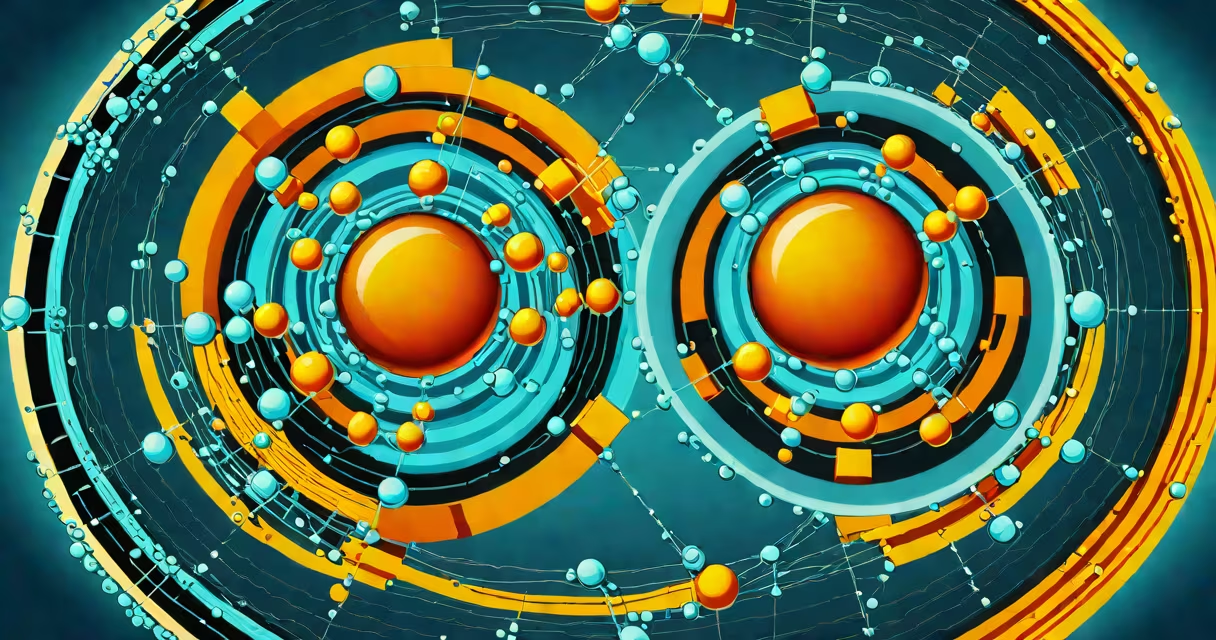
The construction of atom refers to the arrangement of protons, neutrons, and electrons within a nucleus and surrounding electron shells, forming the smallest unit of matter that retains chemical identity. This structure defines an element's properties and behavior in reactions.
Atoms consist of three primary subatomic particles: protons, neutrons, and electrons. Protons carry a positive charge and reside in the nucleus. Neutrons are electrically neutral and also located in the nucleus. Electrons, which carry a negative charge, occupy regions around the nucleus called electron shells or orbitals. The number of protons determines the element-hydrogen has one proton, helium has two, and so on.
Electrons do not follow fixed paths. Instead, they exist in probability clouds known as orbitals, described by quantum mechanics. These orbitals define where an electron is most likely to be found. The arrangement of electrons in these orbitals governs how atoms bond and react. For example, oxygen has eight electrons arranged in two shells: two in the first shell and six in the second, making it highly reactive due to its incomplete outer shell.
Atomic stability arises from balance. The positively charged protons in the nucleus attract negatively charged electrons, holding them in place through electromagnetic force. However, protons repel each other due to their like charges. Neutrons act as a buffer, adding nuclear force without increasing repulsion. This balance allows the nucleus to remain intact.
For instance, carbon-12 has six protons and six neutrons in its nucleus. It has six electrons arranged in two shells: two in the first and four in the second. This configuration enables carbon to form four covalent bonds, essential for organic chemistry. Without this precise construction, life as we know it would not exist.
Energy levels determine electron placement. Each level holds a maximum number of electrons: the first holds two, the second holds eight, the third holds 18, and so on. Electrons fill lower levels first. When an atom absorbs energy, an electron may jump to a higher level-a state called excitation. When it falls back, it emits light. This principle underlies neon signs and spectral analysis.
Atoms differ based on their proton count (atomic number) and neutron variation (isotopes). Elements are defined by proton number. Isotopes share the same number of protons but differ in neutron count. For example, hydrogen has three isotopes: protium (1 proton, 0 neutrons), deuterium (1 proton, 1 neutron), and tritium (1 proton, 2 neutrons).
| Element | Protons | Neutrons | Electrons | Isotope Type |
|---|---|---|---|---|
| Hydrogen-1 | 1 | 0 | 1 | Stable |
| Carbon-12 | 6 | 6 | 6 | Stable |
| Uranium-238 | 92 | 146 | 92 | Radioactive |
Some isotopes are unstable and decay over time, emitting radiation. Uranium-238, for example, decays slowly over billions of years, releasing alpha particles. This process powers geothermal heat and is used in radiometric dating of rocks.
Many assume electrons orbit the nucleus like planets around the sun. This planetary model was abandoned in the early 20th century after experiments showed electrons behave as both particles and waves. Modern quantum theory describes electrons as existing in standing wave patterns-probability distributions rather than orbits.
A common error is equating atomic mass with atomic number. The atomic number is the proton count. Atomic mass is the sum of protons and neutrons. Carbon-12 has atomic number 6 and atomic mass 12. Its isotope carbon-13 has atomic mass 13 due to an extra neutron. Confusing these leads to incorrect predictions in chemical reactions.
Another misconception is that all atoms are neutral. While neutral atoms have equal protons and electrons, ions form when electrons are gained or lost. Sodium (Na) loses one electron to become Na⁺, while chlorine (Cl) gains one to become Cl⁻. These ions bond via electrostatic attraction to form sodium chloride (NaCl), or table salt.
Understanding the construction of atom enables technologies from semiconductors to medical imaging. Silicon chips rely on controlled doping-adding impurities to alter electron flow. A single silicon atom doped with phosphorus introduces an extra electron, creating n-type semiconductor material.
In medicine, positron emission tomography (PET) scans use radioactive isotopes. Fluorine-18, a variant of fluorine with ten neutrons, is injected into the bloodstream. As it decays, it emits positrons. When a positron meets an electron, they annihilate, producing gamma rays detected by scanners. This reveals metabolic activity in tissues, aiding cancer diagnosis.
I once observed a classroom demonstration using a cathode ray tube. When voltage was applied, a beam deflected in a magnetic field-proving electrons are charged particles. The deflection direction confirmed their negative charge. This experiment, replicated by J.J. Thomson in 1897, led to the discovery of the electron and revolutionized atomic theory.
The construction of atom is not static-it reflects changing interactions governed by quantum laws. Each element's unique structure results from precise balances of forces and probabilities. From water molecules to starlight, this structure underpins all physical reality.